
Close Menu
    Facebook X (Twitter) Instagram
    SciTechDaily
    • Biology
    • Chemistry
    • Earth
    • Health
    • Physics
    • Science
    • Space
    • Technology
    Facebook X (Twitter) Pinterest YouTube RSS
    SciTechDaily
    Home»Biology»The “Venom” Spider: New Genus Named After Popular Marvel Character
    Biology

    The “Venom” Spider: New Genus Named After Popular Marvel Character

    By Pensoft PublishersSeptember 12, 2023No Comments2 Mins Read
    Facebook Twitter Pinterest Telegram LinkedIn WhatsApp Email Reddit
    Share
    Facebook Twitter LinkedIn Pinterest Telegram Email Reddit
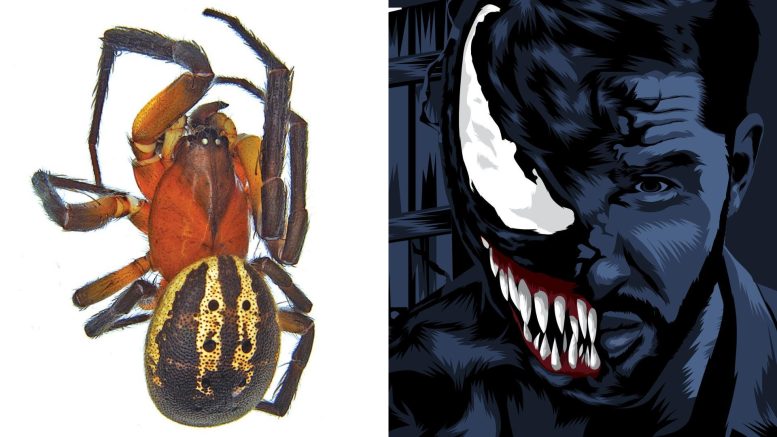
    Venomius Tomhardyi Pictured Next to an Illustration of Tom Hardy’s Venom Character
    Venomius tomhardyi pictured next to an illustration of Tom Hardy’s Venom character. Credit: Photo by Rossi et al. Illustration by Zeeshano0 via Pixabay

    A Distinctive Appearance Leads to an Unusual Name

    Tom Hardy and his iconic Marvel role, Venom, have inspired the naming of a newly discovered Australian spider. The genus Venomius and its only current species Venomius tomhardyi were described following an expedition to Tasmania.

    Scientists MSc Giullia Rossi, Dr Pedro Castanheira, and Dr Volker Framenau from Murdoch University (Perth, Australia) partnered with Dr Renner Baptista from the Federal University of Rio de Janeiro (Brazil) to describe the new genus of orb-weaving spiders published in the open access journal Evolutionary Systematics.

    Tom Hardy portrays Eddie Brock and his alter-ego Venom, an antihero closely associated with Spider-Man, across two Marvel films and gives his name to the sole species of the new genus. The distinctive black spots on the spider’s abdomen reminded the scientists of Venom’s head, inspiring them to select the unusual name.

    Classification and Unique Behavior of the New Genus

    The genus belongs to the Araneidae family of spiders that build upright circular webs to capture prey. Despite resembling the related genus Phonognatha as both do not have tubercles on the abdomen, the newly described spiders are distinct in their behavior of creating silk-lined holes in the branches of trees for shelter, as well as their different genitalia.

    The holotype of the new species was discovered and subsequently preserved at the Queen Victoria Museum and Art Gallery following an expedition to Tasmania, Victoria, South Australia, and Western Australia.

    Supplementary specimens were also sourced from scientific collections, with the researchers examining approximately 12,000 records in Australian and overseas institutions.

    Regarding the bigger picture of the study, Dr Pedro Castanheira said:

    “This is part of a long-term research that aims to document the entire Australian spider fauna, which will be of extreme importance for conservation management plans and the continuation of the decadal plan for taxonomy and biosystematics in Australia and New Zealand.”

    “It is really important to keep describing new spiders to assess the total biodiversity of these predators in Australia,” added the study’s first author MSc Giullia Rossi.

    Reference: “Venomius, a new monotypic genus of Australian orb-weaving spiders (Araneae, Araneidae)” by Giullia de F. Rossi, Pedro de S. Castanheira, Renner L. C. Baptista and Volker W. Framenau, 4 September 2023, Evolutionary Systematics.
    DOI: 10.3897/evolsyst.7.110022

    Never miss a breakthrough: Join the SciTechDaily newsletter.
    Follow us on Google and Google News.

    New Species Pensoft Publishers Spiders Taxonomy
    Share. Facebook Twitter Pinterest LinkedIn Email Reddit

    Related Articles

    Scientists Discover Tiny New Spider That Hunts Prey 6x Its Size

    Scientists Discover New Golden-Tongued Species of Lizard

    Fiery New Tarantula Species Discovered in Arizona’s Sky Islands – but It Could Soon Disappear Forever

    Electric Blue Surprise: Dazzling Tarantula Discovery in Thai Mangroves

    Australia’s Latest Surprise: New Species of Daddy Long-Legs Spider Discovered

    Web of Wonders: Expedition Discovers Four New Tarantula Species in Colombia’s Biodiversity Hotspot

    New Centipede Discovered on Top of Food Chain in Hellish Ecosystem of a Sulfur-Soaked Romanian Cave

    New Diamond Frog From Northern Madagascar – “As Soon as I Saw This Frog, I Knew It Was a New Species!”

    New Green Pit Viper From India Named After Salazar Slytherin From Harry Potter

    Leave A Reply Cancel Reply

    • Facebook
    • Twitter
    • Pinterest
    • YouTube

    Don't Miss a Discovery

    Subscribe for the Latest in Science & Tech!

    Trending News

    Breakthrough Bowel Cancer Trial Leaves Patients Cancer-Free for Nearly 3 Years

    Natural Compound Shows Powerful Potential Against Rheumatoid Arthritis

    100,000-Year-Old Neanderthal Fossils in Poland Reveal Unexpected Genetic Connections

    Simple “Gut Reset” May Prevent Weight Gain After Ozempic or Wegovy

    2.8 Days to Disaster: Scientists Warn Low Earth Orbit Could Suddenly Collapse

    Common Food Compound Shows Surprising Power Against Superbugs

    5 Simple Ways To Remember More and Forget Less

    The Atomic Gap That Could Cost the Semiconductor Industry Billions

    Follow SciTechDaily
    • Facebook
    • Twitter
    • YouTube
    • Pinterest
    • Newsletter
    • RSS
    SciTech News
    • Biology News
    • Chemistry News
    • Earth News
    • Health News
    • Physics News
    • Science News
    • Space News
    • Technology News
    Recent Posts
    • After 37 Years, the World’s Longest-Running Soil Warming Experiment Uncovers a Startling Climate Secret
    • NASA Satellite Captures First-Ever High-Res View of Massive Pacific Tsunami
    • ADHD Isn’t Just a Deficit: Study Reveals Powerful Hidden Strengths
    • Scientists Uncover “Astonishing” Hidden Property of Light
    • Scientists Discover Stem Cells That Could Regrow Teeth and Bone
    Copyright © 1998 - 2026 SciTechDaily. All Rights Reserved.
    • Science News
    • About
    • Contact
    • Editorial Board
    • Privacy Policy
    • Terms of Use

    Type above and press Enter to search. Press Esc to cancel.