
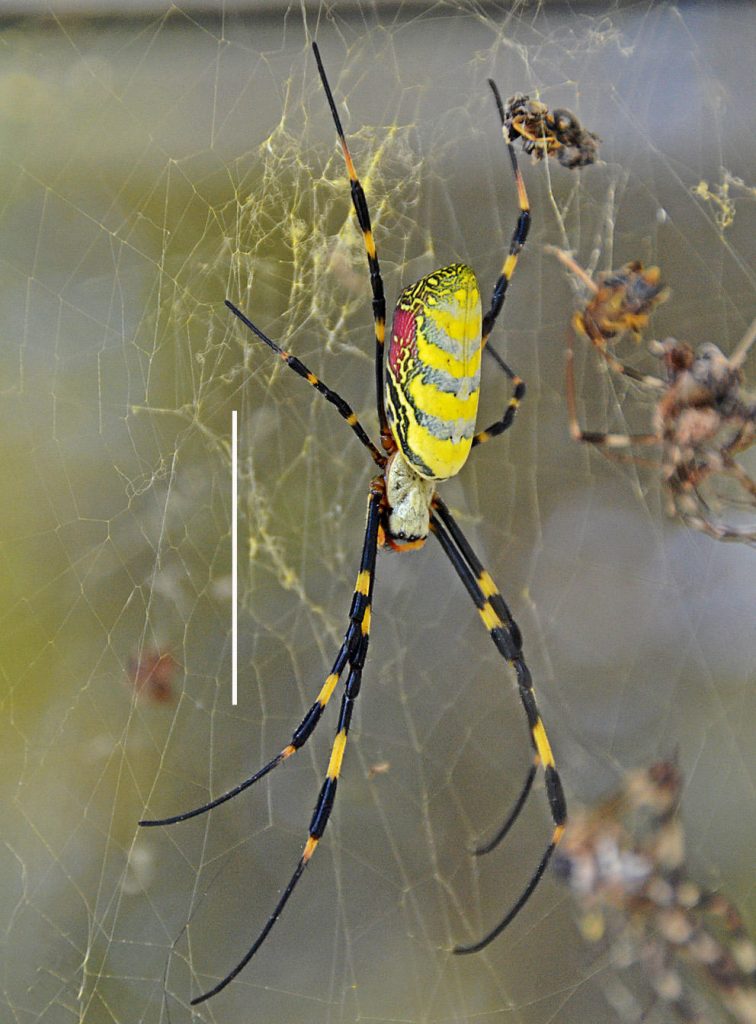
New research finds that the massive Joro spiders are gentle giants and mean people no harm.
Contrary to their daunting looks, the massive yellow and blue-black spiders that are increasingly populating the Southeastern U.S. attribute their survival to an unexpected trait: They’re rather timid.
In fact, a recent study from the University of Georgia reveals that the Jorō (Joro) spider could possibly be the most shy spider ever recorded.
“One of the ways that people think this spider could be affecting other species is that it’s aggressive and out-competing all the other native spiders,” said Andy Davis, lead author of the study and a research scientist in UGA’s Odum School of Ecology. “So we wanted to get to know the personality of these spiders and see if they’re capable of being that aggressive.
“It turns out they’re not.”
The researchers compared more than 450 spiders’ responses to a brief and harmless disturbance across 10 different species.
While most spiders froze for less than a minute before resuming their normal activities, the Joro spiders remained motionless for more than an hour.
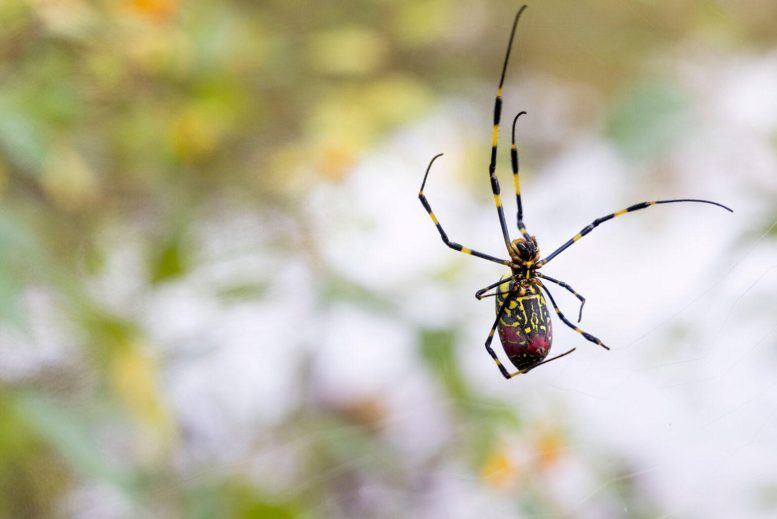
“They basically shut down and wait for the disturbance to go away,” Davis said. “Our paper shows that these spiders are really more afraid of you than the reverse.”
In fact, Joros are relatively harmless to people and pets. Joros won’t bite unless cornered. And even if you did manage to somehow annoy a Joro into biting you, its fangs likely wouldn’t be large enough to pierce your skin.
Most Spiders Begin Moving Quickly After Stress, Joros Remain Immobile for 60+ Minutes
To examine the spiders’ reaction to stress, the researchers used a turkey baster to gently blow two rapid puffs of air onto individual spiders. This minor disturbance causes the spiders to “freeze” for a period of time, going absolutely still.
The researchers tested more than 30 garden spiders, banded garden spiders, and marbled orb weavers. They also analyzed similar data from previously published, peer-reviewed papers that assessed the response of 389 more spiders, comprising five additional species.
All of those spiders began moving again after an average of about a minute and a half of stillness.
The Joros, however, stayed frozen with no body or leg movement for over an hour in most cases.
The only other spider species that exhibited a similarly extended response was the Joro spider’s cousin, the golden silk spider. Known as Trichonephila clavipes, the golden silk spider and the Joro spider are from the same genus.
Joros May Be Invasive, but They’re Not Aggressive
Officially known as Trichonephila clavata, the East Asian Joro spider first arrived in Georgia around 2013. The species is native to Japan, Korea, Taiwan, and China, and likely hitched a ride stateside on a shipping container.
The species has since rapidly spread across the state and much of the Southeast. Joro spiders easily number in the millions now. And there’s not much we can do to stop them from increasing their range.
Davis’ previous research even suggested that the invasive arachnids could spread beyond their current habitats and through most of the Eastern Seaboard.
“Most people think ‘invasive’ and ‘aggressive’ are synonymous,” said Amitesh Anerao, co-author of the study and an undergraduate researcher at the university. “People were freaking out about the Joro spiders at first, but maybe this paper can help calm people down.”
Joro Spiders Built To Withstand Human Activity
Joros are regularly spotted in areas native Georgia spiders don’t typically inhabit.
They build their golden webs between powerlines, on top of stoplights, and even above the pumps at local gas stations—none of which are particularly peaceful spots.
The researchers believe the Joro spiders’ shyness may help them better endure the barrage of noise, vibrations, and visual stimuli they consistently encounter in urban settings. Their prolonged freeze response to being startled could help conserve the Joro spiders’ energy.
If you’re wondering how something so mild-mannered could spread the way Joro spiders have, you aren’t the only one.
“One thing this paper tells me is that the Joros’ rapid spread must be because of their incredible reproductive potential,” Davis said. “They’re simply outbreeding everybody else. It’s not because they’re displacing native spiders or kicking them out of their own webs.”
Arachnophobes can take solace in the Joro spiders’ meek and gentle temperament. But the spiders are likely here to stay.
“They’re so good at living with humans,” Anerao said, “that they’re probably not going away anytime soon.”
Reference: “Startle Responses of Jorō Spiders (Trichonephila clavata) to Artificial Disturbance” by Andrew K. Davis and Amitesh V. Anerao, 15 May 2023, Arthropoda.
DOI: 10.3390/arthropoda1020009
Never miss a breakthrough: Join the SciTechDaily newsletter.
Follow us on Google and Google News.