
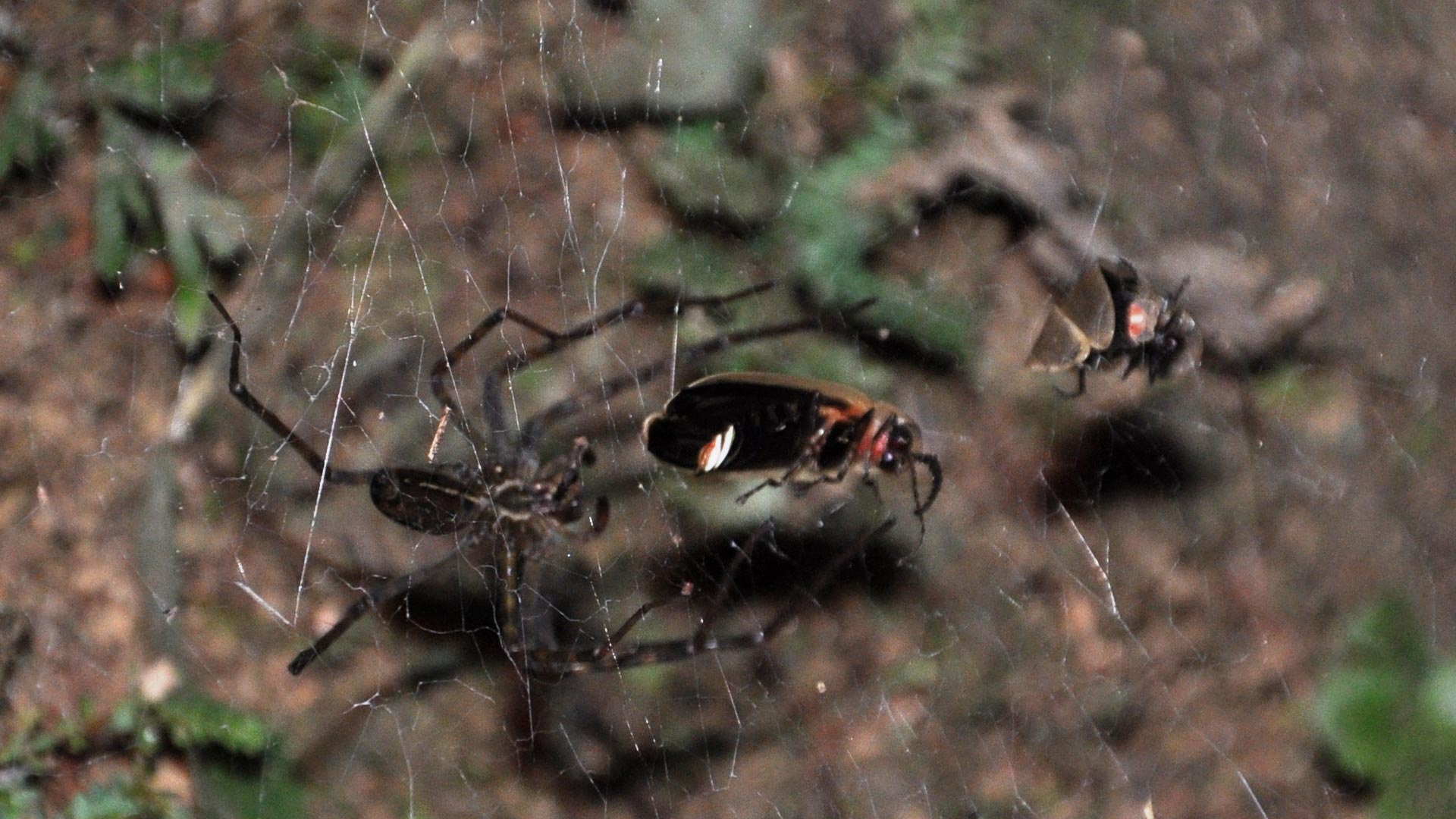
Deep in Taiwan’s forests, researchers uncovered a chilling hunting tactic: sheet web spiders don’t immediately devour fireflies caught in their webs. Instead, they let the insects keep glowing, turning them into living lanterns that lure in more unsuspecting prey.
Fireflies as Glowing Bait
Ecologists have discovered that a nocturnal spider uses the glow of trapped fireflies to draw in new prey. This unusual case of a predator turning its victim’s mating signal into a hunting advantage was recently reported in the British Ecological Society’s Journal of Animal Ecology.
At Tunghai University in Taiwan, researchers observed sheet web spiders (Psechrus clavis) catching fireflies in their webs and then leaving them alive as they continued to shine for nearly an hour. On several occasions, the scientists even saw the spiders returning to inspect their glowing captives.
Testing the Spider’s Strategy
Curious about whether this unusual behavior actually improved hunting, the team designed an experiment. They placed LED lights that mimicked firefly signals in real spider webs, while keeping other webs untouched for comparison.
The results were striking. Webs with glowing LEDs attracted three times as many insects overall as the control webs. When looking specifically at fireflies, those glowing webs caught up to ten times more than the controls.
Bioluminescence as a Deadly Signal
The study shows that leaving fireflies alive and glowing dramatically boosts the spiders’ hunting success. Most of the trapped fireflies were males, likely deceived by the light, which they mistook for potential mates.
Dr. I-Min Tso, the lead author of the study, said: “Our findings highlight a previously undocumented interaction where firefly signals, intended for sexual communication, are also beneficial to spiders.
“This study sheds new light on the ways that nocturnal sit-and-wait predators can rise to the challenges of attracting prey and provides a unique perspective on the complexity of predator-prey interactions.”
The researchers suggest that this behavior could have developed in sheet web spiders to avoid costly investment in their own bioluminescence like other sit-and-wait predators, such as anglerfish. Instead, the spiders are able to outsource prey attraction to their prey’s own signals.
The sheet web spider Psechrus clavis is a nocturnal sit-and-wait predator found in subtropical forests of East Asia. Its main source of prey, the winter firefly Diaphanes lampyroides, uses continuous, non-flashing bioluminescence to attract mates.
Video footage captured by the researchers in their experiment shows sheet web spiders employing different strategies when interacting with different prey species. Spiders would immediately consume any moths captured in their webs, but would not immediately consume the fireflies they captured.
“This study sheds new light on the ways that nocturnal sit-and-wait predators can rise to the challenges of attracting prey.”
“Handling prey in different ways suggests that the spider can use some kind of cue to distinguish between the prey species they capture and determine an appropriate response,” explained Dr. I-Min Tso. “We speculate that it is probably the bioluminescent signals of the fireflies that are used to identify fireflies, enabling spiders to adjust their prey handling behavior accordingly.”
The researchers conducted their field experiment in the conifer plantation forest at National Taiwan University’s Xitou Nature Educational Area.
Because they used LEDs to mimic the light signal emitted by fireflies, the researchers warn that although the wavelength and intensity of the LED setup was a close match to fireflies, it would be best if real fireflies were used in the field experiment. But they admit that this would be extremely difficult in practice.
Reference: “Prey bioluminescence-mediated visual luring in a sit and wait predator” by Ho Yin Yip, Sean J. Blamires, Chen-Pan Liao and I-Min Tso, 27 August 2025, Journal of Animal Ecology.
DOI: 10.1111/1365-2656.70102
Never miss a breakthrough: Join the SciTechDaily newsletter.
Follow us on Google and Google News.