

Sound doesn’t just enter your ears – it may actually talk to your cells.
New research out of Kyoto University shows that acoustic waves, even those in the audible range, can alter cellular behavior. Using specially designed equipment, scientists found that sound can suppress the formation of fat cells and influence gene activity. These surprising findings open the door to non-invasive treatments that harness sound to affect our bodies at the cellular level.
Sound You Can Feel
You’ve probably felt it—standing near a plane as it takes off or beside massive speakers at a concert – when sound becomes so powerful it seems to vibrate through your entire body. In those moments, you’re not just hearing the sound with your ears – your whole body feels it. And as new research suggests, your cells might actually be responding to it, too.
At its core, sound is made up of mechanical waves – compressions and rarefactions – that travel through substances like air, water, or tissue. It’s a fundamental feature of the physical world and a crucial source of information for living organisms. But scientists are only beginning to understand how sound might also influence the body at the cellular level.
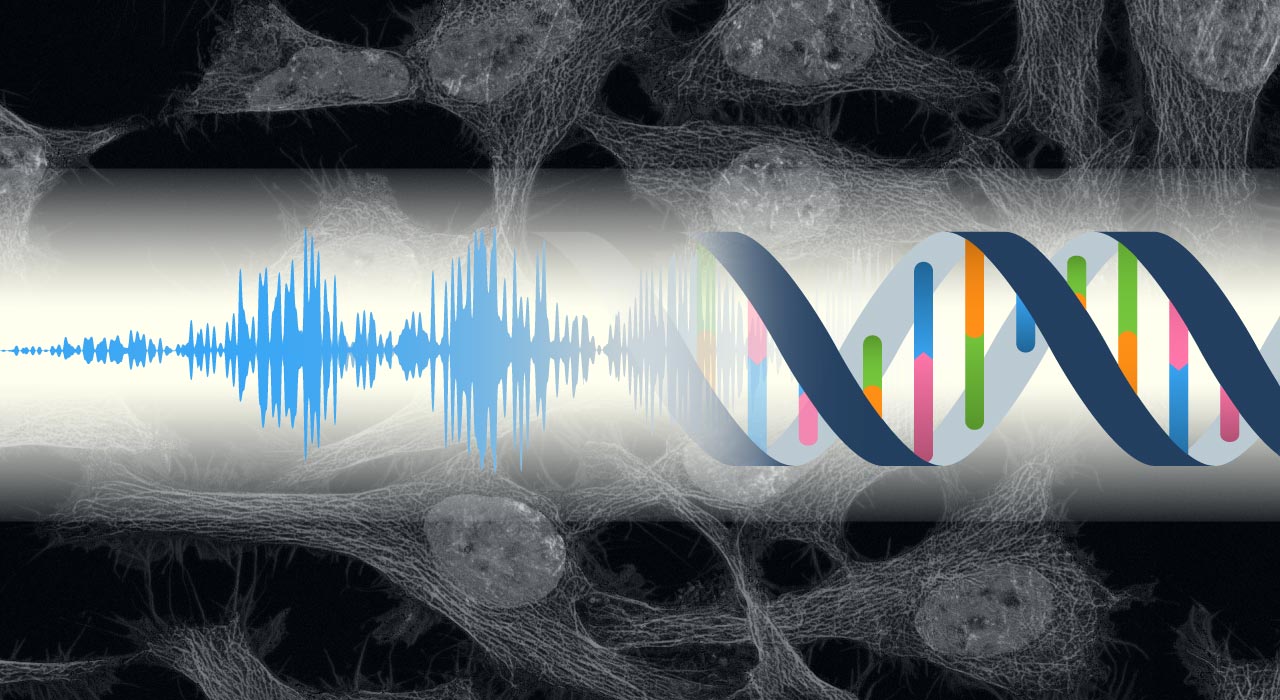
Investigating Sound’s Effects on Cells
Building on earlier work from 2018, researchers at Kyoto University are exploring how cells respond to sound, inspired by advances in mechanobiology and studies of body-conducted sound—the way vibrations move through tissues. Their findings suggest that the pressure from sound waves may be enough to trigger responses inside cells themselves.
“To investigate the effect of sound on cellular activities, we designed a system to bathe cultured cells in acoustic waves,” says corresponding author Masahiro Kumeta.
How the Experiment Worked
The team first attached a vibration transducer upside-down on a shelf. Then using a digital audio player connected to an amplifier, they sent sound signals through the transducer to a diaphragm attached to a cell culture dish. This allowed the researchers to emit acoustic pressure within the range of physiological sound to cultured cells.
Following this experiment, the researchers analyzed the effect of sound on cells using RNA-sequencing, microscopy, and other methods. Their results revealed cell-level responses to the audible range of acoustic stimulation.
Suppressing Fat Cell Formation
In particular, the team noticed the significant effect of sound in suppressing adipocyte differentiation, the process by which preadipocytes transform into fat cells, unveiling the possibility of utilizing acoustics to control cell and tissue states.
“Since sound is non-material, acoustic stimulation is a tool that is non-invasive, safe, and immediate, and will likely benefit medicine and healthcare,” says Kumeta.
The research team also identified about 190 sound-sensitive genes, noted the effect of sound in controlling cell adhesion activity, and observed the subcellular mechanism through which sound signals are transmitted.
Rethinking Sound Perception
In addition to providing compelling evidence of the perception of sound at the cell level, this study also challenges the traditional concept of sound perception by living beings, which is that it is mediated by receptive organs like the brain. It turns out that your cells respond to sounds, too.
Reference: “Acoustic modulation of mechanosensitive genes and adipocyte differentiation” by Masahiro Kumeta, Makoto Otani, Masahiro Toyoda and Shige H. Yoshimura, 16 April 2025, Communications Biology.
DOI: 10.1038/s42003-025-07969-1
Never miss a breakthrough: Join the SciTechDaily newsletter.
Follow us on Google and Google News.
7 Comments
In 1969 high school speech class, I delineated how sound is affecting Behavior. I’m glad to see the article you presented and I’m very interested in the subject. I’m no scientist, rather electrician, but I have wide scope and learning new things about sound. Please forward further info as it develops. Thank you, Robert Blanchard
You play with pissed off pixies and font think you’re a scientist…OK wizard then….
Sound exists only when the energy is processed by our audio cortex.
So, when a tree falls in a forest and no one hears it, there is no sound? Do you think sound vibrations have to be perceived to have an impact?
Correct, from a “perceptual” perspective. But sound is vibration, which means it has a frequency. It can and does affect cells due to the principles of resonance and dissonance.
So why dont you study something everybody doesn’t know. Or maybe get real jobs. If you don’t like my comment too cracking bad waste of money
It’s curious to me the line of thinking immediately goes to developing modalities to treat health and not how man-made sounds affect our organisms negatively.
Such as low frequency noise from factories and datacenters and wind turbines.