
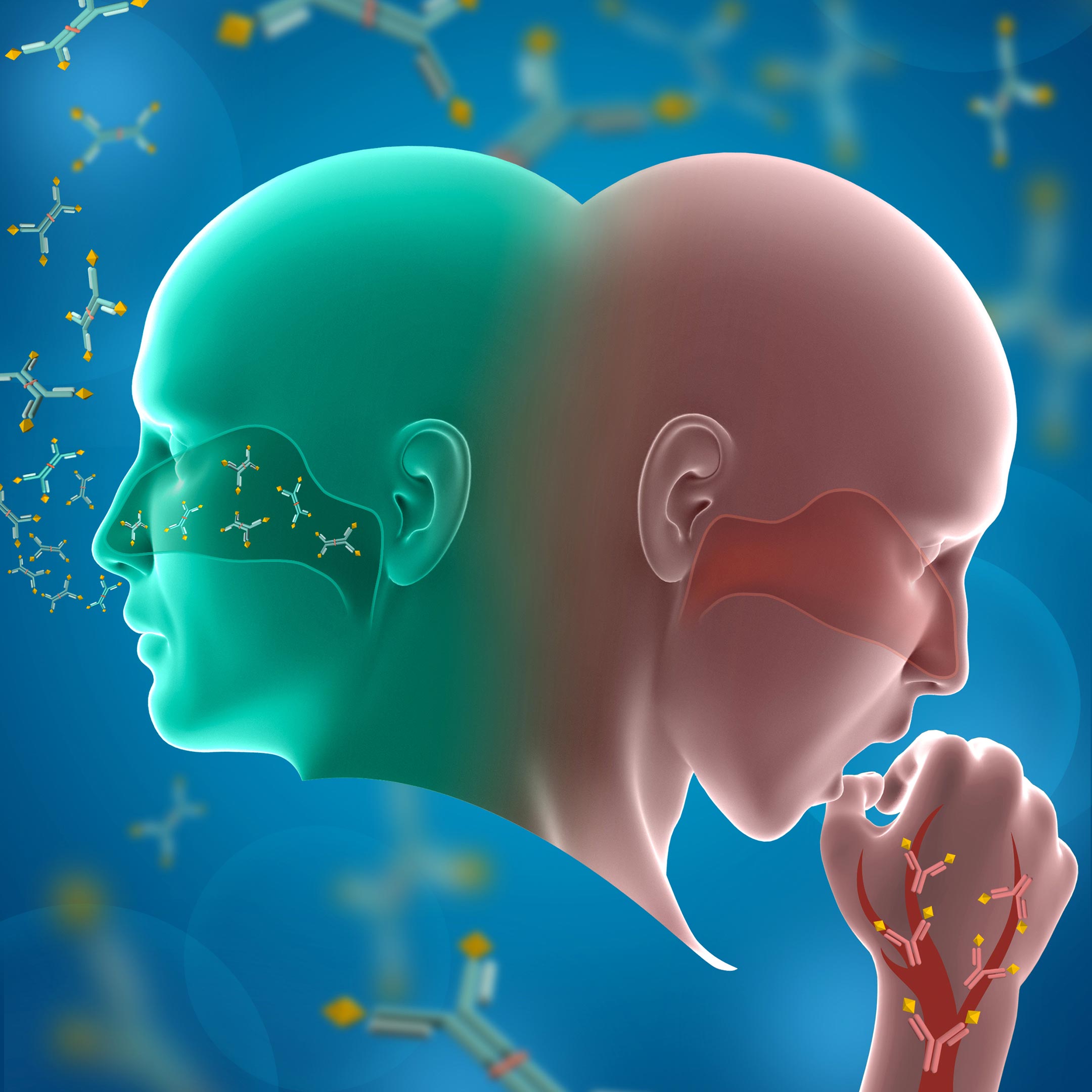
New research from Emory University reveals that nasal autoantibodies in COVID-19 patients may help predict disease severity, with potential implications for treatment.
COVID-19 symptoms vary widely, from mild to severe. While current virus strains tend to cause milder cases, people with underlying health conditions remain at a significantly higher risk for severe illness. New research from Emory University is now offering a way to better predict the severity of COVID-19 by analyzing autoantibodies in the nasal cavity, potentially enabling more personalized treatment approaches. For those at high risk, this insight could guide immediate treatments, such as using medications like Paxlovid within a week of symptoms to reduce the chances of severe outcomes.
Published today (November 6) in Science Translational Medicine, the study followed 125 COVID-19 patients with mild to severe cases over nearly two years. Researchers monitored antibodies in both blood and nasal passages, discovering that over 70% of those with mild or moderate COVID-19 had specific autoantibodies in their nasal cavity. Interestingly, these nasal autoantibodies were linked to milder symptoms, stronger antiviral immune responses, and faster recovery.
Protective Role of Nasal Autoantibodies
The study suggests that nasal autoantibodies may play a protective role by helping to regulate the immune system, reducing excessive inflammation, and enhancing the body’s ability to fight the virus effectively.
“Generally, autoantibodies are associated with pathology and a negative prognosis, causing increased inflammation that would indicate more severe disease,” says Eliver Ghosn, senior author on the paper and faculty member of the Lowance Center for Human Immunology and Emory Vaccine Center. “What’s interesting about our findings is that with COVID-19, it’s the opposite. The nasal autoantibodies showed up soon after infection, targeting an important inflammatory molecule produced by the patient’s cells. These autoantibodies latched on to the molecule, likely to prevent excessive inflammation, and faded as people recovered, suggesting the body uses them to keep things in balance.”
Surprising Differences Between Blood and Nasal Responses
Previous studies on COVID-19 patients have suggested that autoantibodies in the blood predispose them to life-threatening disease. However, these studies often neglect the nose – the actual site of infection. The new study suggests that the immune responses mounted in the nose against the virus differ from those in the blood. In short, nasal autoantibodies equal protection, whereas autoantibodies found in the blood equal severity.
“The key to this puzzle was to look directly at the site of infection, in the nose, instead of the blood,” says Ghosn. “While autoantibodies in the blood were linked to bad prognosis, producing them only in the nose soon after infection is linked to efficient recovery.”
FlowBEAT: Innovation in Antibody Measurement
To allow more precise measurements of antibodies produced locally in the nasal site of infection, the Ghosn lab developed a new biotechnology tool called FlowBEAT to quantify different types of antibodies in nasal cavities and other biological samples, which could soon have implications for the testing of other respiratory viruses, like flu or RSV.
“Historically, the technology to measure antibodies has low sensitivity and is inefficient since they are limited to measuring one or a few antibodies at a time,” says Ghosn. “With FlowBEAT, we can take any standard nasal swab and perform a combination test to simultaneously measure all human antibody types against dozens of viral and host antigens in a single tube – a much more sensitive, efficient, and scalable way to measure for autoantibodies in the nose that can also predict the severity of symptoms.”
Implications for Other Respiratory Infections
Next, the researchers want to find out whether this surprising mechanism to control COVID-19 infection in the nose also plays a role in other respiratory infections like flu and RSV.
“If this nasal autoantibody response turns out to be a common mechanism to protect us against other viral infections, it can be a paradigm shift in how we study protective immunity,” says Ghosn. “We will interpret autoantibodies through an innovative lens, hopefully inspiring new lines of research and better therapeutic options for common respiratory infections.”
Future of Diagnostic Testing for Respiratory Viruses
Based on their findings, the Ghosn Lab is currently working with Emory’s patent office to develop a predictive diagnostic tool using “leftover” samples from standard nasal swabs widely used as a diagnostic test for COVID-19.
“Right now, we’re either looking at infection risk before it happens or analyzing the infection course well after recovery,” says Ben Babcock, a PhD candidate who led the study in the Ghosn Lab. “Imagine if we could capture the immune response in real-time, right in the clinic. A just-in-time test could give physicians and patients the real-time information they need to make faster, smarter treatment decisions.”
Reference: “Transient anti-interferon autoantibodies in the airways are associated with recovery from COVID-19” by Benjamin R. Babcock, Astrid Kosters, Devon J. Eddins, Maria Sophia Baluyot Donaire, Sannidhi Sarvadhavabhatla, Vivian Pae, Fiona Beltran, Victoria W. Murray, Gurjot Gill, Guorui Xie, Brian S. Dobosh, Vincent D. Giacalone, Rabindra M. Tirouvanziam, Richard P. Ramonell, Scott A. Jenks, Ignacio Sanz, F. Eun-Hyung Lee, Nadia R. Roan, Sulggi A. Lee and Eliver E. B. Ghosn, 6 November 2024, Science Translational Medicine.
DOI: 10.1126/scitranslmed.adq1789
This study was part of a large collaboration between the Ghosn Lab at Emory and Drs. Sulggi Lee from UCSF and Nadia Roan from Gladstone Institutes, and in partnership with Emory laboratories of Drs. F. Eun-Hyung Lee, Iñaki Sanz, and Rabin Tirouvanziam.
This work was supported by the NIH’s National Institute of Allergy and Infectious Diseases (NIAID) awards R21AI167032, R01AI123126-05S1 and National Cancer Institute (NCI) award U54 CA260563 Emory SeroNet; COVID Fast Grant from Emergent Ventures at the Mercatus Center; and the Program for Breakthrough Biomedical Research Award. Ben Babcock was partially supported by the American Society of Hematology (ASH).
Never miss a breakthrough: Join the SciTechDaily newsletter.
Follow us on Google and Google News.