
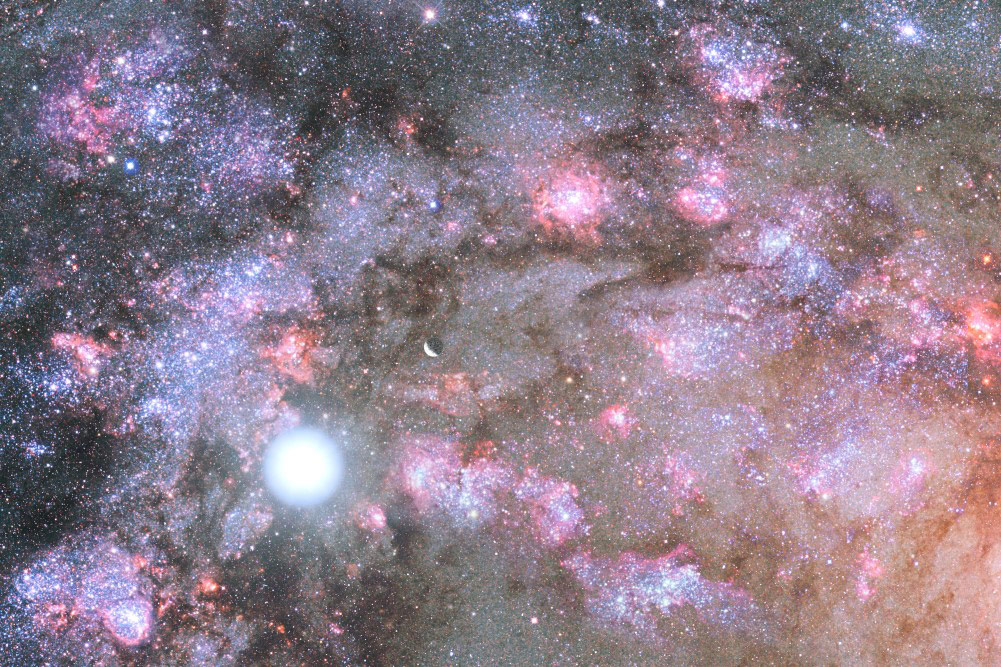
By combining observations from several telescopes, astronomers have viewed a massive galaxy in its core formation phase three billion years after the Big Bang.
Astronomers have for the first time caught a glimpse of the earliest stages of massive galaxy construction. The building site, dubbed “Sparky,” is a dense galactic core blazing with the light of millions of newborn stars that are forming at a ferocious rate.
The discovery was made possible through combined observations from NASA’s Hubble and Spitzer space telescopes, the W.M. Keck Observatory in Mauna Kea, Hawaii, and the European Space Agency’s Herschel space observatory, in which NASA plays an important role.
A fully developed elliptical galaxy is a gas-deficient gathering of ancient stars theorized to develop from the inside out, with a compact core marking its beginnings. Because the galactic core is so far away, the light of the forming galaxy that is observable from Earth was actually created 11 billion years ago, just 3 billion years after the Big Bang.
Although only a fraction of the size of the Milky Way, the tiny powerhouse galactic core already contains about twice as many stars as our own galaxy, all crammed into a region only 6,000 light-years across. The Milky Way is about 100,000 light-years across.
“We really hadn’t seen a formation process that could create things that are this dense,” explained Erica Nelson of Yale University in New Haven, Connecticut, lead author of the study. “We suspect that this core-formation process is a phenomenon unique to the early universe because the early universe, as a whole, was more compact. Today, the universe is so diffuse that it cannot create such objects anymore.”
In addition to determining the galaxy’s size from the Hubble images, the team dug into archival far-infrared images from Spitzer and Herschel. This allowed them to see how fast the galaxy core was creating stars. Sparky produced roughly 300 stars per year, compared to the 10 stars per year produced by our Milky Way.
“They’re very extreme environments,” Nelson said. “It’s like a medieval cauldron forging stars. There’s a lot of turbulence, and it’s bubbling. If you were in there, the night sky would be bright with young stars, and there would be a lot of dust, gas, and remnants of exploding stars. To actually see this happening is fascinating.”
Astronomers theorize that this frenzied star birth was sparked by a torrent of gas flowing into the galaxy’s core while it formed deep inside a gravitational well of dark matter, invisible cosmic material that acts as the scaffolding of the universe for galaxy construction.
Observations indicate that the galaxy had been furiously making stars for more than a billion years. It is likely that this frenzy eventually will slow to a stop, and that over the next 10 billion years other smaller galaxies may merge with Sparky, causing it to expand and become a mammoth, sedate elliptical galaxy.
“I think our discovery settles the question of whether this mode of building galaxies actually happened or not,” said team member Pieter van Dokkum of Yale University. “The question now is, how often did this occur? We suspect there are other galaxies like this that are even fainter in near-infrared wavelengths. We think they’ll be brighter at longer wavelengths, and so it will really be up to future infrared telescopes such as NASA’s James Webb Space Telescope to find more of these objects.”
The paper appears in the August 27 issue of the journal Nature.
The Hubble Space Telescope is a project of international cooperation between NASA and the European Space Agency. NASA’s Goddard Space Flight Center in Greenbelt, Maryland, manages the telescope. The Space Telescope Science Institute (STScI) in Baltimore conducts Hubble science operations. STScI is operated for NASA by the Association of Universities for Research in Astronomy, Inc., in Washington.
NASA’s Jet Propulsion Laboratory, Pasadena, California, manages the Spitzer Space Telescope mission for NASA’s Science Mission Directorate in Washington. Science operations are conducted at the Spitzer Science Center at the California Institute of Technology in Pasadena. Spacecraft operations are based at Lockheed Martin Space Systems Company, Littleton, Colorado. Data are archived at the Infrared Science Archive housed at the Infrared Processing and Analysis Center at Caltech. Caltech manages JPL for NASA.
Reference: “A massive galaxy in its core formation phase three billion years after the Big Bang” by Erica Nelson, Pieter van Dokkum, Marijn Franx, Gabriel Brammer, Ivelina Momcheva, Natascha Förster Schreiber, Elisabete da Cunha, Linda Tacconi, Rachel Bezanson, Allison Kirkpatrick, Joel Leja, Hans-Walter Rix, Rosalind Skelton, Arjen van der Wel, Katherine Whitaker and Stijn Wuyts, 27 August 2014, Nature.
DOI: 10.1038/nature13616
arXiv: 1406.3350
Never miss a breakthrough: Join the SciTechDaily newsletter.
Follow us on Google and Google News.