
Close Menu
    Facebook X (Twitter) Instagram
    SciTechDaily
    • Biology
    • Chemistry
    • Earth
    • Health
    • Physics
    • Science
    • Space
    • Technology
    Facebook X (Twitter) Pinterest YouTube RSS
    SciTechDaily
    Home»Space»How Large Can a Black Hole Grow? As Large as 50 Billion Solar Masses
    Space

    How Large Can a Black Hole Grow? As Large as 50 Billion Solar Masses

    By University of LeicesterDecember 23, 2015No Comments3 Mins Read
    Facebook Twitter Pinterest Telegram LinkedIn WhatsApp Email Reddit
    Share
    Facebook Twitter LinkedIn Pinterest Telegram Email Reddit
    How Big Can a Black Hole Grow
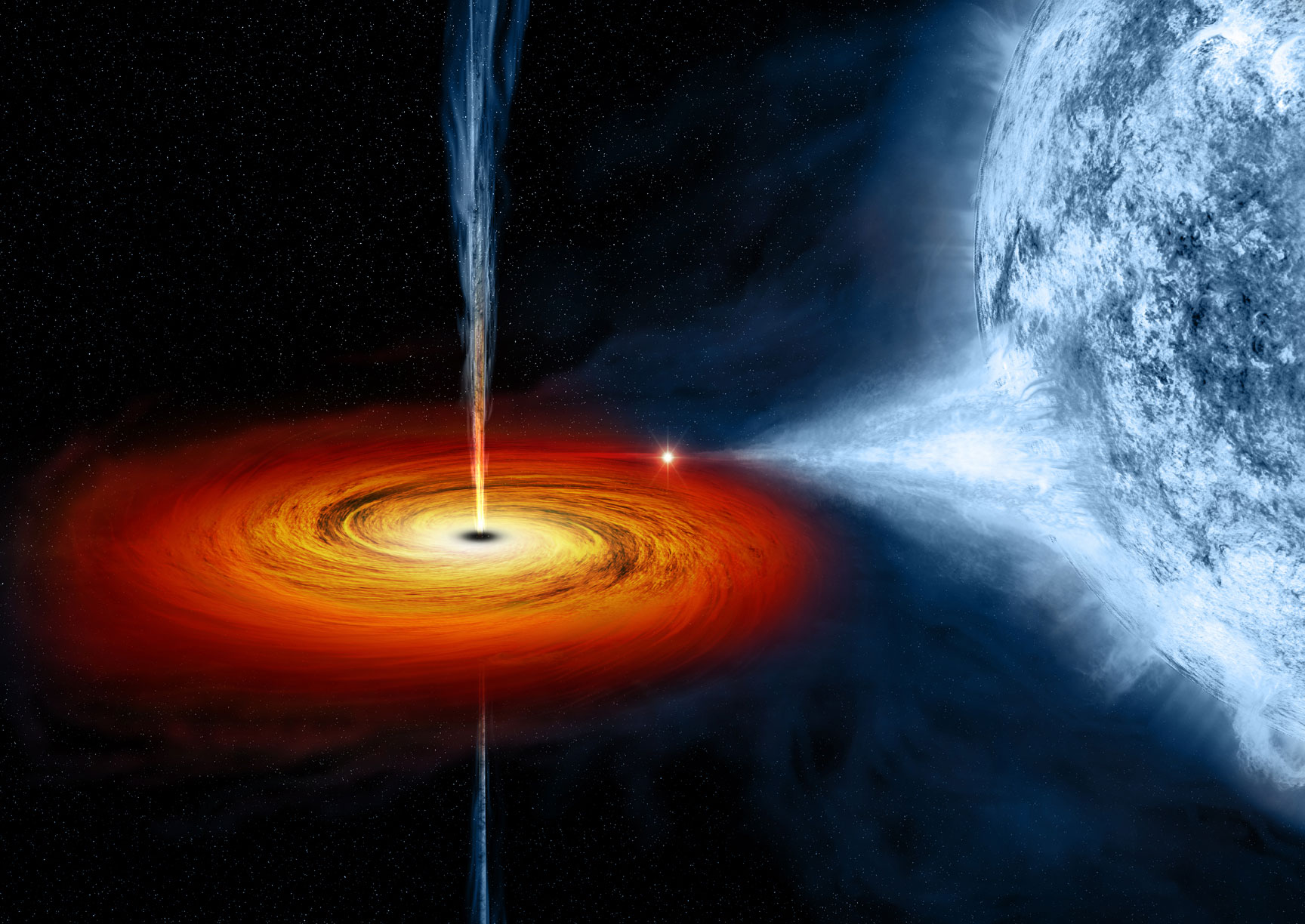
    An artist’s drawing a black hole named Cygnus X-1. It formed when a large star caved in. This black hole pulls matter from blue star beside it.

    New research from the University of Leicester reveals how large black holes can grow to.

    Black holes at the heart of galaxies could swell to 50 billion times the mass of the sun before losing the discs of gas they rely on to sustain themselves, according to research at the University of Leicester.

    In a study titled ‘How Big Can a Black Hole Grow?’ published in the journal Monthly Notices Letters of the Royal Astronomical Society, Professor Andrew King from the University of Leicester’s Department of Physics and Astronomy explores supermassive black holes at the center of galaxies, around which are regions of space where gas settles into an orbiting disc.

    This gas can lose energy and fall inwards, feeding the black hole. But these discs are known to be unstable and prone to crumbling into stars.

    Professor King calculated how big a black hole would have to be for its outer edge to keep a disc from forming, coming up with the figure of 50 billion solar masses.

    The study suggests that without a disc, the black hole would stop growing, meaning 50 billion suns would roughly be the upper limit. The only way it could get larger is if a star happened to fall straight in or another black hole merged with it.

    Professor King said: “The significance of this discovery is that astronomers have found black holes of almost the maximum mass, by observing the huge amount of radiation given off by the gas disc as it falls in. The mass limit means that this procedure should not turn up any masses much bigger than those we know, because there would not be a luminous disc.”

    “Bigger black hole masses are in principle possible – for example, a hole near the maximum mass could merge with another black hole, and the result would be bigger still. But no light would be produced in this merger, and the bigger merged black hole could not have a disc of gas that would make light.”

    “One might nevertheless detect it in other ways, for example as it bent light rays passing very close to it (gravitational lensing) or perhaps in the future from the gravitational waves that Einstein’s General Theory of Relativity predicts would be emitted as it merged.”

    Reference: “How Big Can a Black Hole Grow?” by Andrew King, 17 December 2015, MNRAS Letters.
    DOI: 10.1093/mnrasl/slv186
    arXiv:1511.08502

    Never miss a breakthrough: Join the SciTechDaily newsletter.
    Follow us on Google and Google News.

    Astronomy Astrophysics Black Hole University of Leicester
    Share. Facebook Twitter Pinterest LinkedIn Email Reddit

    Related Articles

    Stellar Feast: Ferocious Black Hole Consumes Three Earths’-Worth of Star Every Time It Passes

    NASA Investigates an “Old Faithful” Active Galaxy That Erupts Every 114 Days

    Deepening Mystery: Astronomers on the Hunt for a Missing Supermassive Black Hole [Video]

    When Galaxies Collide: How Galactic Collisions Can Starve Massive Black Holes

    Massive Stellar Triples Leading to Sequential Binary Black-Hole Mergers

    Astronomers Discover Earliest Supermassive Black Hole and Quasar in the Universe – 1000x More Luminous Than the Milky Way

    Most Distant Quasar Discovered Sheds Light on How Supermassive Black Holes Grow

    Deepening Astronomical Mystery: On the Hunt for a Missing Giant Black Hole

    Supermassive Black Hole’s Dust Ring May Be Casting Shadows From Heart of a Galaxy

    Leave A Reply Cancel Reply

    • Facebook
    • Twitter
    • Pinterest
    • YouTube

    Don't Miss a Discovery

    Subscribe for the Latest in Science & Tech!

    Trending News

    FDA-Approved Drug Shows Promise for Reversing Osteoarthritis Damage

    11,000-Year-Old Grains Reveal a Surprise About the Origins of Agriculture

    This Common Type of Medication Is Linked to Slower Cognitive Decline

    Quantum Computer Solves a Problem in 15 Minutes That Classical Methods Can’t Practically Compute

    Taking the Stairs Could Cut Your Risk of Heart-Related Death by 39%

    Scientists Uncover a Surprising New Route for Stonehenge’s Most Mysterious Stone

    A Star Near the Milky Way’s Black Hole Is Losing Mass at an Astonishing Rate

    Scientists Solve a Vitamin B12 Mystery With an Unexpected Culprit

    Follow SciTechDaily
    • Facebook
    • Twitter
    • YouTube
    • Pinterest
    • Newsletter
    • RSS
    SciTech News
    • Biology News
    • Chemistry News
    • Earth News
    • Health News
    • Physics News
    • Science News
    • Space News
    • Technology News
    Recent Posts
    • Scientists Find a Hidden Biological Link Across Different Forms of Autism
    • Scientists Discover a 3.7-Billion-Year-Old Secret of Early Life
    • Scientists Revisited a Forest Experiment That Was Forgotten for 30 Years. What They Found Was Astounding
    • Astronomers Discover a Ghostly River of Stars That Could Reveal Dark Matter
    • NASA Is Building a Moon Base – and the First Pieces Are Already Coming Together
    Copyright © 1998 - 2026 SciTechDaily. All Rights Reserved.
    • Science News
    • About
    • Contact
    • Editorial Board
    • Privacy Policy
    • Terms of Use

    Type above and press Enter to search. Press Esc to cancel.