
Close Menu
    Facebook X (Twitter) Instagram
    SciTechDaily
    • Biology
    • Chemistry
    • Earth
    • Health
    • Physics
    • Science
    • Space
    • Technology
    Facebook X (Twitter) Pinterest YouTube RSS
    SciTechDaily
    Home»Technology»Boston Dynamics Robotic Cheetah Clocked At 28.3 MPH
    Technology

    Boston Dynamics Robotic Cheetah Clocked At 28.3 MPH

    By SciTechDailySeptember 7, 20122 Comments2 Mins Read
    Facebook Twitter Pinterest Telegram LinkedIn WhatsApp Email Reddit
    Share
    Facebook Twitter LinkedIn Pinterest Telegram Email Reddit
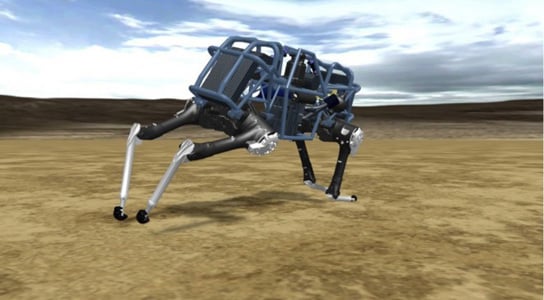
    boston-dynamics-darpa-wildcat
    Boston Dynamics WildCat 

    Developed for DARPA, Boston Dynamics’ Cheetah robot broke a new speed record recently, and it’s capable of running at 28.3 mph (45.5 kph), on a treadmill. That’s faster than Usain Bolt, the current fastest man on Earth.

    Usain Bolt’s fastest speed over 20 meters (65.6 feet) was 27.78 mph (44.7 kph). The Cheetah can attain 28.3 mph, in controlled conditions. It remains to be seen if this robot can attain this speed in real-world conditions.
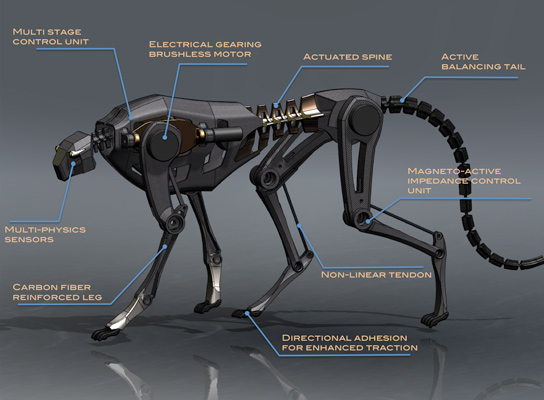
    boston-dynamics-darpa-cheetah-concept

    The four-legged robot looks slightly clumsy until you see that it replicates the gait of feline at higher speeds. The quadrupedal robot had attained 18 mph just 6 months ago. It’s an impressive feat that it surpassed its previous record by more than 10 mph.

    The Cheetah had no wind drag to set this record, and had an off-board power supply. The team behind the Cheetah has been able to increase the amount of power that’s shunted into the robot. This allowed for faster motion and better control of the actuators. The control system has also been refined, augmenting the coordination of the legs.

    At the end of the video, the robot starts to go faster, but loses control and slips. That means that there is even more room for improvement. The next step is to build an untethered version, one with an onboard engine and operator controls that work in 3D.

    The outdoor version will be called WildCat, and should be ready for early testing next year. The robot is marketed as an emergency response to offer humanitarian assistance or on defense missions.


    DARPA’s Cheetah robot—already the fastest legged robot in history—just broke its own land speed record of 18 miles per hour (mph). In the process, Cheetah also surpassed another very fast mover: Usain Bolt. According to the International Association of Athletics Federations, Bolt set the world speed record for a human in 2009 when he reached a peak speed of 27.78 mph for a 20-meter split during the 100-meter sprint. Cheetah was recently clocked at 28.3 mph for a 20-meter split. The Cheetah had a slight advantage over Bolt as it ran on a treadmill, the equivalent of a 28.3 mph tail wind, but most of the power Cheetah used was to swing its legs fast enough, not to propel itself forward.

    Never miss a breakthrough: Join the SciTechDaily newsletter.
    Follow us on Google and Google News.

    Boston Dynamics Cheetah DARPA Robotics WildCat
    Share. Facebook Twitter Pinterest LinkedIn Email Reddit

    Related Articles

    One Giant Leap for MIT’s Robotic Mini Cheetah

    DARPA Underground Autonomous Robot Navigation Challenge

    Ape-Like RoboSimian Robot in Development

    DARPA’s New Pet-Proto Robot Navigates Obstacles

    Robotic Tentacles Have a Soft Enough Touch to Pick Up Flowers

    DARPA & Harvard’s Soft, Self-Camouflaging Robot

    “Cheetah” Sets Legged Robot Land Speed Record

    Elastomeric “Soft” Robots Running on Pneumatic Actuators

    DARPA’s Legged Squad Support System (LS3) To Ease Physical Load on Troops

    2 Comments

    1. Alex on September 11, 2012 3:29 pm

      As cool as this is, this is incredibly old news.

      Reply
      • Staff on September 11, 2012 3:49 pm

        Old News? DARPA just reported it last week.

        Reply
    Leave A Reply Cancel Reply

    • Facebook
    • Twitter
    • Pinterest
    • YouTube

    Don't Miss a Discovery

    Subscribe for the Latest in Science & Tech!

    Trending News

    AI Could Detect Early Signs of Alzheimer’s in Under a Minute – Far Before Traditional Tests

    What if Dark Matter Has Two Forms? Bold New Hypothesis Could Explain a Cosmic Mystery

    This Metal Melts in Your Hand – and Scientists Just Discovered Something Strange

    Beef vs. Chicken: Surprising Results From New Prediabetes Study

    Alzheimer’s Breakthrough: Scientists Discover Key Protein May Prevent Toxic Protein Clumps in the Brain

    Quantum Reality Gets Stranger: Physicists Put a Lump of Metal in Two Places at Once

    Scientists May Have Found the Key to Jupiter and Saturn’s Moon Mystery

    Scientists Uncover Brain Changes That Link Pain to Depression

    Follow SciTechDaily
    • Facebook
    • Twitter
    • YouTube
    • Pinterest
    • Newsletter
    • RSS
    SciTech News
    • Biology News
    • Chemistry News
    • Earth News
    • Health News
    • Physics News
    • Science News
    • Space News
    • Technology News
    Recent Posts
    • Living With Roommates Might Be Changing Your Gut Microbiome Without You Knowing
    • Simple and Cheap Blood Test Could Detect Cancer and Other Diseases Before Symptoms Appear
    • Century-Old Cleaning Chemical Linked to 500% Increased Risk of Parkinson’s Disease
    • What if Your Memories Never Happened? Physicists Take a New Look at the Boltzmann Brain Paradox
    • Students Found an Ancient Star That Shouldn’t Be in the Milky Way
    Copyright © 1998 - 2026 SciTechDaily. All Rights Reserved.
    • Science News
    • About
    • Contact
    • Editorial Board
    • Privacy Policy
    • Terms of Use

    Type above and press Enter to search. Press Esc to cancel.