
According to data from NASA-supported observatories, the sun’s vast magnetic field is about to flip. Watch this new four minute ScienceCast video to learn more details.
A new ScienceCast video anticipates the reversal of the sun’s global magnetic field. Credit: Science@NASA
Something big is about to happen on the sun. According to measurements from NASA-supported observatories, the sun’s vast magnetic field is about to flip.
“It looks like we’re no more than three to four months away from a complete field reversal,” said solar physicist Todd Hoeksema of Stanford University. “This change will have ripple effects throughout the solar system.”
The sun’s magnetic field changes polarity approximately every 11 years. It happens at the peak of each solar cycle as the sun’s inner magnetic dynamo re-organizes itself. The coming reversal will mark the midpoint of Solar Cycle 24. Half of “solar max” will be behind us, with half yet to come.
Hoeksema is the director of Stanford’s Wilcox Solar Observatory, one of the few observatories in the world that monitors the sun’s polar magnetic fields. The poles are a herald of change. Just as Earth scientists watch our planet’s polar regions for signs of climate change, solar physicists do the same thing for the sun. Magnetograms at Wilcox have been tracking the sun’s polar magnetism since 1976, and they have recorded three grand reversals—with a fourth in the offing.
Solar physicist Phil Scherrer, also at Stanford, describes what happens: “The sun’s polar magnetic fields weaken, go to zero, and then emerge again with the opposite polarity. This is a regular part of the solar cycle.”
A reversal of the sun’s magnetic field is, literally, a big event. The domain of the sun’s magnetic influence (also known as the “heliosphere”) extends billions of kilometers beyond Pluto. Changes to the field’s polarity ripple all the way out to the Voyager probes, on the doorstep of interstellar space.
When solar physicists talk about solar field reversals, their conversation often centers on the “current sheet.” The current sheet is a sprawling surface jutting outward from the sun’s equator where the sun’s slowly rotating magnetic field induces an electrical current. The current itself is small, only one ten-billionth of an amp per square meter (0.0000000001 amps/m2), but there’s a lot of it: the amperage flows through a region 10,000 km (6,200 mi) thick and billions of kilometers wide. Electrically speaking, the entire heliosphere is organized around this enormous sheet.
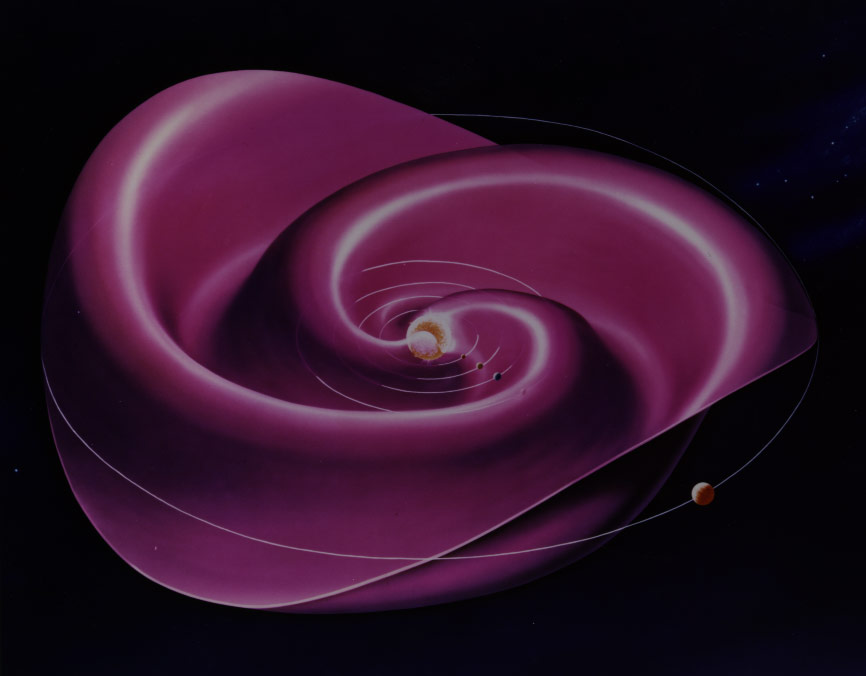
During field reversals, the current sheet becomes very wavy. Scherrer likens the undulations to the seams on a baseball. As Earth orbits the sun, we dip in and out of the current sheet. Transitions from one side to another can stir up stormy space weather around our planet.
Cosmic rays are also affected. These are high-energy particles accelerated to nearly light speed by supernova explosions and other violent events in the galaxy. Cosmic rays are a danger to astronauts and space probes, and some researchers say they might affect the cloudiness and climate of Earth. The current sheet acts as a barrier to cosmic rays, deflecting them as they attempt to penetrate the inner solar system. A wavy, crinkly sheet acts as a better shield against these energetic particles from deep space.
As the field reversal approaches, data from Wilcox show that the sun’s two hemispheres are out of synch.
“The sun’s north pole has already changed sign, while the south pole is racing to catch up,” Scherrer said. “Soon, however, both poles will be reversed, and the second half of solar max will be underway.”
When that happens, Hoeksema and Scherrer will share the news with their colleagues and the public.
Never miss a breakthrough: Join the SciTechDaily newsletter.
Follow us on Google and Google News.
11 Comments
And… the consequences to us piddly little humans are……????
None. It does this every eleven years.
Might have some issues with things we didn’t use as much 11 years ago though, GPS and what not… As for any huge changes we would have seen those 11 years ago so there should be nothing to worry about.
So poker night’s still on for first Tuesday? Good.
You know how the world ended in 2002? it will happen exactly the same
Yeah…there really a consequence of this. I’m not sure why this kind of thing matters. At the beginning, they made it seem like it was extremely important. “Something big is about to happen to the sun…” IT HAPPENS EVERY 11 YEARS. Oh well, it’s knowledge of our universe, and right now we need that.
The sun does this every 11 years, every 11 years the media tries to spin it into some crazy new thing to scare people.
You are a moron. Where in this article (or any credible science article about it) is it portrayed as something people should be scared of? Did you even read the article? This event actually has some slight positives. Nothing scary mentioned here. I am so sick of morons like you. Read the article, engage your brain, and stop writing moronic posts. What annoys me is that people like you get to vote. What an uneducated ass.
OMGZORZ, David Ikes was right!
The flip flop of the Sun every 11 years is regular since Sun is a huge liquid (rather plasma) magnet. You know that even when ferro magnets are magnetised by induction , that is by taking another magnet near a ferro-magnetic material like iron, the poles are induced in the opposite way. But when touched and magnetised they are assumed in the same way. The magnetic field induces rather haphazard orientation of electrons in the ferro magnetic materials to orient in the opposite direction or in the same direction by induction or touching and thereby the materials are magnetised. In Sun which takes 24 days to spin on its own axis the magnetic lines are constantly undergoing change in orientation and then this flip flop occurs periodically. By the by North and South Poles are arbitrarily labelled by us and they can be in any way. What it matters is the solar particles which deflects in the magnetic field of the Sun from its North to South changes their direction and it doesn’t matter whether it strikes the Earth in clockwise or anti-clockwise direction. Magnetic storms on the Sun’s surface is elevated during this flip flop due to large number of Sun spots and this is the reason for increased solar particles reaching the Earth in the 11 year cycle. Moreover the magnetic flip flop is common in all stars and spherical shaped terrestrial planets like Earth under various periodicity due to the magnetic material of the inner core magma and plasma. Thank You.
This is a very important observation which will have its implication over coaster topological storm striking behaviour and act as a function of Storm drifting . The sun’s magnetic field changes polarity approximately every 11 years. It happens at the peak of each solar cycle as the sun’s inner magnetic dynamo re-organizes itself. The coming reversal will mark the midpoint of Solar Cycle 24. Half of “solar max” will be behind us, with half yet to come. This will have its earth’s reflection by way of declining magnetic-field which will have its topological effect to attract more storm into coastal area that deflects any eye of the storm.