
Close Menu
    Facebook X (Twitter) Instagram
    SciTechDaily
    • Biology
    • Chemistry
    • Earth
    • Health
    • Physics
    • Science
    • Space
    • Technology
    Facebook X (Twitter) Pinterest YouTube RSS
    SciTechDaily
    Home»Chemistry»Revolutionizing Renewable Energy: Innovative Salt Battery Efficiently Harvests Osmotic Power
    Chemistry

    Revolutionizing Renewable Energy: Innovative Salt Battery Efficiently Harvests Osmotic Power

    By American Chemical SocietyApril 24, 20241 Comment3 Mins Read
    Facebook Twitter Pinterest Telegram LinkedIn WhatsApp Email Reddit
    Share
    Facebook Twitter LinkedIn Pinterest Telegram Email Reddit
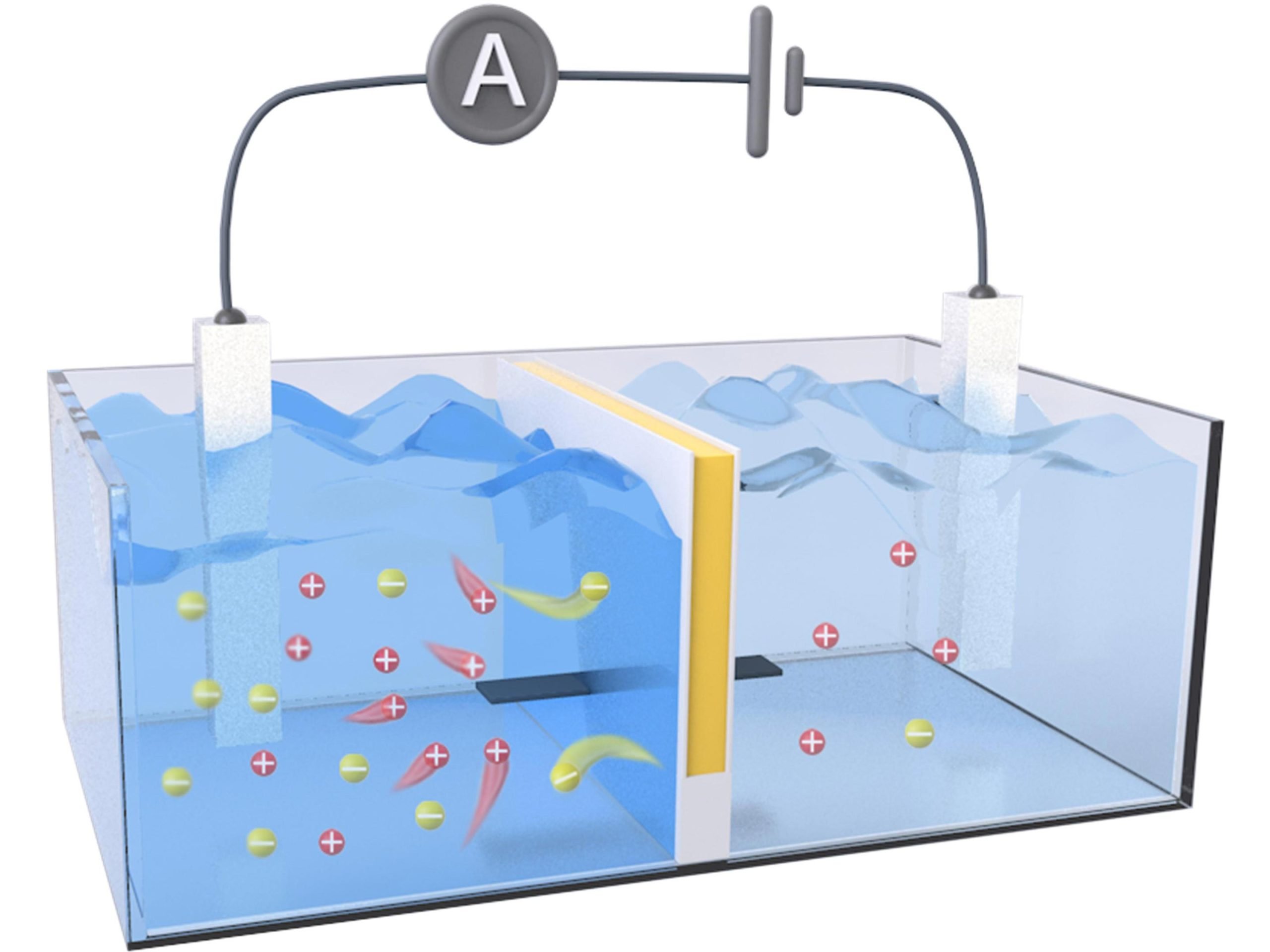
    Salt Battery Harvests Osmotic Energy
    An improved membrane (yellow line) dramatically increased the amount of osmotic power harvested from salt gradients, like those found in estuaries where salt water (left tank) meets fresh water (right tank). Credit: Adapted from ACS Energy Letters 2024, DOI: 10.1021/acsenergylett.4c00320

    A new semipermeable membrane doubles the osmotic energy output in estuaries, showing potential for sustainable power generation.

    Estuaries — where freshwater rivers meet the salty sea — are great locations for birdwatching and kayaking. In these areas, waters containing different salt concentrations mix and may be sources of sustainable, “blue” osmotic energy. In the journal ACS Energy Letters, researchers report creating a semipermeable membrane that harvests osmotic energy from salt gradients and converts it to electricity.

    The new design had an output power density more than two times higher than commercial membranes in lab demonstrations.

    Advancements in Osmotic Energy Technology

    Osmotic energy can be generated anywhere salt gradients are found, but the available technologies to capture this renewable energy have room for improvement. One method uses an array of reverse electrodialysis (RED) membranes that act as a sort of “salt battery,” generating electricity from pressure differences caused by the salt gradient.

    To even out that gradient, positively charged ions from seawater, such as sodium, flow through the system to the freshwater, increasing the pressure on the membrane. To further increase its harvesting power, the membrane also needs to keep a low internal electrical resistance by allowing electrons to easily flow in the opposite direction of the ions.

    Previous research suggests that improving both the flow of ions across the RED membrane and the efficiency of electron transport would likely increase the amount of electricity captured from osmotic energy. So, Dongdong Ye, Xingzhen Qin, and colleagues designed a semipermeable membrane from environmentally friendly materials that would theoretically minimize internal resistance and maximize output power.

    Innovative Membrane Design by Researchers

    The researchers’ RED membrane prototype contained separate (i.e., decoupled) channels for ion transport and electron transport. They created this by sandwiching a negatively charged cellulose hydrogel (for ion transport) between layers of an organic, electrically conductive polymer called polyaniline (for electron transport).

    Initial tests confirmed their theory that decoupled transport channels resulted in higher ion conductivity and lower resistivity compared to homogenous membranes made from the same materials. In a water tank that simulated an estuary environment, their prototype achieved an output power density 2.34 times higher than a commercial RED membrane and maintained performance during 16 days of non-stop operation, demonstrating its long-term, stable performance underwater.

    In a final test, the team created a salt battery array from 20 of their RED membranes and generated enough electricity to individually power a calculator, LED light, and stopwatch.

    Practical Applications and Future Prospects

    Ye, Qin, and their team members say their findings expand the range of ecological materials that could be used to make RED membranes and improve osmotic energy-harvesting performance, making these systems more feasible for real-world use.

    Reference: “Decoupled Ionic and Electronic Pathways for Enhanced Osmotic Energy Harvesting” by Zhijiang Xie, Zhongrun Xiang, Xiaotong Fu, Zewan Lin, Chenlu Jiao, Ke Zheng, Mei Yang, Xingzhen Qin and Dongdong Ye, 24 April 2024, ACS Energy Letters.
    DOI: 10.1021/acsenergylett.4c00320

    The authors acknowledge funding from the National Natural Science Foundation of China.

    Never miss a breakthrough: Join the SciTechDaily newsletter.
    Follow us on Google and Google News.

    American Chemical Society Battery Technology Energy
    Share. Facebook Twitter Pinterest LinkedIn Email Reddit

    Related Articles

    What Makes Electric Vehicle Fires So Difficult To Extinguish? [Video]

    Solar Flow Battery: Single Device Generates, Stores and Redelivers Renewable Electricity From the Sun

    New Re-Attachable & Flexible “Sticker-Type” Rechargeable Batteries

    Cobalt Is Used for Electric Vehicle and Electronics Batteries – Can Supply Meet Demand?

    Scientists Explore Hazards of Pushing Lithium-Ion Cells Too Far [Video]

    Post-Lithium Technology: High-Energy-Density Next-Generation Rechargeable Batteries

    New Electrolyte Improves Cycle Life of Next-Generation Lithium-Ion Batteries

    New Concept Enables More Eco-Friendly Batteries With Twice the Energy Density

    Sustainable Organic Batteries for Safer, Environmentally Friendly Power Storage

    1 Comment

    1. Nicholas Jones on April 24, 2024 2:46 pm

      I’m having trouble visualizing what an actual functional construction placed in an estuary to harvest power would look like. How about republishing with an informed artist’s rendering of such a system?

      Reply
    Leave A Reply Cancel Reply

    • Facebook
    • Twitter
    • Pinterest
    • YouTube

    Don't Miss a Discovery

    Subscribe for the Latest in Science & Tech!

    Trending News

    Scientists Discover How Obesity May Trigger Alzheimer’s Disease

    Scientists Confirm Alcohol Causes Widespread Health Damage

    Researchers Discover Cannabis Compounds That May Fight Obesity Without the High

    Scientists Just Found Evidence That Asteroids May Have Helped Create Life on Earth

    Scientists Create “Trojan Horse” Weight Loss Drug That Supercharges Results

    Cats Have a Unique Kidney Chemistry That Could Be Harming Their Health

    Scientists Discover Major Errors in Al Gore-Founded Climate Pollution Database

    New Vitamin B12-Based Therapy Could Change How Brain Cancer Is Treated

    Follow SciTechDaily
    • Facebook
    • Twitter
    • YouTube
    • Pinterest
    • Newsletter
    • RSS
    SciTech News
    • Biology News
    • Chemistry News
    • Earth News
    • Health News
    • Physics News
    • Science News
    • Space News
    • Technology News
    Recent Posts
    • Scientists Uncover Hidden Rare Earth Treasure Map Beneath Ancient Continents
    • Scientists Just Confirmed What’s Driving Sea Level Rise And It’s Alarming
    • Scientists Unveil the Hidden Electrical Structure of the U.S., Exposing Serious Risks
    • Plant-Based Diet Linked to Lower Alzheimer’s Risk, Study Finds
    • Why Taking Too Many Supplements Could Be Harming Your Health
    Copyright © 1998 - 2026 SciTechDaily. All Rights Reserved.
    • Science News
    • About
    • Contact
    • Editorial Board
    • Privacy Policy
    • Terms of Use

    Type above and press Enter to search. Press Esc to cancel.