
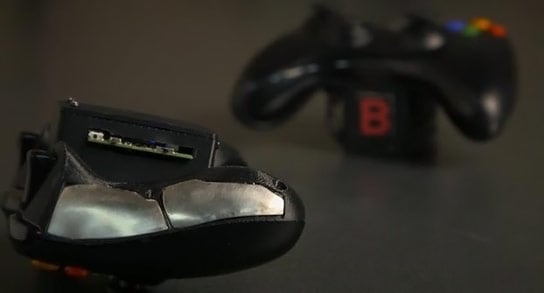
Engineers from Stanford University have developed a handheld video game controller that can measure the player’s physiology and alter the gameplay to make it more engaging.
Sometimes, a dozen ravenous zombies just aren’t exciting enough to hold a video gamer’s interest. The next step in interactive gaming, however, could come in the form of a handheld game controller that gauges the player’s brain activity and throws more zombies on the screen when it senses the player is bored.
The prototype controller was born from research conducted in the lab of Gregory Kovacs, a professor of electrical engineering at Stanford, in collaboration with Texas Instruments. The main area of research by grad students in Kovacs’ lab involves developing practical ways of measuring physiological signals to determine how a person’s bodily systems are functioning.
Stanford engineers have developed what could be the next big thing in interactive gaming: handheld game controllers that measure the player’s physiology and alter the gameplay to make it more engaging.
One such system of interest to Corey McCall, a doctoral candidate in Kovacs’ lab, is the autonomic nervous system, the emotional part of the brain – the part that changes when you get excited or bored, happy or sad. This activity, in turn, influences your heart rate, respiration rate, temperature, perspiration, and other key bodily processes. Measuring these outward signs offers a way of reverse engineering what’s occurring in the brain.
“You can see the expression of a person’s autonomic nervous system in their heart rate and skin temperature and respiration rate, and by measuring those outputs, we can understand what’s happening in the brain almost instantaneously,” said McCall, the leader on the game controller project.
This method of sensing autonomic activity is particularly intriguing, McCall said, because it can be conducted via non-invasive means. In fact, another of his projects involves monitoring the skin temperature of epilepsy patients at Stanford Hospital in an effort to sense the early indicators of a seizure.
As McCall worked out other ways to measure autonomic activity, he realized that he could easily monitor people in various mental states as they played video games and that he could gather most of the data he needed straight from test subjects’ hands.
McCall popped the back panel off an Xbox 360 controller and replaced it with a 3-D printed plastic module packed with sensors. Small metal pads on the controller’s surface measure the user’s heart rate, blood flow, and both the rate of breath and how deeply the user is breathing. Another light-operated sensor gives a second heart rate measurement, and accelerometers measure how frantically the person is shaking the controller.
Meanwhile, custom-built software gauges the intensity of the game – a simple but fast-paced racing game in which the player must drive over colored tiles in a particular sequence. McCall can then compare all this data to generate an overall picture of the player’s level of mental engagement.
The controller received a lot of positive interest when McCall presented it at the International Consumer Electronics Show in Las Vegas in January, in part because of the next phase of the work: Use the controller to provide feedback to the gaming console, which can then alter the pace of gameplay to better suit the player.
“If a player wants maximum engagement and excitement, we can measure when they are getting bored and, for example, introduce more zombies into the level,” McCall said. “We can also control the game for children. If parents are concerned that their children are getting too wrapped up in the game, we can tone it down or remind them that it’s time for a healthy break.”
Never miss a breakthrough: Join the SciTechDaily newsletter.
Follow us on Google and Google News.
2 Comments
I know about the emotion controlled bra but not a controller.
Hopefully this technology will sense my disappointment in the quality of the game and refund my money.