
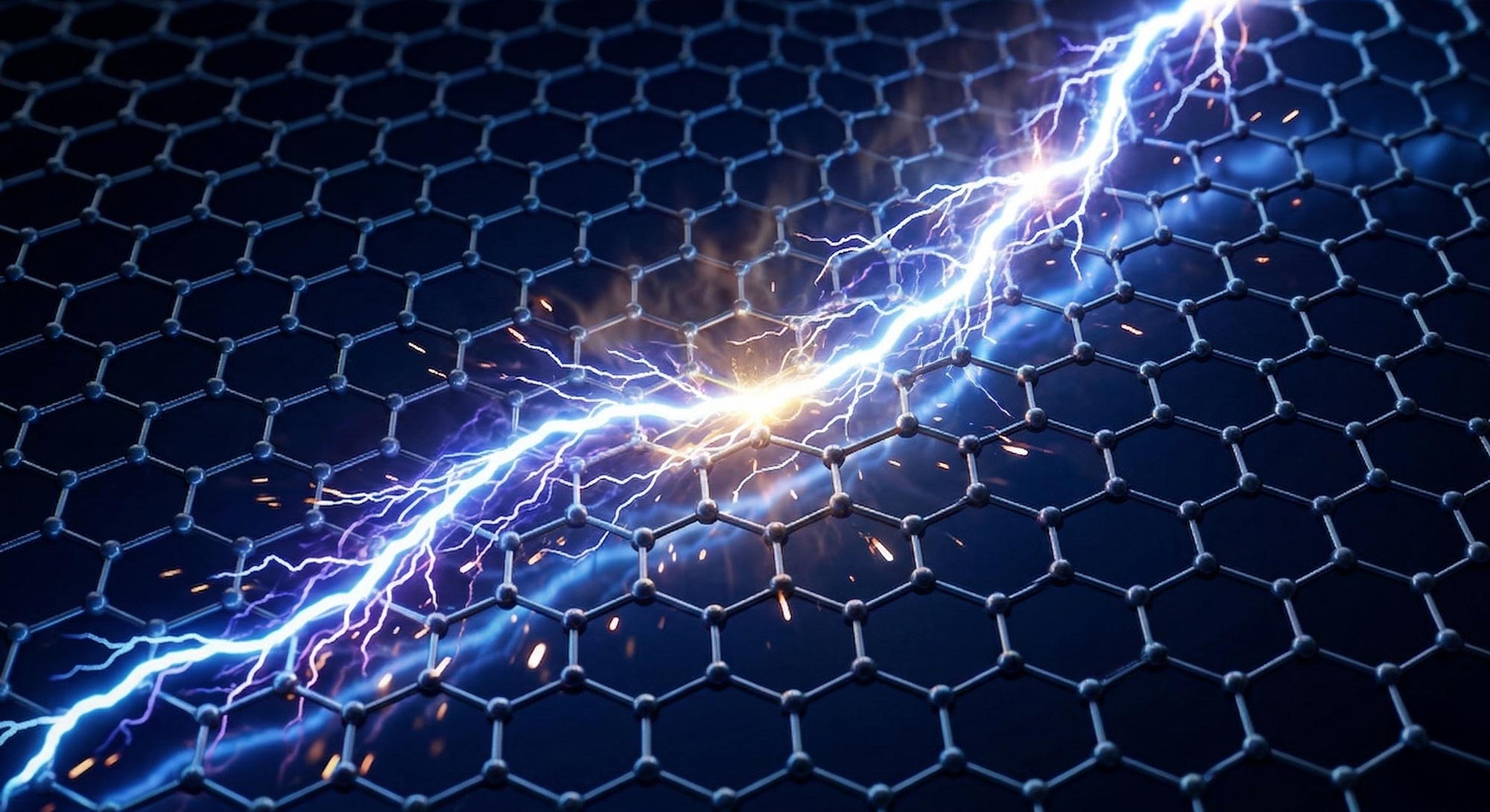
Scientists have found a new way to influence superconductivity by adjusting a material’s environment.
Researchers have uncovered new evidence that superconductivity can be steered by a material’s surroundings, opening a potential path toward electronics that waste far less energy. Instead of changing the material itself, the team showed that subtle environmental tuning can reshape how electrons behave at a fundamental level.
Superconductivity allows certain materials to carry electrical current with zero resistance once cooled below a critical temperature. This eliminates energy loss as heat, a limitation that affects everything from power grids to microchips. Yet the microscopic processes that enable this frictionless flow remain one of the biggest open questions in condensed matter physics.
Engineering Superconductivity in Graphene
New research, led by Chun Ning (Jeanie) Lau, a professor of physics at The Ohio State University, focused on a carefully designed material known as twisted bilayer graphene. This structure is made by stacking two layers of carbon and rotating one slightly relative to the other.
The team placed this material on a synthetic substrate called strontium titanate, which allowed them to monitor and adjust how electrons, the tiny particles responsible for electrical behavior, interact. These interactions occur in pairs and play a key role in determining properties such as magnetism and chemical bonding. By tuning these paired interactions, the researchers were able to turn superconductivity on and off.
“Electrons normally repel each other, but in superconductors they form pairs; this pair formation is the key to a superconductor’s ability to conduct electricity without dissipation,” said Lau. “Our evidence suggests that electrons themselves, depending on their sensitivity to their nearby environment, are unexpectedly important for material changes.”
Toward Practical Applications
The researchers observed an unexpected trend. Increasing their adjustments reduced superconductivity, which contrasts with traditional superconductors where weakening repulsive forces between electrons typically strengthens pairing. This difference highlights the unusual behavior of materials like twisted bilayer graphene.
“If you could transmit electricity without energy loss, that would be hugely important for technologies used in our everyday life,” said Lau. “Despite the fundamental questions that still need answers, this work basically provides a path toward a new type of physics mechanism.”
This discovery could help scientists design materials that operate as superconductors at higher temperatures, potentially even at room temperature. Achieving this long-standing goal would have major implications for electronics, power transmission, and communication systems.
The findings were published April 7 in the journal Nature Physics.
Overall, the work points to a more direct way of controlling the conditions that enable superconductivity. Many high-temperature superconductors face performance limits, but adjusting their environment could enhance their capabilities and support the creation of more efficient devices.
Future Directions and Implications
According to lead author Xueshi Gao, a PhD student in physics at Ohio State, these results may soon be applied to a wide range of systems and experiments.
“The mechanism of superconductivity in the twisted bilayer graphene system we used is still not well understood,” said Gao. “But our result can shed light on and help people to better understand the concept when applying it to future work.”
The researchers note that their model represents an early step in exploring complex electronic interactions. Future studies will examine additional interaction types and address the many open questions raised by this work.
“We’re showing capabilities that we haven’t shown before, so many people in the field are getting really excited about this result,” said Lau.
Reference: “Double-edged role of interactions in superconducting twisted bilayer graphene” by Xueshi Gao, Alejandro Jimeno-Pozo, Pierre A. Pantaleon, Aatmaj Rajesh, Emilio Codecido, Daria L. Sharifi, Zheneng Zhang, Youwei Liu, Kenji Watanabe, Takashi Taniguchi, Marc W. Bockrath, Francisco Guinea and Chun Ning Lau, 7 April 2026, Nature Physics.
DOI: 10.1038/s41567-026-03243-1
This work was supported by the Department of Energy and the National Science Foundation.
Never miss a breakthrough: Join the SciTechDaily newsletter.
Follow us on Google and Google News.