
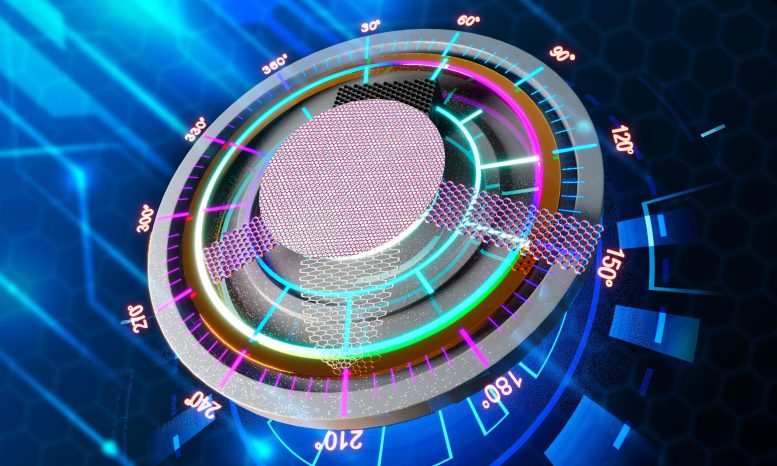
Physicists have developed a technique to precisely align supermoiré lattices, revolutionizing the potential for next-generation moiré quantum matter.
National University of Singapore (NUS) physicists have developed a technique to precisely control the alignment of supermoiré lattices by using a set of golden rules, paving the way for the advancement of next-generation moiré quantum matter.
Supermoiré Lattices
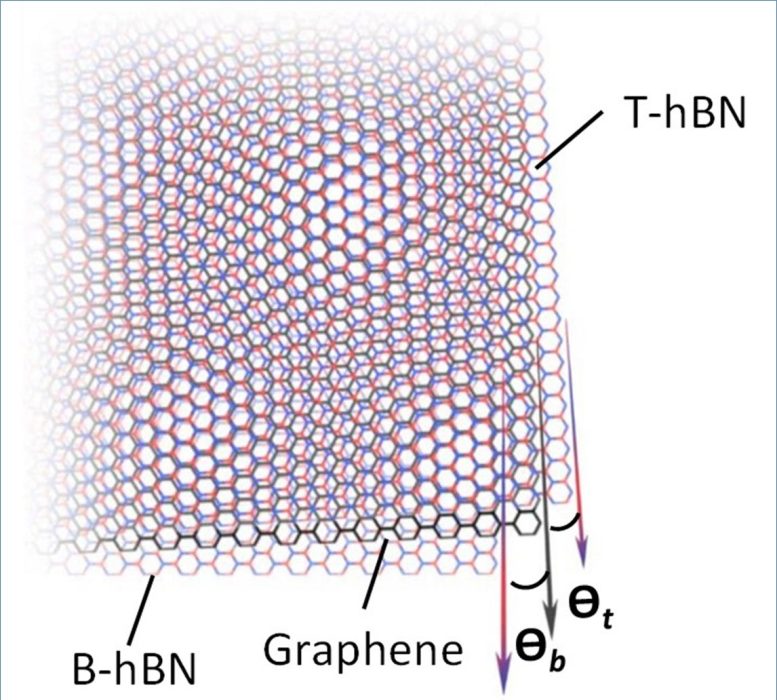
Moiré patterns are formed when two identical periodic structures are overlaid with a relative twist angle between them or two different periodic structures but overlaid with or without a twist angle. The twist angle is the angle between the crystallographic orientations of the two structures. For example, when graphene and hexagonal boron nitride (hBN) which are layered materials are overlaid on each other, the atoms in the two structures do not line up perfectly, creating a pattern of interference fringes, called a moiré pattern. This results in an electronic reconstruction.
The moiré pattern in graphene and hBN has been used to create new structures with exotic properties, such as topological currents and Hofstadter butterfly states. When two moiré patterns are stacked together, a new structure called a supermoiré lattice is created. Compared with the traditional single moiré materials, this supermoiré lattice expands the range of tunable material properties allowing for potential use in a much larger variety of applications.
Achievements from NUS Physics Department
A research team led by Professor Ariando from the NUS Department of Physics developed a technique and successfully realized the controlled alignment of the hBN/graphene/hBN supermoiré lattice. This technique allows for the precise arrangement of two moiré patterns, one on top of the other. Meanwhile, the researchers also formulated the “Golden Rule of Three” to guide the use of their technique for creating supermoiré lattices.
The findings were published recently in the journal Nature Communications.
Challenges and Solutions
There are three main challenges in creating a graphene supermoiré lattice. First, the traditional optical alignment strongly depends on the straight edges of graphene, but it is time-consuming and labor-intensive to find a suitable graphene flake; Second, even if the straight-edged graphene sample is used, there is a low probability of 1/8 to obtain a double-aligned supermoiré lattice, due to the uncertainty of its edge chirality and lattice symmetry. Third, although the edge chirality and lattice symmetry can be identified, the alignment errors are often found to be large (greater than 0.5 degrees), as it is physically challenging to align two different lattice materials.
Dr. Junxiong Hu, the lead author of the research paper, said, “Our technique helps to solve a real-life problem. Many researchers have told me that it usually takes almost one week to make a sample. With our technique, they can not only greatly shorten the fabrication time, but also greatly improve the accuracy of the sample.”
Technical Insights
The scientists use a “30° rotation technique” at the start to control the alignment of the top hBN and graphene layers. Then they use a “flip-over technique” to control the alignment of the top hBN and bottom hBN layers. Based on these two methods, they can control the lattice symmetry and tune the band structure of the graphene supermoiré lattice. They have also shown that the neighboring graphite edge can act as a guide for the stacking alignment. In this study, they have fabricated 20 moiré samples with an accuracy better than 0.2 degrees.
Prof. Ariando said, “We have established three golden rules for our technique which can help many researchers in the two-dimensional materials community. Many scientists working in other strongly correlated systems like magic-angle twisting bilayer graphene or ABC-stacking multilayer graphene are also expected to benefit from our work. Through this technical improvement, I hope that it will accelerate the development of the next generation of moiré quantum matter.”
Future Endeavors
Currently, the research team is leveraging this technique to fabricate the single-layer graphene supermoiré lattice and explore the unique properties of this material system. Furthermore, they are also extending the current technique to other material systems, to discover other novel quantum phenomena.
Reference: “Controlled alignment of supermoiré lattice in double-aligned graphene heterostructures” by Junxiong Hu, Junyou Tan, Mohammed M. Al Ezzi, Udvas Chattopadhyay, Jian Gou, Yuntian Zheng, Zihao Wang, Jiayu Chen, Reshmi Thottathil, Jiangbo Luo, Kenji Watanabe, Takashi Taniguchi, Andrew Thye Shen Wee, Shaffique Adam and A. Ariando, 12 July 2023, Nature Communications.
DOI: 10.1038/s41467-023-39893-5
Never miss a breakthrough: Join the SciTechDaily newsletter.
Follow us on Google and Google News.
1 Comment
Low dimensional spatiotemporal matter is the foundation of high-dimensional spatiotemporal matter. If you don’t understand how low dimensional spacetime matter interacts with each other. Any Golden Rules can be suspected of delusion. So far, relativity and quantum mechanics are the most successful theories for describing low-dimensional spacetime matter. If you are really interested in science, please use your mind to understand them.