
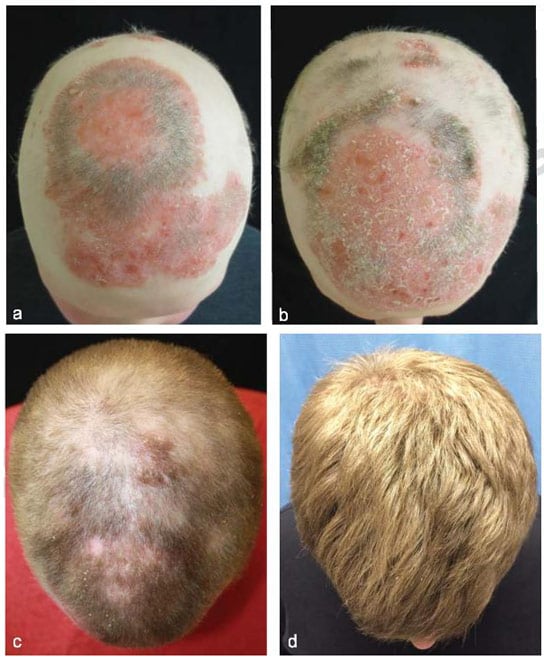
Using an existing FDA-approved drug for rheumatoid arthritis called tofacitinib citrate, a man with alopecia universalis has grown a full head of hair, eyebrows and eyelashes, as well as facial, armpit, and other hair.
A man with almost no hair on his body has grown a full head of it after a novel treatment by doctors at Yale University.
There is currently no cure or long-term treatment for alopecia universalis, the disease that left the 25-year-old patient bare of hair. This is the first reported case of a successful targeted treatment for the rare, highly visible disease.
The patient has also grown eyebrows and eyelashes, as well as facial, armpit, and other hair, which he lacked at the time he sought help.
“The results are exactly what we hoped for,” said Dr. Brett A. King, assistant professor of dermatology at Yale University School of Medicine and senior author of a paper reporting the results online June 18 in the Journal of Investigative Dermatology. “This is a huge step forward in the treatment of patients with this condition. While it’s one case, we anticipated the successful treatment of this man based on our current understanding of the disease and the drug. We believe the same results will be duplicated in other patients, and we plan to try.”
The patient had previously been diagnosed with both alopecia universalis, a disease that results in loss of all body hair, and plaque psoriasis, a condition characterized by scaly red areas of skin. The only hair on his body was within the psoriasis plaques on his head. He was referred to Yale Dermatology for treatment of the psoriasis. The alopecia universalis had never been treated.
King believed it might be possible to address both diseases simultaneously using an existing FDA-approved drug for rheumatoid arthritis called tofacitinib citrate. The drug had been used successfully for treatingpsoriasis in humans. It had also reversed alopecia areata, a less extreme form of alopecia, in mice.
“There are no good options for long-term treatment of alopecia universalis,” said King, a clinician interested in the treatment of rare but devastating skin diseases. “The best available science suggested this might work, and it has.”
After two months on tofacitinib at 10 mg daily, the patient’s psoriasis showed some improvement, and the man had grown scalp and facial hair — the first hair he’d grown there in seven years. After three more months of therapy at 15 mg daily, the patient had completely regrown scalp hair and also had clearly visible eyebrows, eyelashes, and facial hair, as well as armpit and other hair, the doctors said.
“By eight months there was full regrowth of hair,” said co-author Dr. Brittany G. Craiglow. “The patient has reported feeling no side effects, and we’ve seen no lab test abnormalities, either.”
Tofacitinib appears to spur hair regrowth in a patient with alopecia universalis by turning off the immune system attack on hair follicles that is prompted by the disease, King said.
The drug helps in some, but not all, cases of psoriasis, and was mildly effective in this patient’s case, the authors said.
King has submitted a proposal for a clinical trial involving a cream form of tofacitinib as a treatment for alopecia areata.
He cited work by Columbia University scientist Angela Christiano as the reason he decided to try tofacitinib as a therapy in this patient with both alopecia universalis and psoriasis. She has shown thattofacitinib and a related medicine reverse alopecia areata in mice. King called her work exemplary and a clear example of how society’s investment in science research leads to improvement in human life.
“This case highlights the interplay between advances in science and the treatment of disease,” he said, “and it provides a compelling example of the ways in which an increasingly complex understanding of medicine, combined with ingenuity in treatment, benefits patients.”
The paper is titled “Killing Two Birds with One Stone: Oral Tofacitinib Reverses Alopecia Universalis in a Patient with Plaque Psoriasis.” Images available.
Reference: “Killing Two Birds with One Stone: Oral Tofacitinib Reverses Alopecia Universalis in a Patient with Plaque Psoriasis” by Brittany G Craiglow and Brett A King, 17 July 2014, Journal of Investigative Dermatology.
DOI: 10.1038/jid.2014.260
Never miss a breakthrough: Join the SciTechDaily newsletter.
Follow us on Google and Google News.
13 Comments
Trials will probably be on mice and never develop into anything for humans but only making researchers richer as usual.
A quick search on Indeed.com shows that research scientists will likely top out at $100,000/year (http://www.indeed.com/salary/Research-Scientist.html). Not a bad living, but not extravagant considering they will likely have a doctorate by this point, and will have spent the better part of 10 years perusing education. They will also have been working for a decade or more in the field. A person can as well as an engineer with half of the education…
Quote “a man with alopecia universalis has grown a full head of hair, eyebrows and eyelashes, as well as facial, armpit, and other hair” unquote
How quaint. The “other hair” is presumably on his knuckles.
If they are able to get this to market it will be a real game changer. Alopecia is a debilitating disease for many and there aren’t a lot of real options at the moment.
this is truly a groundbreaking discovery and a hope for anyone suffering from this terrible disease
May I simply just say what a comfort to uncover someone that
actually knows what they are discussing over the internet.
You definitely realize how to bring a problem to light and make it important.
More people ought to read this and understand this side of your story.
I was surprised you’re not more popular because you certainly
possess the gift.
Fine way of describing, and pleasant post to obtain facts about
my presentation topic, which i am going to present in college.
It’s awesome to go to see this site and reading the views of all mates regarding this paragraph,
while I am also zealous of getting familiarity.
If Tofacitinib works for alopecia why not for other auto-immune diseases like Lupis, or Parkinson’s?
You’re so awesome! I do not believe I’ve truly read through a single thing like this before.
So wonderful to discover someone with some original
thoughts on this subject. Really.. thank you for starting this
up. This web site is something that’s needed on the web, someone with some originality!
Hi there Dear, are you in fact visiting this web page on a regular basis, if so after that you will absolutely take nice experience.
I’m having issues that’s debilitating for me, and I don’t know what it is. I’ve got black things all over me including inside my mouth! I’ve been researching and to no avail. My symptoms seem to morph, and is taking away my life, and getting worse. Sometimes it seems to be a resistant energy or magnetic-based. I’m losing my hair, having skin and scalp issues,…etc. it’s been a year now.There’s plenty more, I can’t due to sounding crazy… Thanks
Get a biopsy, it could be melanoma.