
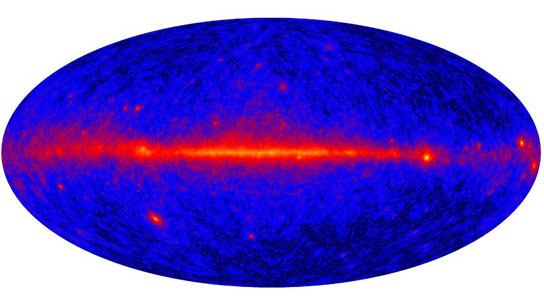
Roughly four years after Fermi began studying gamma-rays, a soon-to-be-published study documents interesting findings. It turns out that the Crab Nebula and other individual point sources are producing less gamma rays than previously thought, helping researchers come to conclusions about the density of cosmic rays and the total amount of gamma radiation.
The SLAC-built Large Area Telescope (LAT), the main instrument of the Fermi Gamma-ray Space Telescope, has been studying the gamma-ray sky for almost four years. During that time, the LAT has identified hundreds of gamma-ray sources, including pulsars and active galactic nuclei. It has shown that the Crab Nebula isn’t the steady emitter of gamma rays it’s long been thought to be. The LAT has cataloged lightning in the Earth’s atmosphere and flares on the sun.
But, as reported in a paper soon to appear in The Astrophysical Journal, most of the gamma rays detected by the LAT cannot be attributed to individual point sources.
The team discovered that the pulsars, active galactic nuclei, and all the rest of the gamma-ray sources pinpointed by the LAT account for only about 10 percent of the gamma-ray photons that have been detected. Extragalactic diffuse emission, a glow that pervades the universe and originates in distant, indistinct sources, comprises approximately 15 percent of the total.
Most of the gamma rays detected by the LAT are “diffuse” emissions originating from our own Milky Way galaxy.
The main source of these pervasive, diffuse gamma-ray emissions are high-energy charged particles known as cosmic rays that interact with the gas and radiation fields between the stars, which is called the interstellar medium. The interstellar medium is far from empty space; scientists are busy gathering crucial information about the gas, dust and high-energy charged particles that fill it.
These cosmic particles can come from pulsars, supernova explosions, and other powerful astrophysical sources. There may be an additional contribution from annihilating dark-matter particles or the black hole at the center of our galaxy.
The study was led by Gudlaugar Johannesson, a former postdoctoral researcher member and current affiliate of the SLAC- and Stanford-based Kavli Institute for Particle Astrophysics and Cosmology who is now at the University of Iceland; Andrew Strong of the Max Planck Institute in Garching, Germany; and KIPAC and Stanford scientist Troy Porter.
According to Porter, the new analysis leads to several conclusions. For example, it shows that the density of cosmic rays is higher than anticipated in the outer regions of the galaxy and beyond the central galactic plane. In addition, the total amount of gamma radiation from cosmic ray electrons due to interactions with infrared and visible light – which consist of photons of much lower energy than gamma rays – is larger than previously thought.
One of the major goals of the LAT collaboration is to better define these origins and the composition of the interstellar medium that permeates our galaxy, and this research has provided crucial input for their work.
Reference: “Search for Dark Matter Satellites Using Fermi-Lat” by M. Ackermann, A. Albert, L. Baldini, J. Ballet, G. Barbiellini, D. Bastieri, K. Bechtol, R. Bellazzini, R. D. Blandford, E. D. Bloom, E. Bonamente, A. W. Borgland, E. Bottacini, T. J. Brandt, J. Bregeon, M. Brigida, P. Bruel, R. Buehler, T. H. Burnett, G. A. Caliandro, R. A. Cameron, P. A. Caraveo, J. M. Casandjian, C. Cecchi, E. Charles, J. Chiang, S. Ciprini, R. Claus, J. Cohen-Tanugi, J. Conrad, S. Cutini, F. de Palma, C. D. Dermer, S. W. Digel, E. do Couto e Silva, P. S. Drell, A. Drlica-Wagner, R. Essig, L. Falletti, C. Favuzzi, S. J. Fegan, W. B. Focke, Y. Fukazawa, S. Funk, P. Fusco, F. Gargano, S. Germani, N. Giglietto, F. Giordano, M. Giroletti, T. Glanzman, G. Godfrey, I. A. Grenier, S. Guiriec, M. Gustafsson, D. Hadasch, M. Hayashida, X. Hou, R. E. Hughes, R. P. Johnson, A. S. Johnson, T. Kamae, H. Katagiri, J. Kataoka, J. Knödlseder, M. Kuss, J. Lande, L. Latronico, S.-H. Lee, A. M. Lionetto, M. Llena Garde, F. Longo, F. Loparco, M. N. Lovellette, P. Lubrano, M. N. Mazziotta, J. E. McEnery, P. F. Michelson, W. Mitthumsiri, T. Mizuno, A. A. Moiseev, C. Monte, M. E. Monzani, A. Morselli, I. V. Moskalenko, S. Murgia, M. Naumann-Godo, J. P. Norris, E. Nuss, T. Ohsugi, A. Okumura, E. Orlando, J. F. Ormes, M. Ozaki, D. Paneque, V. Pelassa, M. Pierbattista, F. Piron, G. Pivato, T. A. Porter, S. Rainò, R. Rando, M. Razzano, A. Reimer, O. Reimer, S. Ritz, H. F.-W. Sadrozinski, N. Sehgal, C. Sgrò, E. J. Siskind, P. Spinelli, L. Strigari, D. J. Suson, H. Tajima, H. Takahashi, T. Tanaka, J. G. Thayer, J. B. Thayer, L. Tibaldo, M. Tinivella, D. F. Torres, E. Troja, Y. Uchiyama, T. L. Usher, J. Vandenbroucke, V. Vasileiou, G. Vianello, V. Vitale, A. P. Waite, P. Wang, B. L. Winer, K. S. Wood, Z. Yang, S. Zalewski and S. Zimmer, 20 February 2012, The Astrophysical Journal.
DOI: 10.1088/0004-637X/747/2/121
Never miss a breakthrough: Join the SciTechDaily newsletter.
Follow us on Google and Google News.