
Close Menu
    Facebook X (Twitter) Instagram
    SciTechDaily
    • Biology
    • Chemistry
    • Earth
    • Health
    • Physics
    • Science
    • Space
    • Technology
    Facebook X (Twitter) Pinterest YouTube RSS
    SciTechDaily
    Home»Space»Hubble Reveals Dusty Filaments in NGC 4696
    Space

    Hubble Reveals Dusty Filaments in NGC 4696

    By Hubble Space TelescopeDecember 5, 2016No Comments3 Mins Read
    Facebook Twitter Pinterest Telegram LinkedIn WhatsApp Email Reddit
    Share
    Facebook Twitter LinkedIn Pinterest Telegram Email Reddit
    Dusty Filaments in NGC 4696
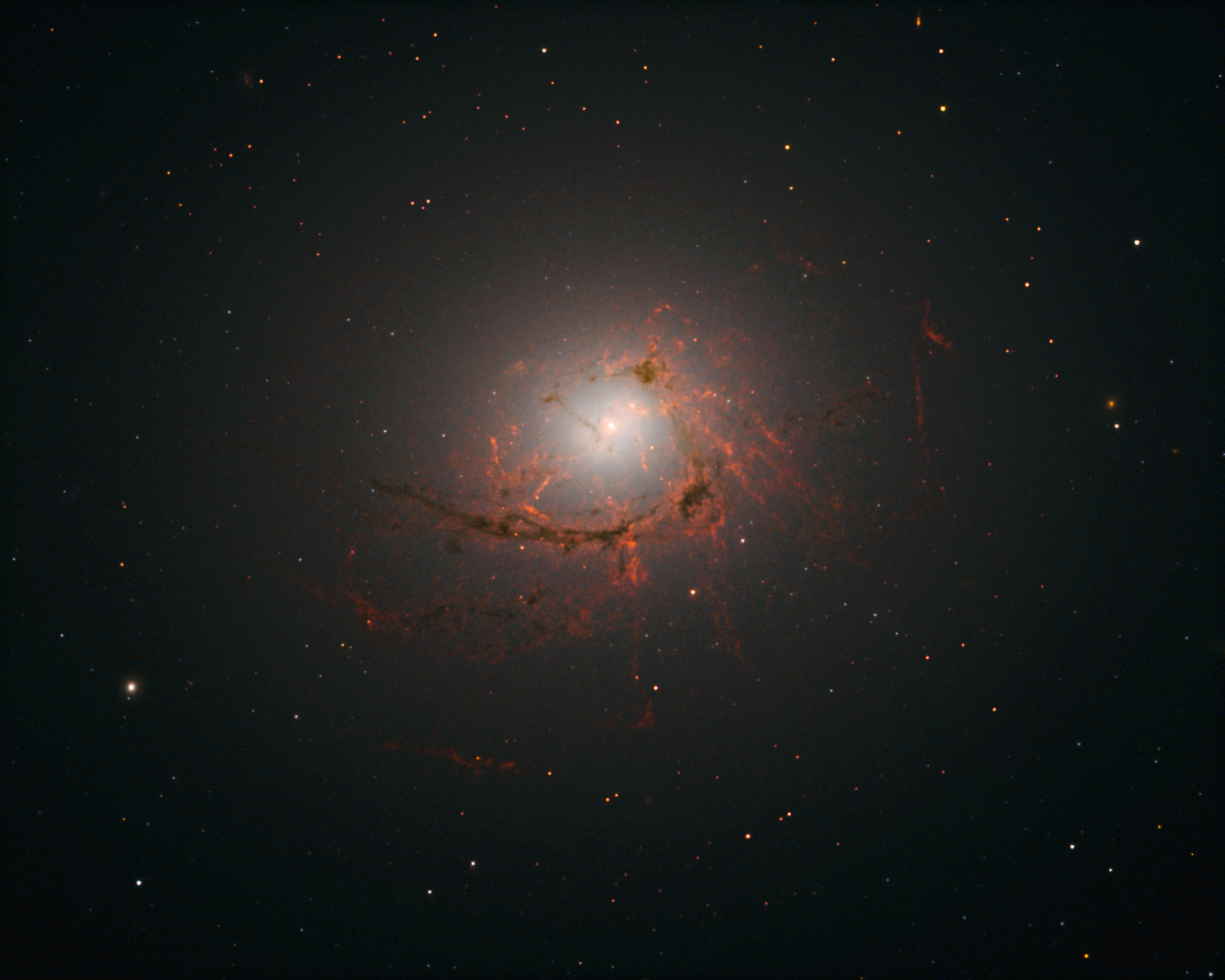
    This picture, taken by Hubble’s Wide Field Camera 3 (WFC3), shows NGC 4696, the largest galaxy in the Centaurus Cluster. The new images taken with Hubble show the dusty filaments surrounding the center of this huge galaxy in greater detail than ever before. These filaments loop and curl inwards in an intriguing spiral shape, swirling around the supermassive black hole at such a distance that they are dragged into and eventually consumed by the black hole itself.

    New images from Hubble reveal the intricate structure of the galaxy NGC 4696 in greater detail than ever before. The elliptical galaxy is a beautiful cosmic oddity with a bright core wrapped in a system of dark, swirling, thread-like filaments.

    NGC 4696 is a member of the Centaurus galaxy cluster, a swarm of hundreds of galaxies all sitting together, bound together by gravity, about 150 million light-years from Earth, and located in the constellation of Centaurus.

    Despite the cluster’s size, NGC 4696 still manages to stand out from its companions — it is the cluster’s brightest member, known for obvious reasons as the Brightest Cluster Galaxy. This puts it in the same category as some of the biggest and brightest galaxies known in the Universe.

    Even if NGC 4696 keeps impressive company, it has a further distinction: the galaxy’s unique structure. Previous observations have revealed curling filaments that stretch out from its main body and carve out a cosmic question mark in the sky, the dark tendrils encircling a brightly glowing center.

    An international team of scientists, led by astronomers from the University of Cambridge, UK, have now used new observations from the NASA/ESA Hubble Space Telescope to explore this thread-like structure in more detail. They found that each of the dusty filaments has a width of about 200 light-years, and a density some 10 times greater than the surrounding gas. These filaments knit together and spiral inwards towards the center of NGC 4696, connecting the galaxy’s constituent gas to its core.


    This video pans over NASA/ESA Hubble Space Telescope observations of the massive galaxy NGC 4696, which lies about 150 million light-years from Earth.

    In fact, it seems that the galaxy’s core is actually responsible for the shape and positioning of the filaments themselves. At the center of NGC 4696 lurks an active supermassive black hole. This floods the galaxy’s inner regions with energy, heating the gas there and sending streams of heated material outwards.

    It appears that these hot streams of gas bubble outwards, dragging the filamentary material with them as they go. The galaxy’s magnetic field is also swept out with this bubbling motion, constraining and sculpting the material within the filaments.

    At the very center of the galaxy, the filaments loop and curl inwards in an intriguing spiral shape, swirling around the supermassive black hole at such a distance that they are dragged into and eventually consumed by the black hole itself.

    Understanding more about filamentary galaxies such as NGC 4696 may help us to better understand why so many massive galaxies near to us in the Universe appear to be dead; rather than forming newborn stars from their vast reserves of gas and dust, they instead sit quietly and are mostly populated with old and aging stars. This is the case with NGC 4696. It may be that the magnetic structure flowing throughout the galaxy stops the gas from creating new stars.

    Never miss a breakthrough: Join the SciTechDaily newsletter.
    Follow us on Google and Google News.

    Astronomy Astrophysics Hubble Space Telescope Popular
    Share. Facebook Twitter Pinterest LinkedIn Email Reddit

    Related Articles

    The Universe’s Invisible Skeleton Is Finally Revealed

    Hubble’s Newest Discovery Isn’t a Star, It’s a Window Into the Dark Universe

    Astronomers Just Found a “Zombie Star” With a Shocking Backstory

    WASP-12 b, A Planet Being Consumed By Its Own Sun

    Hubble Views What Is Probably the Most Distant Known Galaxy

    New Study Revives Doubted Exoplanet Fomalhaut b

    Scientists Search for Quasar’s “Missing” Galaxy

    NASA Data Reveals Significant Changes in Exoplanet’s Atmosphere

    Lonestar Supercomputer Helps Explore Dark Matter

    Leave A Reply Cancel Reply

    • Facebook
    • Twitter
    • Pinterest
    • YouTube

    Don't Miss a Discovery

    Subscribe for the Latest in Science & Tech!

    Trending News

    Could Low Vitamin D Be Making Your Pain Worse?

    Scientists Discover Once-Weekly Workout That Melts Belly Fat Surprisingly Effectively

    Scientists Just Tested a Thruster Powerful Enough for Human Missions to Mars

    Doctors Say Your Ice Pack Might Be Making Injuries Worse

    Scientists Discover 43-Foot Sea Reptile Twice the Size of a Great White Shark

    Bees and Birds Are Drinking Alcohol From Flowers

    Scientists Discover How Obesity May Trigger Alzheimer’s Disease

    Scientists Confirm Alcohol Causes Widespread Health Damage

    Follow SciTechDaily
    • Facebook
    • Twitter
    • YouTube
    • Pinterest
    • Newsletter
    • RSS
    SciTech News
    • Biology News
    • Chemistry News
    • Earth News
    • Health News
    • Physics News
    • Science News
    • Space News
    • Technology News
    Recent Posts
    • Just Minutes of Intense Exercise Could Slash Disease Risk by 50%
    • People Who Stop Ozempic Often Don’t Gain the Weight Back
    • Why More People in Their 30s Are Suddenly Getting Colon Cancer
    • Scientists Discover Sperm Seem To Bypass a Fundamental Law of Physics
    • The Secret Behind Indigenous Andeans’ “Digestive Superpower” May Be Potatoes
    Copyright © 1998 - 2026 SciTechDaily. All Rights Reserved.
    • Science News
    • About
    • Contact
    • Editorial Board
    • Privacy Policy
    • Terms of Use

    Type above and press Enter to search. Press Esc to cancel.