
Close Menu
    Facebook X (Twitter) Instagram
    SciTechDaily
    • Biology
    • Chemistry
    • Earth
    • Health
    • Physics
    • Science
    • Space
    • Technology
    Facebook X (Twitter) Pinterest YouTube RSS
    SciTechDaily
    Home»Space»Hubble Views Two Festive-Looking Emission Nebulae
    Space

    Hubble Views Two Festive-Looking Emission Nebulae

    By Hubble Space TelescopeDecember 26, 2016No Comments3 Mins Read
    Facebook Twitter Pinterest Telegram LinkedIn WhatsApp Email Reddit
    Share
    Facebook Twitter LinkedIn Pinterest Telegram Email Reddit
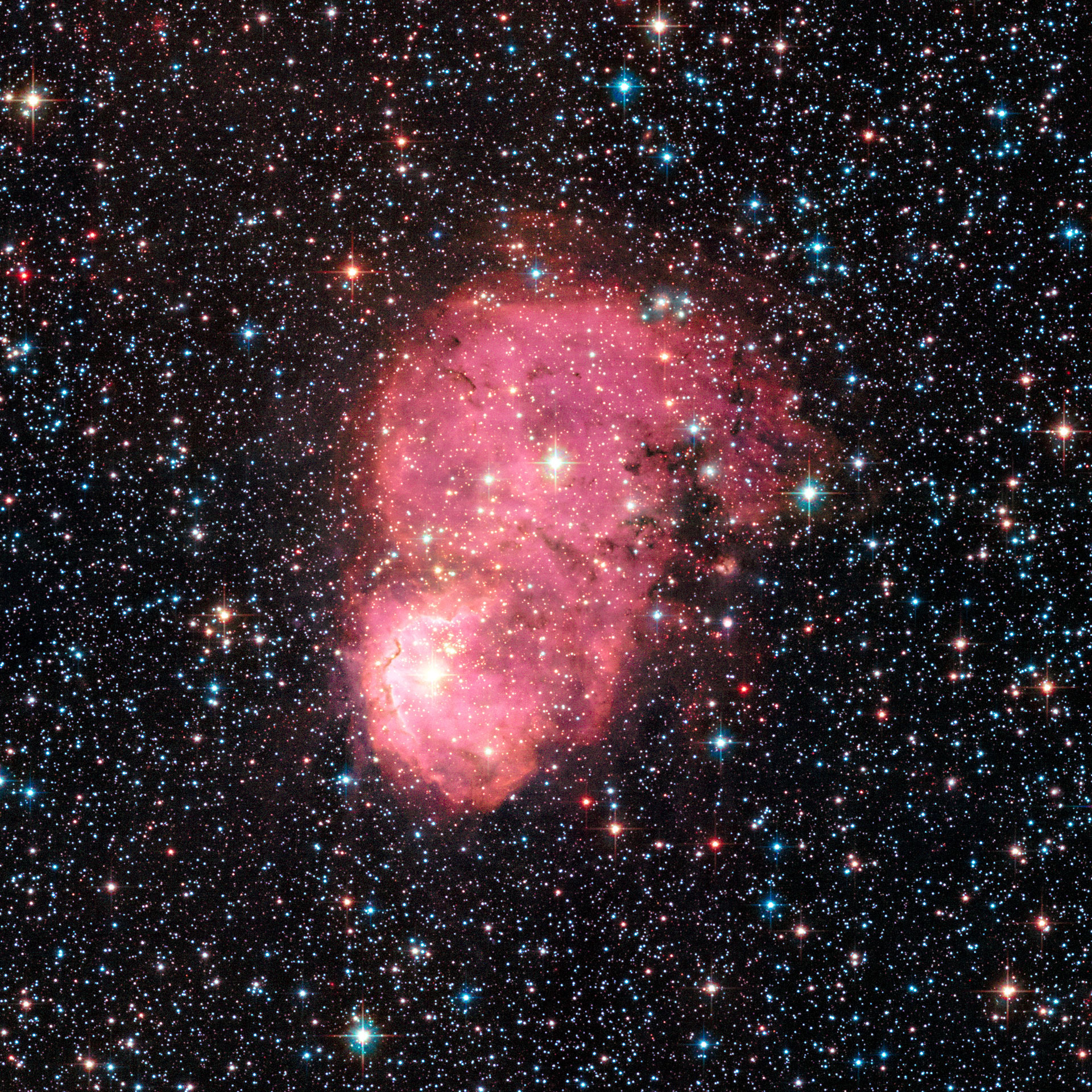
    Nebula NGC 248
    This glowing nebula, named NGC 248, is located within the Small Magellanic Cloud, a satellite galaxy of the Milky Way and about 200,000 light-years from Earth. The nebula was observed with Hubble’s Advanced Camera for Surveys in September 2015, as part of a survey called the Small Magellanic cloud Investigation of Dust and Gas Evolution (SMIDGE).

    The Hubble Space Telescope captured two festive-looking emission nebulae conjoined so they appear as one.

    The sheer observing power of the NASA/ESA Hubble Space Telescope is rarely better illustrated than in an image such as this. This glowing pink nebula, named NGC 248, is located in the Small Magellanic Cloud, just under 200,000 light-years away and yet can still be seen in great detail.

    Our home galaxy, the Milky Way, is part of a collection of galaxies known as the Local Group. Along with the Andromeda Galaxy, the Milky Way is one of the Group’s most massive members, around which many smaller satellite galaxies orbit. The Magellanic Clouds are famous examples, which can easily be seen with the naked eye from the southern hemisphere.

    Within the smaller of these satellite galaxies, the Small Magellanic Cloud, the NASA/ESA Hubble Space Telescope captured two festive-looking emission nebulae, conjoined so they appear as one. Intense radiation from the brilliant central stars is causing hydrogen in the nebulae to glow pink.

    Together the nebulae are called NGC 248. They were discovered in 1834 by the astronomer Sir John Herschel. NGC 248 is about 60 light-years long and 20 light-years wide. It is among a number of glowing hydrogen nebulae in the Small Magellanic Cloud, which lies in the southern constellation of Tucana (The Toucan), about 200,000 light-years away.


    This zoom video starts with a wide-field view of both the Small and the Large Magellanic Clouds before zooming into the emission nebula NGC 248, located on the southern end of the Small Magellanic Cloud, as it is seen with the NASA/ESA Hubble Space Telescope.

    The nebula was observed as part of a Hubble survey, the Small Magellanic cloud Investigation of Dust and Gas Evolution (SMIDGE). In this survey astronomers are using Hubble to probe the Small Magellanic Cloud to understand how its dust — an important component of many galaxies and related to star formation — is different from the dust in the Milky Way.

    Thanks to its relative proximity, the Small Magellanic Cloud is a valuable target. It also turns out to have only between a fifth and a tenth of the amount of heavy elements that the Milky Way has, making the dust similar to what we expect to see in galaxies in the earlier Universe.

    This allows astronomers to use it as a cosmic laboratory to study the history of the Universe in our cosmic backyard. These observations also help us to understand the history of our own galaxy as most of the star formation happened earlier in the Universe, at a time when the percentage of heavy elements in the Milky Way was much lower than it is now.

    The data used in this image were taken with Hubble’s Advanced Camera for Surveys in September 2015.

    Never miss a breakthrough: Join the SciTechDaily newsletter.
    Follow us on Google and Google News.

    Astronomy Astrophysics Cosmology Hubble Space Telescope
    Share. Facebook Twitter Pinterest LinkedIn Email Reddit

    Related Articles

    Astronomers Measure the Farthest Galaxy Ever Seen in the Universe

    Hubble Views Turbulent Birthing Ground Orion B Molecular Cloud Complex

    Hubble Uncovers the Blueprints of Our Galaxy’s Early Construction Phase

    Hubble Image of the Week: Quadruple Star System DI Cha

    ESO and Hubble Reveal Fast-Moving, Wave-Like Features in the Debris Disk Around AU Microscopii

    New Phoenix Cluster Observations Provide A Fresh Perspective

    Astronomers Discover Supernovae in ‘Wrong Place at Wrong Time’

    Hubble Reveals Diffusion of Stars Through the Core of the Globular Cluster 47 Tucanae

    Study Suggest Spiral Galaxies Are Larger Than Previously Thought

    Leave A Reply Cancel Reply

    • Facebook
    • Twitter
    • Pinterest
    • YouTube

    Don't Miss a Discovery

    Subscribe for the Latest in Science & Tech!

    Trending News

    First-of-Its-Kind Discovery: Homer’s Iliad Found Embedded in a 1,600-Year-Old Egyptian Mummy

    Beyond Inflammation: Scientists Uncover New Cause of Persistent Rheumatoid Arthritis

    A Simple Molecule Could Unlock Safer, Easier Weight Loss

    Scientists Just Built a Quantum Battery That Charges Almost Instantly

    Researchers Unveil Groundbreaking Sustainable Solution to Vitamin B12 Deficiency

    Millions of People Have Osteopenia Without Realizing It – Here’s What You Need To Know

    Researchers Discover Boosting a Single Protein Helps the Brain Fight Alzheimer’s

    World-First Study Reveals Human Hearts Can Regenerate After a Heart Attack

    Follow SciTechDaily
    • Facebook
    • Twitter
    • YouTube
    • Pinterest
    • Newsletter
    • RSS
    SciTech News
    • Biology News
    • Chemistry News
    • Earth News
    • Health News
    • Physics News
    • Science News
    • Space News
    • Technology News
    Recent Posts
    • Physicists Propose Strange Experiment Where Time Goes Quantum
    • Scientists Flip Immune System “Switch,” Uncover Surprising Path To Stop Gut Inflammation
    • Magnesium Magic: New Drug Melts Fat Even on a High-Fat, High-Sugar Diet
    • Weight-Loss Drugs Like Ozempic May Come With an Unexpected Cost
    • After Decades, MIT Researchers Capture the First 3D Atomic View of a Mysterious Material
    Copyright © 1998 - 2026 SciTechDaily. All Rights Reserved.
    • Science News
    • About
    • Contact
    • Editorial Board
    • Privacy Policy
    • Terms of Use

    Type above and press Enter to search. Press Esc to cancel.