

Close Menu
    Facebook X (Twitter) Instagram
    SciTechDaily
    • Biology
    • Chemistry
    • Earth
    • Health
    • Physics
    • Science
    • Space
    • Technology
    Facebook X (Twitter) Pinterest YouTube RSS
    SciTechDaily
    Home»Technology»IBM Supercomputer Simulates 530 Billion Neurons & 100 Trillion Synapses
    Technology

    IBM Supercomputer Simulates 530 Billion Neurons & 100 Trillion Synapses

    By SciTechDailyNovember 21, 2012No Comments2 Mins Read
    Facebook Twitter Pinterest Telegram LinkedIn WhatsApp Email Reddit
    Share
    Facebook Twitter LinkedIn Pinterest Telegram Email Reddit
    ibm-synapse-darpa
    DARPA’s SyNAPSE program, announced in 2008, aims to develop electronic neuromorphic technology—a brain simulation with cognitive computing architecture. It scales to biological levels with 10 billion neurons and 100 trillion synapses.

    At the Supercomputing 2012 conference last week, IBM Research-Almaden presented its next milestone towards fulfilling DARPA’s cognitive computing program, Systems of Neuromorphic Adaptive Plastic Scalable Electronics (SyNAPSE).

    DARPA’s SyNAPSE program was announced in 2008, and it calls for developing an electronic neuromorphic machine technology, which is basically a brain simulation that scales to biological levels using cognitive computing architecture with 10 billion neurons and 100 trillion synapses. These numbers are based on the number of estimated synapses and neurons in the human brain.
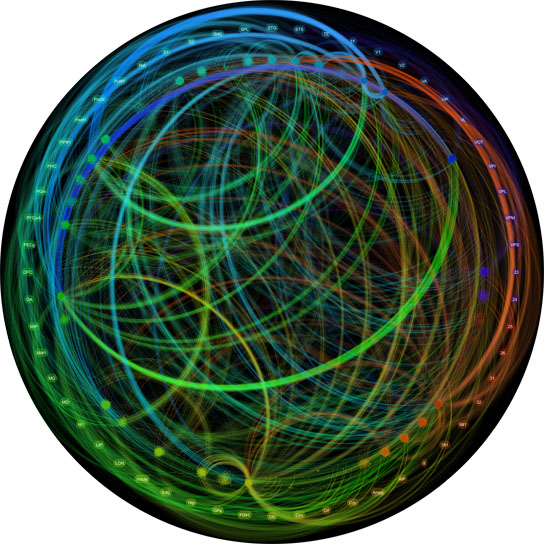
    A Network of Neurosynaptic Cores
    A network of neurosynaptic cores derived from long-distance wiring in the monkey brain: Neuro-synaptic cores are locally clustered into brain-inspired regions, and each core is represented as an individual point along the ring. Arcs are drawn from a source core to a destination core with an edge color defined by the color assigned to the source core. Credit: IBM

    IBM states that it was able to accomplish this using its TrueNorth system running on the world’s second fastest operating supercomputer, the Lawrence Livermore National Lab (LBNL) Blue Gene/Q Sequoia that uses 96 racks with 1,572,864 processor cores, 1.5 PB memory, 98,304 MPI processes and 6,291,456 threads.

    IBM and LBNL achieved a scale of 2.084 billion neurosynaptic cores containing 530 billion neurons and 100 trillion synapses running only 1542 times slower than in real time.

    There is no biologically realistic simulation of a complete human brain, explains the abstract of the SC12 paper. “Computation (‘neurons’), memory (‘synapses’), and communication (‘axons,’ ‘dendrites’) are mathematically abstracted away from biological detail toward engineering goals of maximizing function (utility, applications) and minimizing cost (power, area, delay) and design complexity of hardware implementation.”


    Join IBM’s Dharmendra Modha – Manager, Cognitive Computing Systems and Master Inventor – as he offers a glimpse of IBM Research’s efforts to develop a computer chip inspired by the human brain.

    Never miss a breakthrough: Join the SciTechDaily newsletter.
    Follow us on Google and Google News.

    DARPA IBM Neuroscience Supercomputing
    Share. Facebook Twitter Pinterest LinkedIn Email Reddit

    Related Articles

    Microwire Array Brings Silicon Computing Power to Brain Research and Prosthetics

    DARPA’s CT2WS Program Improves Target Detection

    Radio Telescope Square Kilometer Array Will be Powered by $43-Million IBM Supercomputer

    “Cheetah” Sets Legged Robot Land Speed Record

    Elastomeric “Soft” Robots Running on Pneumatic Actuators

    DARPA’s Legged Squad Support System (LS3) To Ease Physical Load on Troops

    DARPA’s HACMS Program Seeks to Create New Technology

    Researchers Designing Eye-Enhancing Virtual Reality Contact Lenses for Soldiers

    DARPA Seeks Researchers for PERFECT Program

    Leave A Reply Cancel Reply

    • Facebook
    • Twitter
    • Pinterest
    • YouTube

    Don't Miss a Discovery

    Subscribe for the Latest in Science & Tech!

    Trending News

    Your Blood Pressure Reading Could Be Wrong Because of One Simple Mistake

    Astronomers Stunned by Ancient Galaxy With No Spin

    Physicists May Be on the Verge of Discovering “New Physics” at CERN

    Scientists Solve 320-Million-Year Mystery of Reptile Skin Armor

    Scientists Say This Daily Walking Habit May Be the Secret to Keeping Weight Off After Dieting

    New Therapy Rewires the Brain To Restore Joy in Depression Patients

    Giant Squid Detected off Western Australia in Stunning Deep-Sea Discovery

    Popular Sugar-Free Sweetener Linked to Liver Disease, Study Warns

    Follow SciTechDaily
    • Facebook
    • Twitter
    • YouTube
    • Pinterest
    • Newsletter
    • RSS
    SciTech News
    • Biology News
    • Chemistry News
    • Earth News
    • Health News
    • Physics News
    • Science News
    • Space News
    • Technology News
    Recent Posts
    • Hidden Warm Water Beneath Antarctica Could Rapidly Raise Global Sea Levels
    • Scientists Revive Ancient Chemistry Trick To Engineer Next-Generation Glass
    • Scientists Use AI To Supercharge Ultrafast Laser Simulations by More Than 250x
    • Scientists Just Found a Surprising Way To Destroy “Forever Chemicals”
    • Popular Supplement Ingredient Linked to Shorter Lifespan in Men
    Copyright © 1998 - 2026 SciTechDaily. All Rights Reserved.
    • Science News
    • About
    • Contact
    • Editorial Board
    • Privacy Policy
    • Terms of Use

    Type above and press Enter to search. Press Esc to cancel.