
Close Menu
    Facebook X (Twitter) Instagram
    SciTechDaily
    • Biology
    • Chemistry
    • Earth
    • Health
    • Physics
    • Science
    • Space
    • Technology
    Facebook X (Twitter) Pinterest YouTube RSS
    SciTechDaily
    Home»Space»NASA’s Dawn Spacecraft Completes Primary Mission
    Space

    NASA’s Dawn Spacecraft Completes Primary Mission

    By Elizabeth Landau, Jet Propulsion LaboratoryJune 30, 2016No Comments2 Mins Read
    Facebook Twitter Pinterest Telegram LinkedIn WhatsApp Email Reddit
    Share
    Facebook Twitter LinkedIn Pinterest Telegram Email Reddit
    Dawn Completes Primary Mission
    NASA’s Dawn mission exceeded all expectations during its primary mission to Vesta and Ceres.

    NASA’s Dawn spacecraft completes its primary mission, exceeding all expectations.

    On June 30, just in time for the global celebration known as Asteroid Day, NASA’s Dawn spacecraft completes its primary mission. The mission exceeded all expectations originally set for its exploration of protoplanet Vesta and dwarf planet Ceres.

    The historic mission is the first to orbit two extraterrestrial solar system targets, and the first to orbit any object in the main asteroid belt, between Mars and Jupiter. On March 6, 2015, Dawn also became the first spacecraft to enter orbit around a dwarf planet.

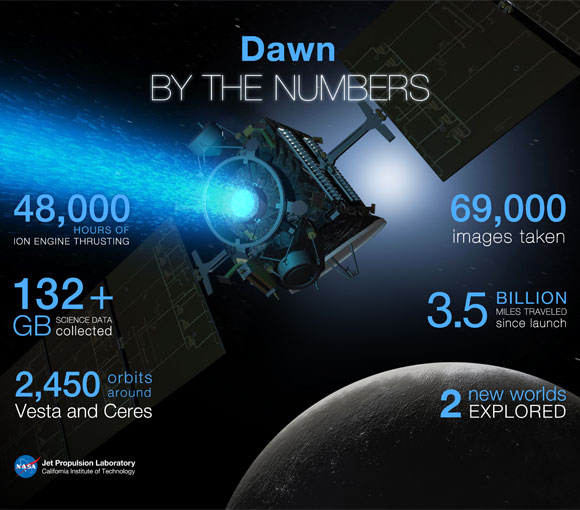
    An infographic highlights some of the accomplishments of Dawn’s journey since launching in September 2007. Dawn has traveled 3.5 billion miles (5.6 billion kilometers) since launch, and has made 2,450 orbits around Vesta and Ceres. The spacecraft has returned about 69,000 images, combined, of both bodies.

    Dawn’s advanced ion propulsion system made it possible for the spacecraft to orbit two targets in the main asteroid belt. The spacecraft has logged about 48,000 hours of ion engine thrusting.

    Scientists have learned a great deal about these unique, massive residents of the asteroid belt through data from the mission. Dawn has revealed that while Vesta is a dry body, Ceres could be as much as 25 percent water ice by mass. Dawn also discovered many intriguing features at both bodies – Vesta is home to a mountain whose height is more than twice that of Mount Everest, and Ceres has a crater called Occator with mysterious bright features that continue to spark scientific investigation.

    Never miss a breakthrough: Join the SciTechDaily newsletter.
    Follow us on Google and Google News.

    Astronomy Ceres Dawn Spacecraft NASA Planetary Science Vesta
    Share. Facebook Twitter Pinterest LinkedIn Email Reddit

    Related Articles

    NASA’s Dawn Spacecraft Delivers Sharper Images Ceres

    New NASA Video Highlights Dwarf Planet Ceres

    NASA’s Dawn Reveals Topography of Dwarf Planet Ceres

    Ceres Spots Remain a Mystery in Latest Dawn Images

    New Fly Over Video Shows a Unique Perspective of Ceres

    A New View of Ceres, Dawn Shows Finer Detail

    New Images by NASA’s Dawn Spacecraft Show Mysterious Bright Spots on Ceres

    Dawn Spacecraft Finds Traces of Water on Giant Asteroid Vesta

    NASA’s Dawn Mission Reveals Hydrated Minerals on Vesta

    Leave A Reply Cancel Reply

    • Facebook
    • Twitter
    • Pinterest
    • YouTube

    Don't Miss a Discovery

    Subscribe for the Latest in Science & Tech!

    Trending News

    Your Blood Pressure Reading Could Be Wrong Because of One Simple Mistake

    Astronomers Stunned by Ancient Galaxy With No Spin

    Physicists May Be on the Verge of Discovering “New Physics” at CERN

    Scientists Solve 320-Million-Year Mystery of Reptile Skin Armor

    Scientists Say This Daily Walking Habit May Be the Secret to Keeping Weight Off After Dieting

    New Therapy Rewires the Brain To Restore Joy in Depression Patients

    Giant Squid Detected off Western Australia in Stunning Deep-Sea Discovery

    Popular Sugar-Free Sweetener Linked to Liver Disease, Study Warns

    Follow SciTechDaily
    • Facebook
    • Twitter
    • YouTube
    • Pinterest
    • Newsletter
    • RSS
    SciTech News
    • Biology News
    • Chemistry News
    • Earth News
    • Health News
    • Physics News
    • Science News
    • Space News
    • Technology News
    Recent Posts
    • Scientists Discover “Hidden” Materials That Could Transform Clean Energy and Batteries
    • Scientists Just Measured an Energy Pulse Smaller Than a Trillionth of a Billionth of a Joule
    • 540-Million-Year-Old Fossils Reveal a Huge Surprise About Early Life on Earth
    • Scientists Create “Living” Materials That Crawl, Walk, and Dig on Their Own
    • Dante’s Inferno May Secretly Be About a Planet-Destroying Asteroid Strike
    Copyright © 1998 - 2026 SciTechDaily. All Rights Reserved.
    • Science News
    • About
    • Contact
    • Editorial Board
    • Privacy Policy
    • Terms of Use

    Type above and press Enter to search. Press Esc to cancel.