
Close Menu
    Facebook X (Twitter) Instagram
    SciTechDaily
    • Biology
    • Chemistry
    • Earth
    • Health
    • Physics
    • Science
    • Space
    • Technology
    Facebook X (Twitter) Pinterest YouTube RSS
    SciTechDaily
    Home»Space»NASA’s SDO Views Earth and the Moon Transiting the Sun
    Space

    NASA’s SDO Views Earth and the Moon Transiting the Sun

    By Sarah Frazier, NASA's Goddard Space Flight CenterSeptember 15, 2015No Comments3 Mins Read
    Facebook Twitter Pinterest Telegram LinkedIn WhatsApp Email Reddit
    Share
    Facebook Twitter LinkedIn Pinterest Telegram Email Reddit

    NASA’s Solar Dynamics Observatory captured images of Earth and the moon as they crossed the sun. Just before the moon entered the shot, Earth blocked SDO’s view completely. By the time SDO had a clear view again, the moon was just completing its journey across the sun’s face.

    On September 13, 2015, as NASA’s Solar Dynamics Observatory, or SDO, kept up its constant watch on the sun, its view was photobombed not once, but twice. Just as the moon came into SDO’s field of view on a path to cross the sun, Earth entered the picture, blocking SDO’s view completely. When SDO’s view of the sun emerged from Earth’s shadow, the moon was just completing its journey across the sun’s face.

    Though SDO sees dozens of Earth eclipses and several lunar transits each year, this is the first time ever that the two have coincided. This alignment of the sun, moon, and Earth also resulted in a partial solar eclipse on September 13, visible only from parts of Africa and Antarctica.
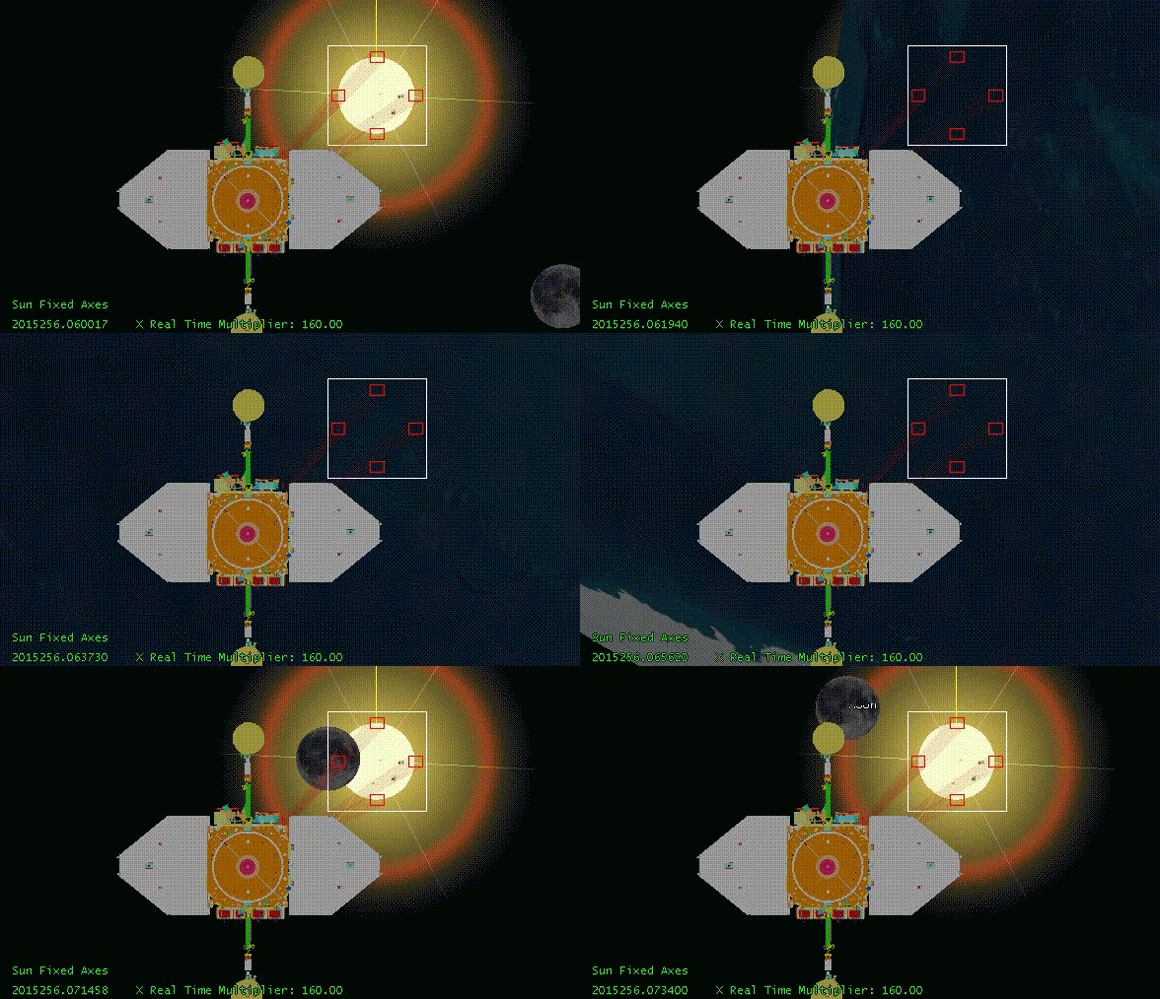
    NASA's SDO Catches a Double Photobomb
    This animation shows the relative movement of Earth and the moon as they both crossed SDO’s field of view on September 13, 2015. Just as the moon came into SDO’s field of view on a path to cross the sun, Earth entered the picture, blocking SDO’s view completely. When SDO’s orbit finally emerged from behind Earth, the moon was just completing its journey across the sun’s face. Credit: NASA/SDO

    SDO’s orbit usually gives us unobstructed views of the sun, but Earth’s revolution around the sun means that SDO’s orbit passes behind Earth twice each year, for two to three weeks at a time. During these phases, Earth blocks SDO’s view of the sun for anywhere from a few minutes to over an hour once each day.
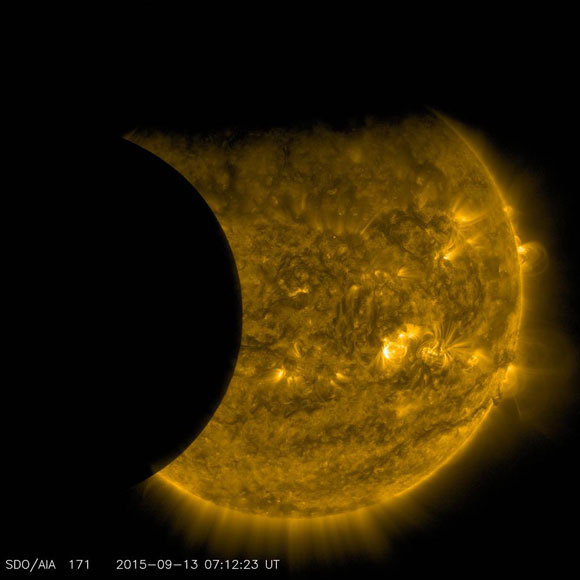
    SDO Views Earth and the Moon Transiting the Sun
    NASA’s Solar Dynamics Observatory captured this image of Earth and the moon transiting the sun together on September 13, 2015. The edge of Earth, visible near the top of the frame, appears fuzzy because Earth’s atmosphere blocks different amounts of light at different altitudes. On the left, the moon’s edge is perfectly crisp, because it has no atmosphere. This image was taken in extreme ultraviolet wavelengths of 171 angstroms. Though this light is invisible to our eyes, it is typically colorized in gold. Credit: NASA/SDO

    You may notice that Earth’s outline looks fuzzy, while the moon’s is crystal-clear. This is because—while the planet itself completely blocks the sun’s light—Earth’s atmosphere is an incomplete barrier, blocking different amounts of light at different altitudes. On the other hand, the moon has no atmosphere, so during the transit we can clearly see the crisp edges of the moon’s horizon.

    Never miss a breakthrough: Join the SciTechDaily newsletter.
    Follow us on Google and Google News.

    Astronomy Moon NASA NASA Goddard Space Flight Center Planetary Science Solar Dynamics Observatory
    Share. Facebook Twitter Pinterest LinkedIn Email Reddit

    Related Articles

    NASA’s Solar Dynamics Observatory Spots First Lunar Transit of 2021

    NASA Spacecraft Confirms Existence of Neon in Lunar Atmosphere

    GRAIL Mission Provides New Insight into How the Moon Got Its “Face”

    LADEE Mission To Study Mysterious Lunar Twilight Rays

    Hubble Data Reveals a New Neptune Moon

    NASA’s TWINS Provide Continuous Coverage of the Ring Current

    NASA’s Lunar Program Detects Bright Explosion on the Moon

    Io’s Volcanoes Are Not Located Where Scientists Expected

    A Closer Look at Titan’s Chemical Production

    Leave A Reply Cancel Reply

    • Facebook
    • Twitter
    • Pinterest
    • YouTube

    Don't Miss a Discovery

    Subscribe for the Latest in Science & Tech!

    Trending News

    Artificial Sweeteners May Harm Future Generations, Study Suggests

    Splashdown! NASA Artemis II Returns From Record-Breaking Moon Mission

    What If Consciousness Exists Beyond Your Brain

    Scientists Finally Crack the 100-Million-Year Evolutionary Mystery of Squid and Cuttlefish

    Beyond “Safe Levels”: Study Challenges What We Know About Pesticides and Cancer

    Researchers Have Found a Dietary Compound That Increases Longevity

    Scientists Baffled by Bizarre “Living Fossil” From 275 Million Years Ago

    Your IQ at 23 Could Predict Your Wealth at 27, Study Finds

    Follow SciTechDaily
    • Facebook
    • Twitter
    • YouTube
    • Pinterest
    • Newsletter
    • RSS
    SciTech News
    • Biology News
    • Chemistry News
    • Earth News
    • Health News
    • Physics News
    • Science News
    • Space News
    • Technology News
    Recent Posts
    • What if Dark Matter Has Two Forms? Bold New Hypothesis Could Explain a Cosmic Mystery
    • Researchers Expose Hidden Chemistry of “Ore-Forming” Elements in Biology
    • Geologists Reveal the Americas Collided Earlier Than We Thought
    • 20x Difference: Study Reveals True Source of Airborne Microplastics
    • Scientists Uncover Hidden Force Powering Yellowstone’s Supervolcano
    Copyright © 1998 - 2026 SciTechDaily. All Rights Reserved.
    • Science News
    • About
    • Contact
    • Editorial Board
    • Privacy Policy
    • Terms of Use

    Type above and press Enter to search. Press Esc to cancel.