
Close Menu
    Facebook X (Twitter) Instagram
    SciTechDaily
    • Biology
    • Chemistry
    • Earth
    • Health
    • Physics
    • Science
    • Space
    • Technology
    Facebook X (Twitter) Pinterest YouTube RSS
    SciTechDaily
    Home»Space»New Horizons Reveals Methane Ice on Pluto
    Space

    New Horizons Reveals Methane Ice on Pluto

    By SciTechDailyJuly 17, 2015No Comments2 Mins Read
    Facebook Twitter Pinterest Telegram LinkedIn WhatsApp Email Reddit
    Share
    Facebook Twitter LinkedIn Pinterest Telegram Email Reddit
    New Horizons Reveals an Abundance of Methane Ice on Pluto
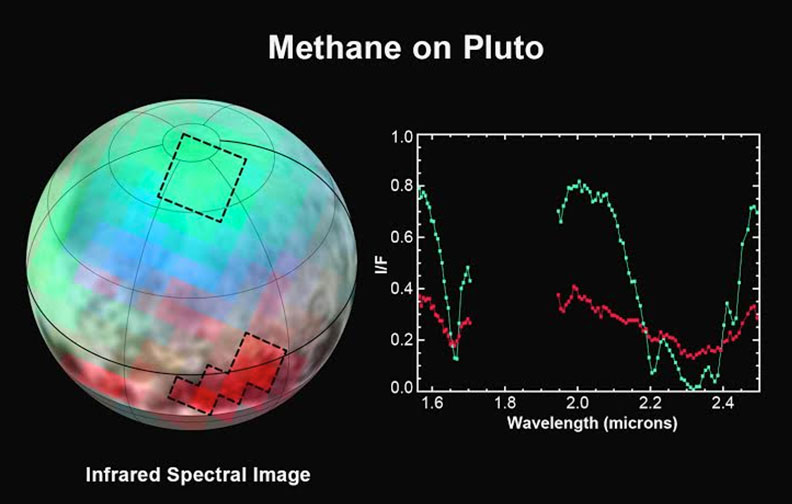
    The latest spectra from the Ralph instrument reveals an abundance of methane ice with striking differences from place to place across the frozen surface of Pluto. Credit: NASA-JHUAPL-SwRI

    As data from New Horizons continues to come in, the latest spectra from the Ralph instrument reveals an abundance of methane ice with striking differences from place to place across the frozen surface of Pluto.

    “We just learned that in the north polar cap, methane ice is diluted in a thick, transparent slab of nitrogen ice resulting in strong absorption of infrared light,” said New Horizons co-investigator Will Grundy, Lowell Observatory, Flagstaff, Arizona. In one of the visually dark equatorial patches, the methane ice has shallower infrared absorptions indicative of a very different texture. “The spectrum appears as if the ice is less diluted in nitrogen,” Grundy speculated “or that it has a different texture in that area.”

    An Earthly example of different textures of a frozen substance: a fluffy bank of clean snow is bright white, but compacted polar ice looks blue. New Horizons’ surface composition team, led by Grundy, has begun the intricate process of analyzing Ralph data to determine the detailed compositions of the distinct regions on Pluto.

    This is the first detailed image of Pluto from the Linear Etalon Imaging Spectral Array, part of the Ralph instrument on New Horizons. The observations were made at three wavelengths of infrared light, which are invisible to the human eye. In this picture, blue corresponds to light of wavelengths 1.62 to 1.70 micrometers, a channel covering a medium-strong absorption band of methane ice, green (1.97 to 2.05 micrometers) represents a channel where methane ice does not absorb light, and red (2.30 to 2.33 micrometers) is a channel where the light is very heavily absorbed by methane ice. The two areas outlined on Pluto show where Ralph observations obtained the spectral traces at the right. Note that the methane absorptions (notable dips) in the spectrum from the northern region are much deeper than the dips in the spectrum from the dark patch. The Ralph data were obtained by New Horizons on July 12, 2015.

    Never miss a breakthrough: Join the SciTechDaily newsletter.
    Follow us on Google and Google News.

    Astronomy Methane NASA New Horizons Planetary Science Pluto
    Share. Facebook Twitter Pinterest LinkedIn Email Reddit

    Related Articles

    New Horizons Reveals Signs of Pluto’s Geology

    NASA’s New Horizons Pluto Flyby Begins

    New Horizons Reflectance and Color Map of Pluto

    The Latest New Horizons Images of Dwarf Planet Pluto

    Dwarf Planet Pluto: The ‘Other’ Red Planet

    New Horizons Spacecraft Reveals Series of Spots on Pluto That Fascinate

    New Horizons Spacecraft Awakens for Encounter with Pluto System

    New ScienceCast Video Previews What New Horizons May See on Pluto

    New ScienceCast Video – Countdown to Pluto

    Leave A Reply Cancel Reply

    • Facebook
    • Twitter
    • Pinterest
    • YouTube

    Don't Miss a Discovery

    Subscribe for the Latest in Science & Tech!

    Trending News

    Common Osteoporosis Drugs Linked to Lower Alzheimer’s Risk in 120,000-Person Study

    Scientists Used Cancer Therapy To Reset Rheumatoid Arthritis

    Scientists Detect a Mysterious Signal That Could Be Dark Matter

    New Tick-Borne Virus May Explain Mysterious Cases of Severe Illness

    Your Brain Cleans Itself While You Sleep – Scientists Just Discovered How Fast

    Cancer Is Quantum – and That Could Change How We Treat It

    A Cosmic Catastrophe May Have Turned Neptune’s Ancient Moons Inside Out

    One of Earth’s Driest Deserts Just Turned White

    Follow SciTechDaily
    • Facebook
    • Twitter
    • YouTube
    • Pinterest
    • Newsletter
    • RSS
    SciTech News
    • Biology News
    • Chemistry News
    • Earth News
    • Health News
    • Physics News
    • Science News
    • Space News
    • Technology News
    Recent Posts
    • Brazilian Tree Compounds Fight COVID-19 on Multiple Fronts
    • Scientists Reveal Who Really Benefits From a Heart Calcium Scan
    • What Really Disappears When You Lose Weight on GLP-1 Drugs?
    • Nickel Catalysts Don’t Work the Way Scientists Thought
    • A Material Just a Few Atoms Thick Reveals Strange New Magnetism
    Copyright © 1998 - 2026 SciTechDaily. All Rights Reserved.
    • Science News
    • About
    • Contact
    • Editorial Board
    • Privacy Policy
    • Terms of Use

    Type above and press Enter to search. Press Esc to cancel.