
Close Menu
    Facebook X (Twitter) Instagram
    SciTechDaily
    • Biology
    • Chemistry
    • Earth
    • Health
    • Physics
    • Science
    • Space
    • Technology
    Facebook X (Twitter) Pinterest YouTube RSS
    SciTechDaily
    Home»Space»New NASA Image Reveals Frosty Slopes on Mars
    Space

    New NASA Image Reveals Frosty Slopes on Mars

    By NASADecember 23, 20143 Comments1 Min Read
    Facebook Twitter Pinterest Telegram LinkedIn WhatsApp Email Reddit
    Share
    Facebook Twitter LinkedIn Pinterest Telegram Email Reddit
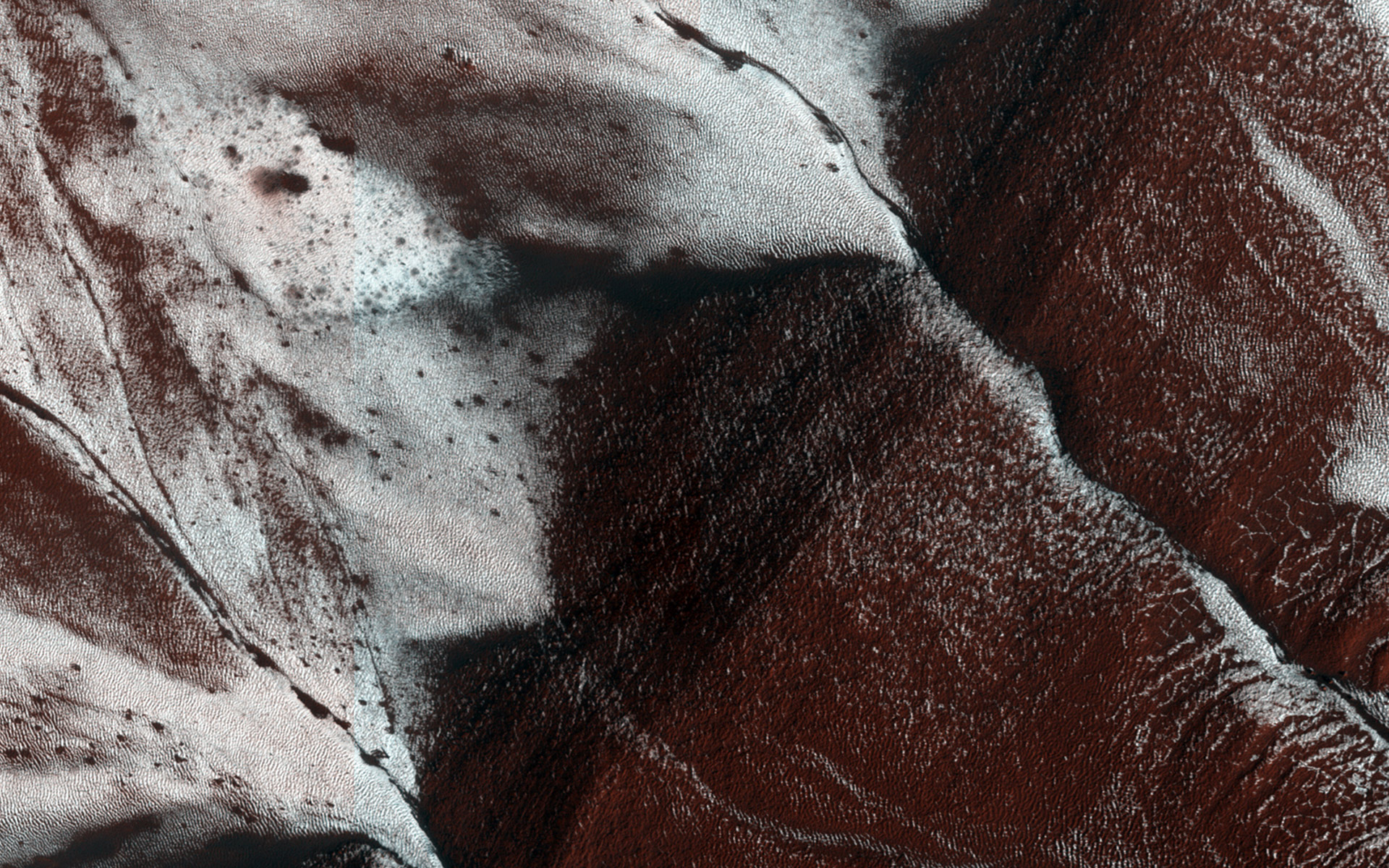
    NASA Shows Frosty Slopes on Mars
    The image reveals frosted gullies on a south-facing slope within a crater on Mars. Credit: NASA/JPL-Caltech/University of Arizona

    This newly released NASA image shows an area on the surface of Mars (approximately 1.5 by 3 kilometers or 0.9 by 1.9 miles in size) with frosted gullies on a south-facing slope within a crater.

    At this time of year, only south-facing slopes retain the frost, while the north-facing slopes have melted. Gullies are not the only active geologic process going on here. A small crater is visible at the bottom of the slope.

    The image was acquired on November 30, 2014, by the High Resolution Imaging Science Experiment (HiRISE) camera, one of six instruments on NASA’s Mars Reconnaissance Orbiter. The University of Arizona, Tucson, operates HiRISE, which was built by Ball Aerospace & Technologies Corp., Boulder, Colorado. NASA’s Jet Propulsion Laboratory, a division of the California Institute of Technology in Pasadena, manages the Mars Reconnaissance Orbiter Project for NASA’s Science Mission Directorate, Washington.


    Never miss a breakthrough: Join the SciTechDaily newsletter.
    Follow us on Google and Google News.

    Astronomy Mars Planetary Science
    Share. Facebook Twitter Pinterest LinkedIn Email Reddit

    Related Articles

    Researchers Found a Surprisingly Realistic Way To Mine Asteroids for Mars

    An Unexpected Planetary Neighbor May Play a Surprising Role in Earth’s Climate Cycles

    New Clues Suggest Mars Once Had a Vast Northern Ocean

    Mystery Ozone Surge Discovered in Mars’s Winter Darkness

    Perseverance Rover Captures Elusive Martian Aurora for a Second Time

    NASA’s Curiosity Readies for First Drive on Mars

    Color HiRISE Image of Curiosity Rover on Mars

    First 360-Degree Color Panorama From NASA’s Curiosity Mars Rover

    A Connection Between Volatiles in the Subsurface of Mars and the Impact Process

    3 Comments

    1. Rich on December 23, 2014 12:29 pm

      Is the frost water or carbon dioxide?

      Reply
      • Phil on December 24, 2014 7:29 pm

        96% of the Martian atmosphere is Carbon Dioxide, and 2% Argon and 2% Nitrogen with trace amounts of Oxygen and Carbon Monoxide which both are in the .0 figures. Any frost would (i suspect) be also in those figures per square mile. There is a lack of H20 on Mars (water) so no the frost is mainly Carbon Dioxide. Merry Christmas.

        Reply
    2. Martianice on December 23, 2014 1:12 pm

      I hope that Frosty the Martian has a compass to extend his lifespan. Pole-facing slopes have orientations such that they do not receive as much sunlight as equator-facing slope, which receive the most sunlight. If you live where it snows regularly you should be able to relate to this. Have you noticed that it takes a lot longer for snow and ice to melt on the north side of structures like apartments and homes (in the norther hemispheres). In the norther hemisphere, pole-facing would be north facing, but, in the souther hemisphere, pole-facing would be south facing. The same deal on Mars.

      Reply
    Leave A Reply Cancel Reply

    • Facebook
    • Twitter
    • Pinterest
    • YouTube

    Don't Miss a Discovery

    Subscribe for the Latest in Science & Tech!

    Trending News

    The Strange “Spacetime Crystal” That Can Suddenly Turn Into a Black Hole

    The Surprising Way Asteroids May Have Helped Life Begin on Earth

    Vast Hidden Structure Discovered Under Miles of Ice in East Antarctica

    A Surprising Discovery Suggests Autism Is Not One Condition

    New Alzheimer’s Discovery Could Change How Scientists Fight the Disease

    Yale Discovery Overturns Long-Held “Evolutionary Dead End” Theory

    UCLA Scientists Uncover a “Hidden Weakness” in Some of the World’s Deadliest Cancers

    Humpback Whale Stuns Scientists With 15,000 Kilometer Journey Across Oceans

    Follow SciTechDaily
    • Facebook
    • Twitter
    • YouTube
    • Pinterest
    • Newsletter
    • RSS
    SciTech News
    • Biology News
    • Chemistry News
    • Earth News
    • Health News
    • Physics News
    • Science News
    • Space News
    • Technology News
    Recent Posts
    • Scientists Discover a Biological Clock Unlike Anything Seen Before
    • This “Zombie” Sea Creature Keeps Growing After Being Cut Apart
    • The Brain May Not Need Full Sleep To Recover, New Research Finds
    • Scientists Reveal the Hidden Way Caffeine Sabotages Sleep
    • Your Gut Microbes May Decide How Many Calories You Really Absorb
    Copyright © 1998 - 2026 SciTechDaily. All Rights Reserved.
    • Science News
    • About
    • Contact
    • Editorial Board
    • Privacy Policy
    • Terms of Use

    Type above and press Enter to search. Press Esc to cancel.