
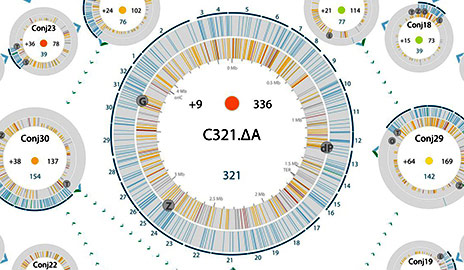
For the first time, scientists have fundamentally changed the genetic code of an organism, raising the possibility that researchers might be able to retool nature and create potent new forms of proteins to combat disease.
Scientists from Yale and Harvard have recoded the entire genome of an organism and improved a bacterium’s ability to resist viruses, a dramatic demonstration of the potential of rewriting an organism’s genetic code.
“This is the first time the genetic code has been fundamentally changed,” said Farren Isaacs, assistant professor of molecular, cellular, and developmental biology at Yale and co-senior author of the research published October 18 in the journal Science. “Creating an organism with a new genetic code has allowed us to expand the scope of biological function in a number of powerful ways.”
The creation of a genomically recoded organism raises the possibility that researchers might be able to retool nature and create potent new forms of proteins to accomplish myriad purposes — from combating disease to generating new classes of materials.
The research — headed by Isaacs and co-author George Church of Harvard Medical School — is a product of years of studies in the emerging field of synthetic biology, which seeks to re-design natural biological systems for useful purposes.
In this case, the researchers changed the fundamental rules of biology.
Proteins, which are encoded by DNA’s instructional manual and are made up of 20 amino acids, carry out many important functional roles in the cell. Amino acids are encoded by the full set of 64 triplet combinations of the four nucleic acids that comprise the backbone of DNA. These triplets (sets of three nucleotides) are called codons and are the genetic alphabet of life.
Isaacs, Jesse Rinehart of Yale, and the Harvard researchers explored whether they could expand upon nature’s handiwork by substituting different codons or letters throughout the genome and then reintroducing entirely new letters to create amino acids not found in nature. This work marks the first time that the genetic code has been completely changed across an organism’s genome.
In the new study, the researchers working with E. coli swapped a codon and eliminated its natural stop sign that terminates protein production. The new genome enabled the bacteria to resist viral infection by limiting the production of natural proteins used by viruses to infect cells. Isaacs — working with Marc Lajoie of Harvard, Alexis Rovner of Yale, and colleagues — then converted the “stop” codon into one that encodes new amino acids and inserted it into the genome in a plug-and-play fashion.
The work now sets the stage to convert the recoded bacterium into a living foundry, capable of biomanufacturing new classes of “exotic” proteins and polymers. These new molecules could lay the foundation for a new generation of materials, nanostructures, therapeutics, and drug delivery vehicles, Isaacs said.
“Since the genetic code is universal, it raises the prospect of recoding genomes of other organisms,” Isaacs said. “This has tremendous implications in the biotechnology industry and could open entirely new avenues of research and applications.”
Other participating researchers from Yale University are Hans Aerni and Adrian Haimovich.
Reference: “Genomically Recoded Organisms Expand Biological Functions” by Marc J. Lajoie, Alexis J. Rovner, Daniel B. Goodman, Hans-Rudolf Aerni, Adrian D. Haimovich, Gleb Kuznetsov, Jaron A. Mercer, Harris H. Wang, Peter A. Carr, Joshua A. Mosberg, Nadin Rohland, Peter G. Schultz, Joseph M. Jacobson, Jesse Rinehart, George M. Church and Farren J. Isaacs, 18 October 2013, Science.
DOI: 10.1126/science.1241459
Never miss a breakthrough: Join the SciTechDaily newsletter.
Follow us on Google and Google News.
16 Comments
Wow, these are interesting times. This has vast potential, both in aiding our species and wiping it out. When the first bacteria they work on is rendered virally immune, we can only hope that this sort of thing doesn’t come back to haunt us. Massive implications…not all good.
Sailing west from Spain in 1492 did not seem like a grand idea at the time. Talk about massive implications !
They just had to choose something like E. Coli bacteria to experiment on didn’t they. Instead of using something relatively harmless they chose something that could potentially end up being what wipes out mankind because they genetically engineer it to be impervious to any form of treatment. Idiotic in my mind. Whoever funded the research along with the idiot scientist that decided to use a potentially deadly strain of bacteria should be shot and their research specific to the E. Coli bacteria destroyed. Yes, the research has profound implications for medical use and development of vastly superior new materials. However, who do you think will control those new materials? It certainly won’t be struggling middleclass citizens of any country. They will be solely controlled by elite members of corporations along with mutually interested tyrannical government officials. Then it will be used to perpetrate even stricter, more efficient means of control over the masses. I fear for seeing how this research is applied and what it is applied to.
Speaking of “Taken out and shot”…E.Coli is relatively harmless, dolt. Your colon full of it- you more than most. You’re thinking of a specific strain of E. coli that’s picked up a shiga toxin gene, 0157:H7. Technically, *any* bacteria can do that, it’s called horizontal gene transfer. Go read….and see about some meds for that paranoid schizophrenia you have coming on.
Re: “substituting different codons or letters throughout the genome and then reintroducing entirely new letters to create amino acids not found in nature.”
…That’s now how things work either; you don’t “create” amino acids with gene code. There’s other amino acids out there (which means by definition, they’re “found in nature”) …but you have to have both the codon, and the tRNA anticodon to bring it. I’m not seeing it; got a hunch you’re misreporting this one. http://en.wikipedia.org/wiki/Expanded_genetic_code
This is an incredibly ignorant criticism. Most strands of E.Coli are completely harmless, and it naturally occurs in the gut of most warm-blooded animals.
The E.coli strain they chose IS harmless.
First, 99.99999% of E. Coli Strains are harmless.
Second, did you read the article? Scientists made the bacteria more resistant to viral infection and disease, but not resistant to standard treatment.
WOW Logan, guess you are REALLY ignorant. I don’t expect everyone who comments here to be experts or even have a trace of knowledge in biology and virology but you just raised this to another level. Really how dumb are you? E coli is harmless in most forms and you are thinking of the few cases where it harms people, and honestly E coli is not something to be very scared of even if it was weaponized (which is pretty easy to do). There are tons of other weaponized strains of bacterias and viruses like weaponized anthrax, measles, influenza etc etc. Honestly these strains have been around for a while but they are kept in a very tight vault and have virtually no chance of getting out. so as for your conspiracy theory of these weaponized strains being develop to keep the masses in check, that’s just your uneducated brain talking. Just turn that side of your brain off, or you can do us a favor and do what you suggested these scientist to do.
You would think people would google a bit of this stuff before posting something ignorant. E. coli has been used extensively in biology. It is an model organism and believe or not you have E. coli in your gut. Harmless bacteria? This is probably the most harmless you can use because of how extensively E. coli has been studied.
Logan, they chose E. coli because it is the bacteriological equivalent of the white lab rat. It is the safest, most studied and understood bacterial species. Your intestines are full of E. coli at this minute. What species would you suggest as being safer?
what a powerful concept.
And frightening.
And since all life seems to have a one time start at the Cambrian Explosion, the current being merely variations on a theme, I wonder if our tinkering will actually be a GO.
Or if this can actually reproduce on its own, for how long?
Introducing a life without the support of nature seems inadequately supported.
I theorize in SUN FLAKES ARE COMING (google drive) that our sun with its incomplete magnetic reversals provide extended energy for the period of the pending but incomplete magnetic reversal. Once the reversal completes the energy levels return to normal. Perhaps this creation can only survive in this temporary high energy environment? And will fail to thrive in the period after magnetic reversal? And perhaps leave us with the much feared myth memory of something akin to gargoyles?
Frankenstein…Jurassic Park…
I thought ‘Synthia’ was ancient news? Those pesky scientists must be raking through the ashes for some more Halloween scare
Cool, great advances in science, I wonder why people are not appreciating it and rather doing the opposite. This has so much applications in the medical field, it could save many lives someday if enough research is done.
E-Coli, the laboratory mice in biology, was already experimented and altered with its gene to produce human insulin in pure form, which was earlier produced from pig , the closest to humans for producing human pig insulin by altering its liver with human genes. The insulin was extracted from pig’s milk then. In E-Coli, human insulin is produced directly out in the test tube. Now E-coli , which should be thanked is used for producing miracle proteins to resist viral multiplication by altering its codon in different ways to try new proteins and enzymes. The formation of an organism with new genetic code will not create any Frankenstein, if ignorant people imagine that way.Thank You.
All those idiots are going to majorly screw us over some day, probably in the not too distant future. It’s a miracle it hasn’t happened yet, and maybe it has a few times, just not on a worldwide pandemic end-of-the-world basis.