
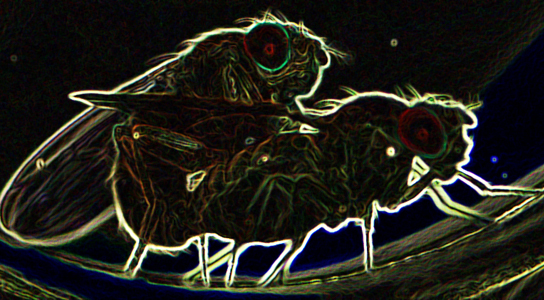
While studying male fruit flies, researchers discovered that sexually deprived flies will consume more alcohol than sexually satisfied male flies and that the flies’ behavior changes as the levels of neuropeptide F in the brain change.
Sexually deprived male fruit flies exhibit a pattern of behavior that seems ripped from the pages of a sad-sack Raymond Carver story: when female fruit flies reject their sexual advances, the males are driven to excessive alcohol consumption, drinking far more than comparable, sexually satisfied male flies.
Now a group of scientists at the University of California, San Francisco (UCSF) has discovered that a tiny molecule in the fly’s brain called neuropeptide F governs this behavior—as the levels of the molecule change in their brains, the flies’ behavior changes as well.
The new work may help shed light on the brain mechanisms that make social interaction rewarding for animals and those that underlie human addiction. A similar human molecule, called neuropeptide Y, may likewise connect social triggers to behaviors like excessive drinking and drug abuse. Adjusting the levels of neuropeptide Y in people may alter their addictive behavior—which is exactly what the UCSF team observed in the fruit flies.
“If neuropeptide Y turns out to be the transducer between the state of the psyche and the drive to abuse alcohol and drugs, one could develop therapies to inhibit neuropeptide Y receptors,” said Ulrike Heberlein, PhD, a Professor of Anatomy and Neurology at UCSF, who led the research.
Clinical trials are underway, she added, to test whether delivery of neuropeptide Y can alleviate anxiety and other mood disorders as well as obesity.
A Reward Switch in the Brain
The experiments, described this week in the journal Science, started with male fruit flies placed in a container with either virgin female flies or female flies that had already mated. While virgin females readily mate and are receptive toward courting males, once they have mated, female flies lose their interest in sex for a time because of the influence of a substance known as sex peptide, which males inject along with sperm at the culmination of the encounter. This causes them to reject the advances of the male flies.
The rejected males then gave up trying to mate altogether. Even when placed in the same cage as virgin flies, they were not as keen to have sex. Their drinking behavior also changed.
When placed by themselves in a new container and presented with two straws, one containing plain food and the other containing food supplemented with 15 percent alcohol, the sexually rejected flies binged on the alcohol, drinking far more than their sexually satisfied cousins whose advances were never spurned. The difference was not only apparent in their behavior. It was completely predicted by the levels of neuropeptide F in their brains.
“It’s a switch that represents the level of reward in the brain and translates it into reward-seeking behavior,” said Galit Shohat-Ophir, PhD, the first author of the new study.
A former postdoctoral researcher at UCSF, Shohat-Ophir is now a research specialist at the Howard Hughes Medical Institute (HHMI) Janelia Farm Research Center in Ashburn, VA. Later this year, Heberlein will also move to Janelia Farm, where she will become scientific program director.
Experiments Began as a “Crazy” Idea
When the work first started a few years ago, Shohat-Ophir said, it was just a crazy idea. The UCSF team suspected there might be a molecular mechanism in the brain linking social experiences like sexual rejection to psychological states such as depression of the brain system that responds to rewards. So they decided to test whether flies that were rejected sexually would be more prone to drinking.
Flies in the laboratory will normally drink to intoxication if given the choice, but this behavior is altered when neuropeptide F levels are altered in their brains because of their sexual experiences. Mated flies are less likely to seek out such rewarding experiences.
The male flies that were paired with receptive virgin females from the start and successfully mated had lots of neuropeptide F in their brains and drank very little alcohol.
Rejected flies, on the other hand, had lower levels of neuropeptide F in their brains, and sought alternative rewards by drinking to intoxication.
In their work, Heberlein, Shohat-Ophir, and their colleagues showed that they could induce the same behaviors by genetically manipulating the neuropeptide F levels in the flies’ brains. Activating the production of neuropeptide F in the brains of virgin male flies made them act as if they were sexually satisfied, and they voluntarily curtailed their drinking.
Lowering the levels of the neuropeptide F receptor made flies that were completely sexually satisfied act as if they were rejected, inciting them to drink more.
The finding has great relevance to addressing human addiction, though it may take years to translate this discovery into any new therapies for addicts, given the much greater complexities of the human mind.
The human version of neuropeptide F, called neuropeptide Y, may work similarly, connecting socially rewarding experiences to behaviors like binge drinking. Already, scientists know that levels of neuropeptide Y are reduced in people who suffer from depression and post-traumatic stress disorder—conditions that are also known to predispose people toward excessive alcohol and drug abuse.
Manipulating neuropeptide Y may not be so straightforward, however, since the molecule is distributed all over the human brain—and based on rodent studies, it has roles in feeding, anxiety, and sleep, in addition to alcohol consumption.
Reference: “Sexual Deprivation Increases Ethanol Intake in Drosophila” by Shohat-Ophir, K. R. Kaun, R. Azanchi and U. Heberlein, 16 March 2012, Science.
DOI: 10.1126/science.1215932
This work was funded by a Sandler Research Fellowship, the Program for Breakthrough Biomedical Research at the University of California, San Francisco and the National Institute on Alcohol Abuse and Alcoholism, one of the National Institutes of Health.
UCSF is a leading university dedicated to promoting health worldwide through advanced biomedical research, graduate-level education in the life sciences and health professions, and excellence in patient care.
Never miss a breakthrough: Join the SciTechDaily newsletter.
Follow us on Google and Google News.