
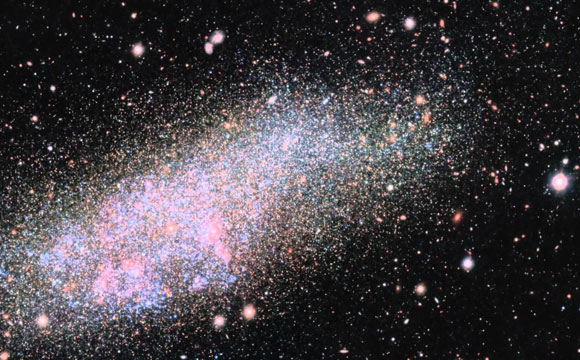
A newly published statistical analysis of mini-spiral galaxies shows an unexpected interaction between dark matter and ordinary matter. The research shows that where the relationship is obvious and cannot be explained in a trivial way within the context of the Standard Model, these objects may serve as “portals” to a completely new form of Physics which can explain phenomena like matter and dark energy.
They resemble a spiral galaxy like ours, only ten thousand times smaller: the mini-spiral galaxies studied by Professor Paolo Salucci of the International School for Advanced Studies (SISSA) in Trieste, and Ekaterina Karukes, who recently earned her Ph.D. at SISSA, may prove to be “the portal that leads us to a whole new Physics, going beyond the standard model of particles to explain matter and dark energy,” says Salucci. It is the first time these elements have been studied statistically, a method that can erase the “individual” variability of each object, thus revealing the general characteristics of the class. “We studied 36 galaxies, which was a sufficient number for statistical study. By doing this, we found a link between the structure of ordinary, or luminous matter like stars, dust, and gas, with dark matter.”
Dark matter is one of the great mysteries of Physics: since it does not emit electromagnetic radiation we cannot see it, even with the most sophisticated instruments. It was only discovered through its gravitational effects. Many believe it makes up 90% of our Universe. “Most dark matter, according to the most credible hypotheses, would be non-baryonic or WIMP. It would not interact with ordinary matter except through gravitational force,” continues Karukes. “Our observations, however, disagree with this notion.”
Salucci and Karukes showed that, in the objects they observed, the structure of dark matter mimics visible matter in its own way. “If, for a given mass, the luminous matter in a galaxy is closely compacted, so it is the dark matter. Similarly, if the former is more widespread than in other galaxies, so is the latter.”
The “tip of the iceberg”
“It is a very strong effect that cannot be explained trivially using the Standard Model of particles.” The Standard Model is the most widely-accepted theory of Physics in the scientific community. It explains fundamental forces (and particles of matter), however, it contains some doubtful points, most notably the fact that it does not include gravitational force. Phenomena such as the existence of dark matter and dark energy make it clear to scientists that there is another sort of physics yet to be discovered and explored. “From our observations, the phenomenon, and thus the necessity, is incredibly obvious. At the same time, this can be a starting point for exploring this new kind of physics,” continues Salucci. “Even in the largest spiral galaxies we find effects similar to the ones we observed, but they are signals that we can try to explain using the framework of the Standard Model through astrophysical processes within galaxies. With mini-spirals, however, there is no simple explanation. These 36 items are the tip of the iceberg of a phenomenon that we will probably find everywhere and that will help us discover what we cannot yet see.”
Reference: “The universal rotation curve of dwarf disk galaxies” by Ekaterina V. Karukes and Paolo Salucci, 29 November 2016, MNRAS.
DOI: 10.1093/mnras/stw3055
arXiv: 1609.06903
Never miss a breakthrough: Join the SciTechDaily newsletter.
Follow us on Google and Google News.
3 Comments
So Galaxies have shadows. Fascinating.
Superfluid dark matter fills ’empty’ space, strongly interacts with and is displaced by baryonic matter.
‘The Milky Way’s dark matter halo appears to be lopsided’
http://arxiv.org/abs/0903.3802
“the emerging picture of the dark matter halo of the Milky Way is dominantly lopsided in nature.”
The Milky Way’s halo is not a clump of dark matter traveling along with the Milky Way. The Milky Way’s halo is lopsided due to the baryonic matter in the Milky Way moving through and displacing the superfluid dark matter, analogous to a submarine moving through and displacing the water.
What ripples when galaxy clusters collide is what waves in a double slit experiment, the superfluid dark matter which fills ’empty’ space.
Superfluid dark matter displaced by baryonic matter relates general relativity and quantum mechanics.
From the article:
“Salucci and Karukes showed that, in the objects they observed, the structure of dark matter mimics visible matter in its own way. “If, for a given mass, the luminous matter in a galaxy is closely compacted, so it is the dark matter. Similarly, if the former is more widespread than in other galaxies, so is the latter.””
What they mistake for “compacted” dark matter is the state of displacement of the dark matter. The more closely compacted a galaxy is the greater the displacement of the superfluid dark matter connected to and neighboring the galaxy. The more widespread the galaxy, the more widespread and dispersed the state of displacement of the superfluid dark matter.
This article states that Dark Matter exists not only in macro state but also in a condensed state so that these 36 micro galaxies formation and spreading can be explained. Our standard model explains everything in light matter in the universe with all the forces it encompasses but fail to explain much about gravitational forces to exist in micro state. Our standard model cannot be altogether discarded but only it is needed to appended for any exotic particles which can explain the mysterious Dark Matter composition. Thank You.