
Close Menu
    Facebook X (Twitter) Instagram
    SciTechDaily
    • Biology
    • Chemistry
    • Earth
    • Health
    • Physics
    • Science
    • Space
    • Technology
    Facebook X (Twitter) Pinterest YouTube RSS
    SciTechDaily
    Home»Health»Yale Scientists Discover Alzheimer’s Missing Link
    Health

    Yale Scientists Discover Alzheimer’s Missing Link

    By Bill Hathaway, Yale UniversitySeptember 9, 20131 Comment3 Mins Read
    Facebook Twitter Pinterest Telegram LinkedIn WhatsApp Email Reddit
    Share
    Facebook Twitter LinkedIn Pinterest Telegram Email Reddit
    Alzheimers Missing Link Found
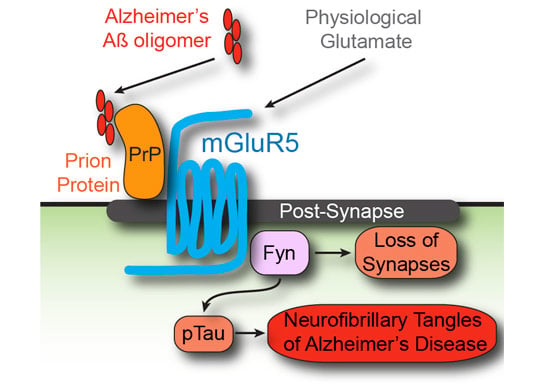
     Researchers have discovered a protein that is the missing link in the complicated chain of events that lead to Alzheimer’s disease. Credit: Yale University

    In a newly published study, Yale researchers reveal that a protein within the cell membrane called metabotropic glutamate receptor 5 is the missing link in the complicated chain of events that lead to Alzheimer’s disease.

    Yale School of Medicine researchers have discovered a protein that is the missing link in the complicated chain of events that lead to Alzheimer’s disease, they report in the September 4 issue of the journal Neuron. Researchers also found that blocking the protein with an existing drug can restore memory in mice with brain damage that mimics the disease.

    “What is very exciting is that of all the links in this molecular chain, this is the protein that may be most easily targeted by drugs,” said Stephen Strittmatter, the Vincent Coates Professor of Neurology and senior author of the study. “This gives us strong hope that we can find a drug that will work to lessen the burden of Alzheimer’s.”

    Scientists have already provided a partial molecular map of how Alzheimer’s disease destroys brain cells. In earlier work, Strittmatter’s lab showed that the amyloid-beta peptides, which are a hallmark of Alzheimer’s, couple with prion proteins on the surface of neurons. By an unknown process, the coupling activates a molecular messenger within the cell called Fyn.

    In the Neuron paper, the Yale team reveals the missing link in the chain, a protein within the cell membrane called metabotropic glutamate receptor 5 or mGluR5. When the protein is blocked by a drug similar to one being developed for Fragile X syndrome, the deficits in memory, learning, and synapse density were restored in a mouse model of Alzheimer’s.

    Strittmatter stressed that new drugs may have to be designed to precisely target the amyloid-prion disruption of mGluR5 in human cases of Alzheimer’s and said his lab is exploring new ways to achieve this.

    Other Yale authors are Ji Won Um, Adam C. Kaufman, Mikhail Kostylev, Jacqueline K. Heiss, Massimiliano Stagi, Hideyuki Takahashi, Meghan E. Kerrisk, Alexander Vortmeyer, Thomas Wisniewski, Anthony J. Koleske, Erik C. Gunther and Haakon B. Nygaard.

    The research was funded by the National Institutes of Health.

    Reference: “Metabotropic Glutamate Receptor 5 Is a Coreceptor for Alzheimer Aβ Oligomer Bound to Cellular Prion Protein” by Ji Won Um, Adam C. Kaufman, Mikhail Kostylev, Jacqueline K. Heiss, Massimiliano Stagi, Hideyuki Takahashi, Meghan E. Kerrisk, Alexander Vortmeyer, Thomas Wisniewski, Anthony J. Koleske, Erik C. Gunther, Haakon B. Nygaard and Stephen M. Strittmatter, 4 September 2013, Neuron.
    DOI: 10.1016/j.neuron.2013.06.036

    Never miss a breakthrough: Join the SciTechDaily newsletter.
    Follow us on Google and Google News.

    Alzheimer's Disease Disease Neurology Protein Yale University
    Share. Facebook Twitter Pinterest LinkedIn Email Reddit

    Related Articles

    Monkeys and Humans Share Same Signs of Alzheimer’s

    New Drug Completely Erases Evidence of Alzheimer’s in Mouse Models

    Proper Copper Levels Essential to Spontaneous Neural Activity

    New Drug Compound Reverses the Brain Deficits of Alzheimer’s Disease in Mice

    Neurobiologists Reveal Age-Related Changes that Answer Key Questions about Alzheimer’s Disease

    New Imaging Method Detects Alzheimer’s Risk Years before the Disease Strikes

    Galactic Cosmic Radiation Poses Significant Threat to Astronauts, Could Accelerate the Onset of Alzheimer’s

    Disrupted Sleep Patterns Linked to Alzheimer’s

    New Antibody Drug Boosts the Immune System’s Capacity to Fight Cancer

    1 Comment

    1. Madanagopal.V.C on September 11, 2013 7:21 am

      Ameloid β Oigomer associates with the naturally finding PrPc protein found in the cell wall to execute Fyn inside the cell to cause loss of synapses and through pTau for causing neuro-fibrillary tangles inside the neuron cell that makes the Alzheimer’s disease. It is a good discovery to find out the facilitator in the cell membrane which is mGluR5 receptor, since the method of actual forming of plaques were not known. If this facilitator is disrupted then plaque formation will stop and the drug to cork this receptor is welcome to be discovered. Thank You.

      Reply
    Leave A Reply Cancel Reply

    • Facebook
    • Twitter
    • Pinterest
    • YouTube

    Don't Miss a Discovery

    Subscribe for the Latest in Science & Tech!

    Trending News

    First-of-Its-Kind Discovery: Homer’s Iliad Found Embedded in a 1,600-Year-Old Egyptian Mummy

    Beyond Inflammation: Scientists Uncover New Cause of Persistent Rheumatoid Arthritis

    A Simple Molecule Could Unlock Safer, Easier Weight Loss

    Scientists Just Built a Quantum Battery That Charges Almost Instantly

    Researchers Unveil Groundbreaking Sustainable Solution to Vitamin B12 Deficiency

    Millions of People Have Osteopenia Without Realizing It – Here’s What You Need To Know

    Researchers Discover Boosting a Single Protein Helps the Brain Fight Alzheimer’s

    World-First Study Reveals Human Hearts Can Regenerate After a Heart Attack

    Follow SciTechDaily
    • Facebook
    • Twitter
    • YouTube
    • Pinterest
    • Newsletter
    • RSS
    SciTech News
    • Biology News
    • Chemistry News
    • Earth News
    • Health News
    • Physics News
    • Science News
    • Space News
    • Technology News
    Recent Posts
    • After Decades, MIT Researchers Capture the First 3D Atomic View of a Mysterious Material
    • Your Favorite Fishing Spot Is Turning Brown – and the Fish Are Changing
    • 380-Million-Year-Old Fish Fossil Reveals Secrets of Life’s First Steps Onto Land
    • Mezcal “Worm” in a Bottle Mystery: DNA Testing Reveals a Surprise
    • Scientists Turn Red Lettuce Green, Unlocking Hidden Nutrients
    Copyright © 1998 - 2026 SciTechDaily. All Rights Reserved.
    • Science News
    • About
    • Contact
    • Editorial Board
    • Privacy Policy
    • Terms of Use

    Type above and press Enter to search. Press Esc to cancel.