

Close Menu
    Facebook X (Twitter) Instagram
    SciTechDaily
    • Biology
    • Chemistry
    • Earth
    • Health
    • Physics
    • Science
    • Space
    • Technology
    Facebook X (Twitter) Pinterest YouTube RSS
    SciTechDaily
    Home»Science»160,000 Years Ago, Hominins in China Were Far More Advanced Than We Thought
    Science

    160,000 Years Ago, Hominins in China Were Far More Advanced Than We Thought

    By Chinese Academy of SciencesApril 2, 20261 Comment3 Mins Read
    Facebook Twitter Pinterest Telegram LinkedIn WhatsApp Email Reddit
    Share
    Facebook Twitter LinkedIn Pinterest Telegram Email Reddit
    Xigou Tool Making
    Reconstruction of Xigou tool-making. Credit: Hulk Yuan

    New findings from central China are reshaping our understanding of early human innovation.

    An international team of researchers has identified evidence of advanced stone tool technologies in East Asia dating from 160,000 to 72,000 years ago. The study was recently published in Nature Communications.

    The project was led by the Institute of Vertebrate Paleontology and Paleoanthropology (IVPP) of the Chinese Academy of Sciences, with contributions from scientists in China, Australia, Spain, and the United States. The team carried out multidisciplinary excavations at the Xigou site in the Danjiangkou Reservoir region of central China.

    Their findings point to sophisticated toolmaking practices over a long time span, showing that hominins in this region were more adaptable and inventive than once believed. During this period, several large-brained hominin species lived in China, including Homo longi, Homo juluensis, and possibly Homo sapiens.

    Xigou Site Location
    Location of the Xigou site. Credit: Image by the Institute of Vertebrate Paleontology and Paleoanthropology, CAS.

    Establishing the Timeline

    To determine the age of the site, researchers used multiple luminescence dating techniques on six samples to cross-check results. They found that quartz recuperated optically stimulated luminescence (ReOSL) provided a dependable estimate for the age of the sediment layers.

    Based on these results, the cultural layer at Xigou dates to about 160,000 to 72,000 years ago. This provides a clear timeline for examining hominin activity at the site.
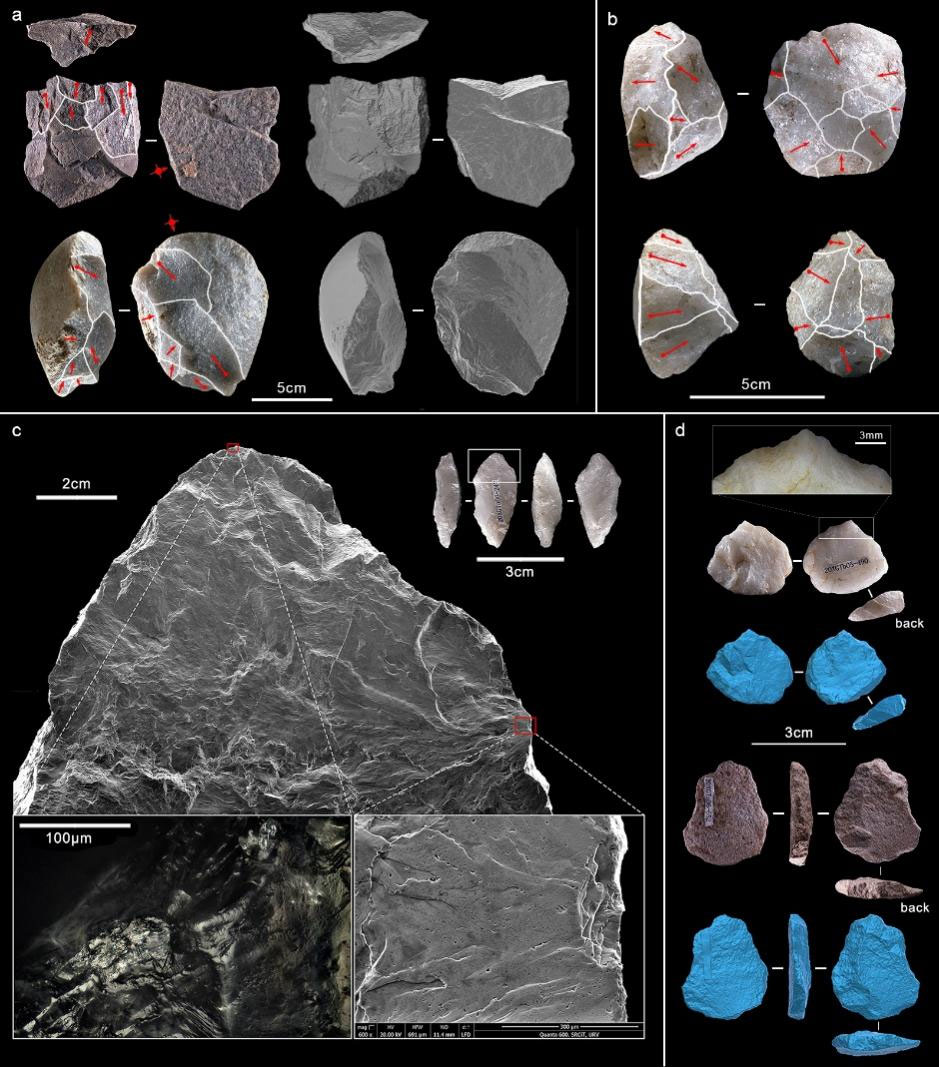
    Xigou Site Cores and Tools
    Cores and tools. (a) Core-on-flake; (b) Discoid core; (c) Tanged borer; (d) Backed borer. Credit: Image by the Institute of Vertebrate Paleontology and Paleoanthropology, CAS.

    A detailed study of 2,601 stone artifacts shows that early inhabitants used refined methods to produce both small flakes and more formal tools. These flakes were made using a range of core reduction approaches, from simple methods to more systematic techniques such as core-on-flake and discoid strategies. The consistent retouching patterns seen on many of the smaller tools suggest a high level of technical skill and standardization.

    Earliest Composite Tools in East Asia

    One of the most important discoveries is the earliest known evidence of hafted stone tools in East Asia, marking the region’s first confirmed composite tools. Analysis of wear patterns revealed two types of handles, described as juxtaposed and male.

    These tools combined stone parts with handles or shafts, indicating careful planning and skilled craftsmanship. They also show that these early toolmakers understood how to improve tool performance by combining materials.

    The discoveries at Xigou challenge the long-standing idea that early hominins in China showed little technological change over time. The site’s stratigraphic sequence spans nearly 90,000 years and supports growing evidence that hominin diversity in China was increasing during this period. Fossils from sites such as Xujiayao and Lingjing, some identified as Homo juluensis, may help explain the advanced behaviors reflected in the Xigou tool assemblage.

    Reference: “Technological innovations and hafted technology in central China ~160,000–72,000 years ago” by Jian-Ping Yue, Guo-Ding Song, Shi-Xia Yang, Shu-Gang Kang, Jing-Ya Li, Ben Marwick, Andreu Ollé, Juan Luis Fernández-Marchena, Pei-Xian Shu, Hao-Yu Liu, Yu-Xiu Zhang, Fa-Xiang Huan, Qing-Po Zhao, Bao-Tong Qiao, Zhong-Shan Shen, Cheng-Long Deng and Michael Petraglia, 27 January 2026, Nature Communications.
    DOI: 10.1038/s41467-025-67601-y

    Never miss a breakthrough: Join the SciTechDaily newsletter.
    Follow us on Google and Google News.

    Anthropology Archaeology Chinese Academy of Sciences Evolutionary Biology Hominin
    Share. Facebook Twitter Pinterest LinkedIn Email Reddit

    Related Articles

    These 160,000-Year-Old Tools Are Rewriting Human History

    This 1.5-Million-Year-Old Human Face Is Rewriting Human Evolution

    Earliest Interbreeding Between Ancient Human Populations Discovered – Evolutionary Puzzle Solved

    New Evidence Shows Humans Mastered Fire Earlier Than Thought

    Scientists Discover New Species of Early Human in the Philippines

    Why Expressive Eyebrows Mattered in Human Evolution

    Scientists Discover A New Species of Hominin

    400,000 Year Old Fossil Helps Shed New Light on Human Evolution

    Million-Year-Old Ash in South African Cave Yields Evidence of Cooking

    1 Comment

    1. Robert on April 3, 2026 6:26 am

      Waiting for the soon-coming “Definitive Proof” article that human origins and all tool making actually came from China. Then further discovery, some errant Chinese ventured out to Africa and mated with Chimps. That’s how all those ‘other races’ came about.

      Reply
    Leave A Reply Cancel Reply

    • Facebook
    • Twitter
    • Pinterest
    • YouTube

    Don't Miss a Discovery

    Subscribe for the Latest in Science & Tech!

    Trending News

    First-of-Its-Kind Discovery: Homer’s Iliad Found Embedded in a 1,600-Year-Old Egyptian Mummy

    Beyond Inflammation: Scientists Uncover New Cause of Persistent Rheumatoid Arthritis

    A Simple Molecule Could Unlock Safer, Easier Weight Loss

    Scientists Just Built a Quantum Battery That Charges Almost Instantly

    Researchers Unveil Groundbreaking Sustainable Solution to Vitamin B12 Deficiency

    Millions of People Have Osteopenia Without Realizing It – Here’s What You Need To Know

    Researchers Discover Boosting a Single Protein Helps the Brain Fight Alzheimer’s

    World-First Study Reveals Human Hearts Can Regenerate After a Heart Attack

    Follow SciTechDaily
    • Facebook
    • Twitter
    • YouTube
    • Pinterest
    • Newsletter
    • RSS
    SciTech News
    • Biology News
    • Chemistry News
    • Earth News
    • Health News
    • Physics News
    • Science News
    • Space News
    • Technology News
    Recent Posts
    • This Simple Exercise Trick Builds Muscle With Less Effort, Study Finds
    • Middle Age Is Becoming a Breaking Point in America, Study Reveals
    • Scientists Discover How Coffee Impacts Memory, Mood, and Gut Health
    • How Cells Copy DNA Might Matter More Than We Ever Realized
    • Scientists Just Solved the Mystery of the Twelve Apostles
    Copyright © 1998 - 2026 SciTechDaily. All Rights Reserved.
    • Science News
    • About
    • Contact
    • Editorial Board
    • Privacy Policy
    • Terms of Use

    Type above and press Enter to search. Press Esc to cancel.