
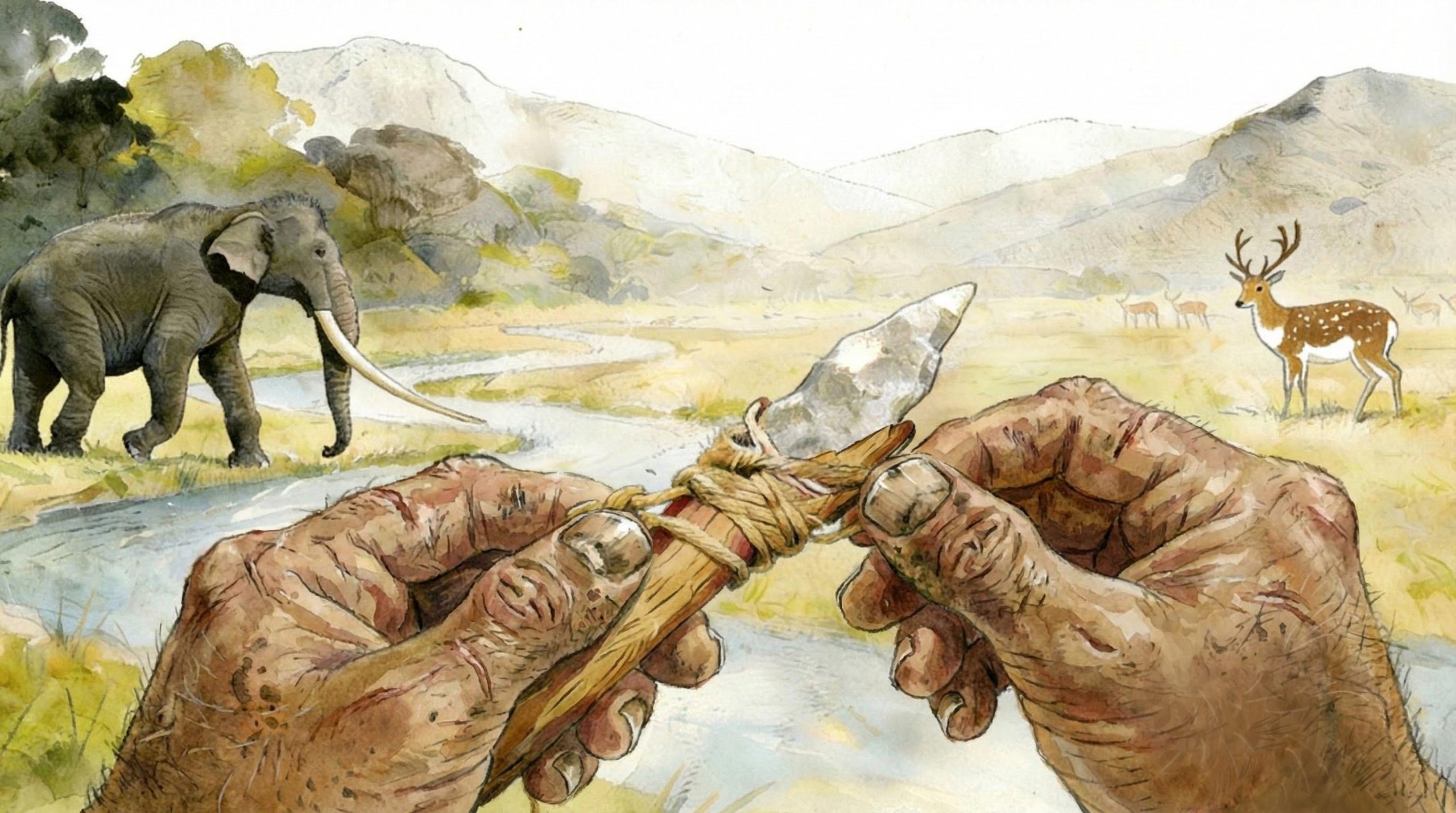
Ancient tools from central China are flipping the script, revealing early humans were far more innovative than history once gave them credit for.
Archaeologists working at a newly excavated site in central China are changing long-standing ideas about how early hominins lived and adapted in East Asia. The discoveries suggest these ancient populations were far more capable and inventive than researchers once believed.
An international research team led by the Chinese Academy of Sciences carried out excavations at Xigou, located in the Danjiangkou Reservoir Region of central China. At the site, scientists uncovered evidence of advanced stone tool technologies dating from about 160,000 to 72,000 years ago.
The work, co-led by Griffith University, shows that hominins living in this region displayed remarkable flexibility and creativity. This period also coincides with the presence of several large-brained hominins in China, including Homo longi and Homo juluensis, and possibly Homo sapiens.
Challenging Long-Held Views of East Asian Technology
“Researchers have argued for decades that while hominins in Africa and western Europe demonstrated significant technological advances, those in East Asia relied on simpler and more conservative stone-tool traditions,” said expedition leader Dr. Shixia Yang of the Institute of Vertebrate Paleontology and Paleoanthropology (IVPP).
Study co-author Professor Michael Petraglia, Director of Griffith University’s Australian Research Centre for Human Evolution, added: “The Xigou findings challenge the narrative that early humans in China were conservative over time.”
According to the research team, detailed analysis of the artifacts shows that hominins at Xigou used sophisticated stone tool-making techniques. They produced small flakes and tools that were applied to a wide range of daily tasks, pointing to complex and varied behaviors.
Earliest Evidence of Composite Tools in East Asia
One of the most notable discoveries at Xigou was evidence of hafted stone tools, representing the earliest known composite tools in East Asia. These implements combined stone pieces with handles or shafts, a design that required careful planning and technical skill.
Such tools reflect an understanding of how different materials could be combined to improve performance. This level of craftsmanship suggests advanced problem-solving abilities and intentional design.
Lead author Dr. Jian-Ping Yue of the IVPP explained: “Their presence indicates the Xigou hominins possessed a high degree of behavioral flexibility and ingenuity.”
A Long Record of Change and Diversity
The archaeological layers at Xigou span roughly 90,000 years, offering a rare, long-term record of technological and behavioral change. This timeline fits with growing evidence that hominin diversity in China was increasing during this period.
Large-brained hominins identified at sites such as Xujiayao and Lingjing, sometimes referred to as Homo juluensis, may provide a biological backdrop for the complex behaviors seen in the Xigou stone tool assemblages.
“The technological strategies evident in the stone tools likely played a crucial role in helping hominin populations adapt to the fluctuating environments that characterized the 90,000-year-period in Eastern Asia,” Professor Petraglia said.
Rethinking Human Evolution in East Asia
The research team says the discoveries at Xigou are reshaping how scientists understand human evolution in East Asia. The findings show that early populations in the region developed cognitive and technical abilities comparable to those seen in Africa and Europe.
Dr. Yang added: “Emerging evidence from Xigou and other sites shows early technologies in China included prepared-core methods, innovative retouched tools, and even large cutting tools, pointing to a richer and more complex technological landscape than previously recognized.”
Reference: “Technological innovations and hafted technology in central China ~160,000–72,000 years ago” by Jian-Ping Yue, Guo-Ding Song, Shi-Xia Yang, Shu-Gang Kang, Jing-Ya Li, Ben Marwick, Andreu Ollé, Juan Luis Fernández-Marchena, Pei-Xian Shu, Hao-Yu Liu, Yu-Xiu Zhang, Fa-Xiang Huan, Qing-Po Zhao, Bao-Tong Qiao, Zhong-Shan Shen, Cheng-Long Deng and Michael Petraglia, 27 January 2026, Nature Communications.
DOI: 10.1038/s41467-025-67601-y
Never miss a breakthrough: Join the SciTechDaily newsletter.
Follow us on Google and Google News.