

A routine fossil-hunting trip turned into a groundbreaking discovery for a pair of researchers when they stumbled upon a rare ammonite fossil with brilliant mother-of-pearl iridescence, similar to Canada’s prized gemstone “ammolite.”
This prehistoric find – dating back 300 million years – could be one of only two known sites in the world with such ancient aragonite preservation. Now, the duo is preparing to publish their findings, which could reshape scientific understanding of fossilization and ancient marine life.
Unearthing a Hidden Treasure
Incredible discoveries can sometimes be found just beneath our feet.
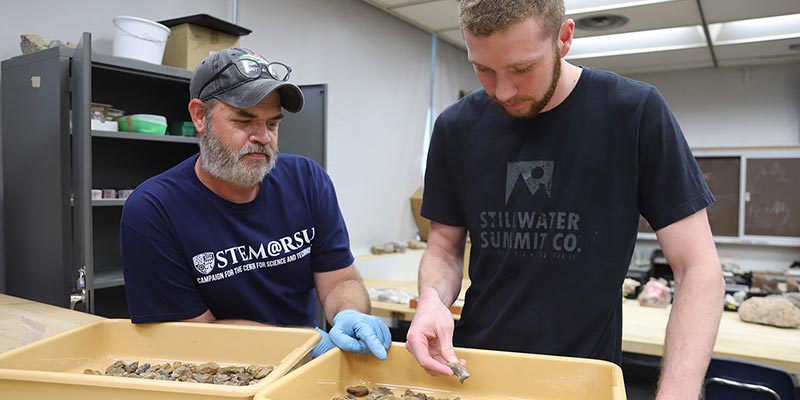
That’s exactly what happened to RSU Professor Dr. Chris Shelton and his student, Kolby Dooling.
During a recent fossil-hunting trip, Dr. Shelton came across a site he believes contains a rich concentration of exceptionally well-preserved ammonites, an extinct group of shelled cephalopods.
“Just before spring break, I took one of my students, Kolby Dooling, to a site that I’d taken other students to before, one that had always been a good place to explore,” Shelton said. “We’d noticed these fossils before, but this time, Kolby brought a very large iridescent piece to me. It was clear he had discovered something extraordinary with this ammonite fossil.”
A Rare Gem in the World of Fossils
After studying the sample over the break, Dr. Shelton concluded that it was an unusually rare ammonite fossil featuring a distinctive mother-of-pearl iridescence. In Canada, similar specimens are classified as a fossil gemstone known as “ammolite.”
“Ammolite is very unique as it’s a biological gemstone, similar to pearls, formed from the fossilized shells of ancient cephalopods (mollusks related to modern squids) that exhibit vibrant, iridescent colors and patterns due to the microstructure of the original aragonite layer (carbonate mineral within the fossil mother of pearl layer),” he said. “They’re particularly rare and sought after by collectors.”
A Moment of Discovery
“I was excited that I’d found something so rare – so unusual,” Dooling said. “I’ve never been so lucky to find as many fossils as I found when I went collecting with Dr. Shelton. I’ve found a few back home, but nothing like this. It really piqued my interest.”
According to Shelton, this fossil is from the Carboniferous Period, during the fifth interval of the Paleozoic Era, around 300 million years ago, pre-dating the dinosaurs.
A Site Full of Potential
Since the initial discovery, Shelton and Dooling have returned to the site, which they are keeping undisclosed for the time being, to uncover numerous other fossil specimens they can use in their research and for teaching, like shark remains and other unique invertebrates.
“We plan to do more expeditions, more collection trips to the site to gather more samples,” he said. “From there, we’ll run many more analytical tests on the fossils to confirm our belief and based on the findings, Kolby and I will write and submit a peer-reviewed paper for acknowledgment of our discovery within the scientific community.”
Shelton added that the paper also will be coauthored by a colleague – Dr. E. Troy Raspbury from Stoney Brook University in New York – who will be fundamental in the analytical testing needed.
A Global Rarity in Fossil History
If confirmed by the scientific community, their discovery will be categorized as a Fossil Lagerstätte, which refers to a fossil deposit exhibiting exceptional preservation, often including soft tissues or a high concentration of fossils, providing crucial insights into ancient ecosystems and evolution.
Should Shelton and Dooling’s discovery be authenticated, this would be only the second location in the world where original aragonite this old has been found. The other known locality is called the Buckhorn Asphalt Lagerstätte in southern Oklahoma’s Arbuckle Mountains. All other fossil sites exhibiting this preserved mother-of-pearl iridescence, like Canada’s, are geologically younger (during dinosaur times, Mesozoic Era).
A Promising Future for Discovery and Research
Shelton said he’s hopeful that the paper on his and Dooling’s discovery will be completed and ready to be submitted by the end of 2025.
Although Dooling is slated to graduate from RSU with his associate’s degree this spring, he said he will stay in touch with Shelton to work on their research paper. Following his time at RSU, Dooling said he hopes to continue his education and eventually work in the field of petroleum geology.
Inspiring the Next Generation
“This will be a significant discovery,” Shelton said. “It’s important that Kolby also get credit for helping me make it, and it’s always good for me to take students out of the classroom and into the field, from the theoretical to the practical, to find fossils for themselves and to get to uncover their own piece of history.”
Shelton’s earth science courses at RSU explore prehistoric life and its evolution through geologic time. By using Paleohistology – the combination of geology and biology – he can unlock evolutionary knowledge by investigating bone microstructures. His travels and research in countries around the world have allowed him to share unique perspectives based on real-world experiences students couldn’t otherwise experience from just reading a textbook.
Never miss a breakthrough: Join the SciTechDaily newsletter.
Follow us on Google and Google News.
3 Comments
not rare, you can buy them cheap at the Tucson and Denver Gem Mineral shows. We sell them.
Dated to 300 million-years?
I found a bunch of them in Colorado Springs