

Close Menu
    Facebook X (Twitter) Instagram
    SciTechDaily
    • Biology
    • Chemistry
    • Earth
    • Health
    • Physics
    • Science
    • Space
    • Technology
    Facebook X (Twitter) Pinterest YouTube RSS
    SciTechDaily
    Home»Technology»3D Magnetic Recording: Unprecedented Hard Drive Storage Density Unlocked
    Technology

    3D Magnetic Recording: Unprecedented Hard Drive Storage Density Unlocked

    By National Institute for Materials Science, JapanApril 14, 20241 Comment3 Mins Read
    Facebook Twitter Pinterest Telegram LinkedIn WhatsApp Email Reddit
    Share
    Facebook Twitter LinkedIn Pinterest Telegram Email Reddit
    Magnetic Data Recording Concept Art
    A new HDD technology involving three-dimensional magnetic recording could enhance storage capacities and reduce the number of HDDs needed, promising future cost and energy efficiencies. Credit: SciTechDaily.com

    Possibility of ultra-high density hard disk drives with areal densities exceeding 10 Tbit/in² using multi-level magnetic recording.

    Research groups from NIMS, Seagate Technology, and Tohoku University have made a breakthrough in the field of hard disk drives (HDD) by demonstrating the feasibility of multi-level recording using a three-dimensional magnetic recording medium to store digital information. The research groups have shown that this technology can be used to increase the storage capacity of HDDs, which could lead to more efficient and cost-effective data storage solutions in the future.

    Enhancing Data Storage Capacity

    Data centers are increasingly storing vast amounts of data on hard disk drives (HDDs) that use perpendicular magnetic recording (PMR) to store information at areal densities of around 1.5 Tbit/in². However, to transition to higher areal densities, a high anisotropy magnetic recording medium consisting of FePt grains combined with heat-assisted laser writing is required. This method, known as heat-assisted magnetic recording (HAMR), is capable of sustaining areal recording densities of up to 10 Tbit/in². Furthermore, densities of larger than 10 Tbit/in² are possible based on a new principle demonstrated by storing multiple recording levels of 3 or 4 compared with the binary level used in HDD technology.
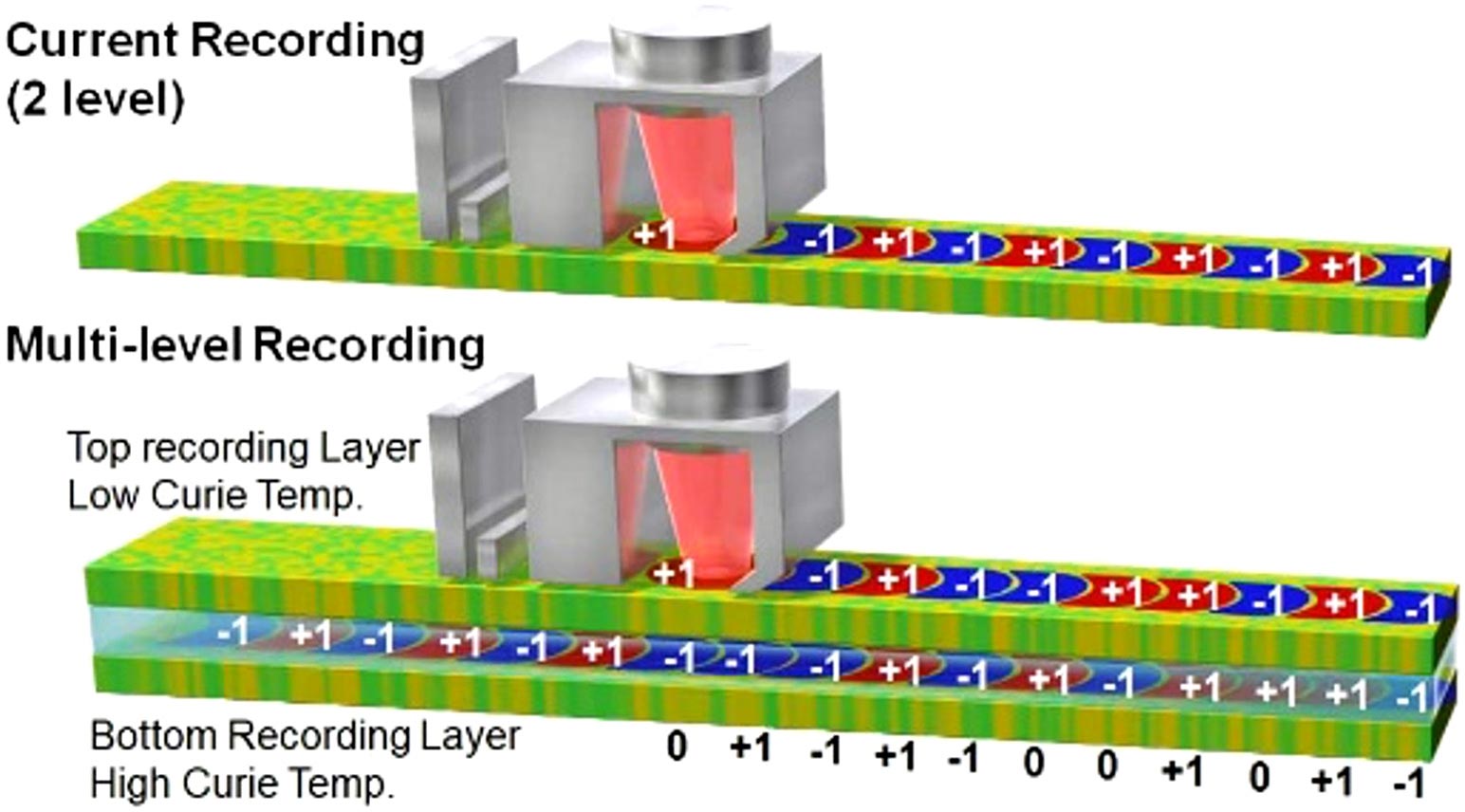
    HAMR and Three-Dimensional Magnetic Recording Systems
    Schematic view of (top) currently used HAMR and (bottom) three-dimensional magnetic recording systems. In the three-dimensional magnetic recording system, the Curie temperature of each recording layer differs by about 100 K and data are written to each layer by adjusting the laser power. Credit: Yukiko Takahashi NIMS, Thomas Chang Seagate Technology, Simon Greaves Tohoku University

    Innovations in 3D Magnetic Recording

    In this study, we succeeded in arranging the FePt recording layers three-dimensionally, by fabricating lattice-matched, FePt/Ru/FePt multilayer films, with Ru as a spacer layer. Measurements of the magnetization show the two FePt layers have different Curie temperatures. This means that three-dimensional recording becomes possible by adjusting the laser power when writing. In addition, we have demonstrated the principle of 3D recording through recording simulations, using a media model that mimics the microstructure and magnetic properties of the fabricated media.

    Future Prospects and Implications

    The three-dimensional magnetic recording method can increase recording capacity by stacking recording layers in three dimensions. This means that more digital information can be stored with fewer HDDs, leading to energy savings for data centers. In the future, we plan to develop processes to reduce the size of FePt grains, to improve the orientation and magnetic anisotropy, and to stack more FePt layers to realize a media structure suitable for practical use as a high-density HDD.

    This research was published in Acta Materialia on March 24, 2024.

    eference: “Dual-layer FePt-C granular media for multi-level heat-assisted magnetic recording” by P. Tozman, S. Isogami, I. Suzuki, A. Bolyachkin, H. Sepehri-Amin, S.J. Greaves, H. Suto, Y. Sasaki, T.Y. Chang, Y. Kubota, P. Steiner, P.W. Huang, K. Hono and Y.K. Takahashi, 24 March 2024, Acta Materialia.
    DOI: 10.1016/j.actamat.2024.119869

    This research was conducted by Dr. P. Tozman, Distinguished Researcher, and Dr. Yukiko Takahashi, Group Leader of NIMS Center for Magnetic and Spintronics Materials Research, Dr. T.Y. Chang, Researcher at Seagate Technology, and Prof. S.J. Greaves of Tohoku University. This work was supported by Japan Science and Technology Agency (JST) Strategic Basic Research Programs (CREST) “Integrated Devices and Systems Utilizing Information Carriers” JPMJCR22C3.

    Never miss a breakthrough: Join the SciTechDaily newsletter.
    Follow us on Google and Google News.

    Information Technology Popular
    Share. Facebook Twitter Pinterest LinkedIn Email Reddit

    Related Articles

    Researchers Develop Million-Year Data Storage Disk

    Researchers Design Cell-Sorting Microchip

    Super-Adhesive “Geckskin” Material Holds 700 Pounds

    Researchers Developing Handheld Pathogen Detector

    Nanoscale Biological Coating Instantly Stops Bleeding

    Sleeping On The Job: Russian Rocket Security

    The Future Of Incandescent Bulbs Not So Bright

    Scottish Wind Turbine Explodes

    Harvard Scientists Develop $5 Rubber Robot

    1 Comment

    1. Bruzote on April 18, 2024 6:57 pm

      This seems to require a lot of things to work out well for using 3 or more layers. And does the material age quickly due to combined the laser and magnetic effects?

      Reply
    Leave A Reply Cancel Reply

    • Facebook
    • Twitter
    • Pinterest
    • YouTube

    Don't Miss a Discovery

    Subscribe for the Latest in Science & Tech!

    Trending News

    Why Popular Diabetes Drugs Like Ozempic Don’t Work for Everyone: The “Genetic Glitch”

    Scientists Stunned After Finding Plant Thought Extinct for 60 Years

    Scientists Discover Tiny New Spider That Hunts Prey 6x Its Size

    Natural Component From Licorice Shows Promise for Treating Inflammatory Bowel Disease

    Scientists Warn: Popular Sweetener Linked to Dangerous Metabolic Effects

    Monster Storms on Jupiter Unleash Lightning Beyond Anything on Earth

    Scientists Create “Liquid Gears” That Spin Without Touching

    The Simple Habit That Could Help Prevent Cancer

    Follow SciTechDaily
    • Facebook
    • Twitter
    • YouTube
    • Pinterest
    • Newsletter
    • RSS
    SciTech News
    • Biology News
    • Chemistry News
    • Earth News
    • Health News
    • Physics News
    • Science News
    • Space News
    • Technology News
    Recent Posts
    • Seeing the Invisible: Scientists Develop New Way To Track Particles in 3D
    • The Atomic Gap That Could Cost the Semiconductor Industry Billions
    • Earth’s Secret Advantage: Why Most Alien Worlds May Be Too Dry for Life
    • Ancient Bacteria Turned a DNA System Into a Cell Skeleton
    • Researchers Finally Solve 50-Year-Old Blood Group Mystery
    Copyright © 1998 - 2026 SciTechDaily. All Rights Reserved.
    • Science News
    • About
    • Contact
    • Editorial Board
    • Privacy Policy
    • Terms of Use

    Type above and press Enter to search. Press Esc to cancel.