
Close Menu
    Facebook X (Twitter) Instagram
    SciTechDaily
    • Biology
    • Chemistry
    • Earth
    • Health
    • Physics
    • Science
    • Space
    • Technology
    Facebook X (Twitter) Pinterest YouTube RSS
    SciTechDaily
    Home»Space»3D Map of Core-Collapse Supernova Remnant Cassiopeia A
    Space

    3D Map of Core-Collapse Supernova Remnant Cassiopeia A

    By Harvard-Smithsonian Center for AstrophysicsJanuary 30, 2015No Comments4 Mins Read
    Facebook Twitter Pinterest Telegram LinkedIn WhatsApp Email Reddit
    Share
    Facebook Twitter LinkedIn Pinterest Telegram Email Reddit
    CAT Scan of Nearby Supernova Remnant Reveals Frothy Interior
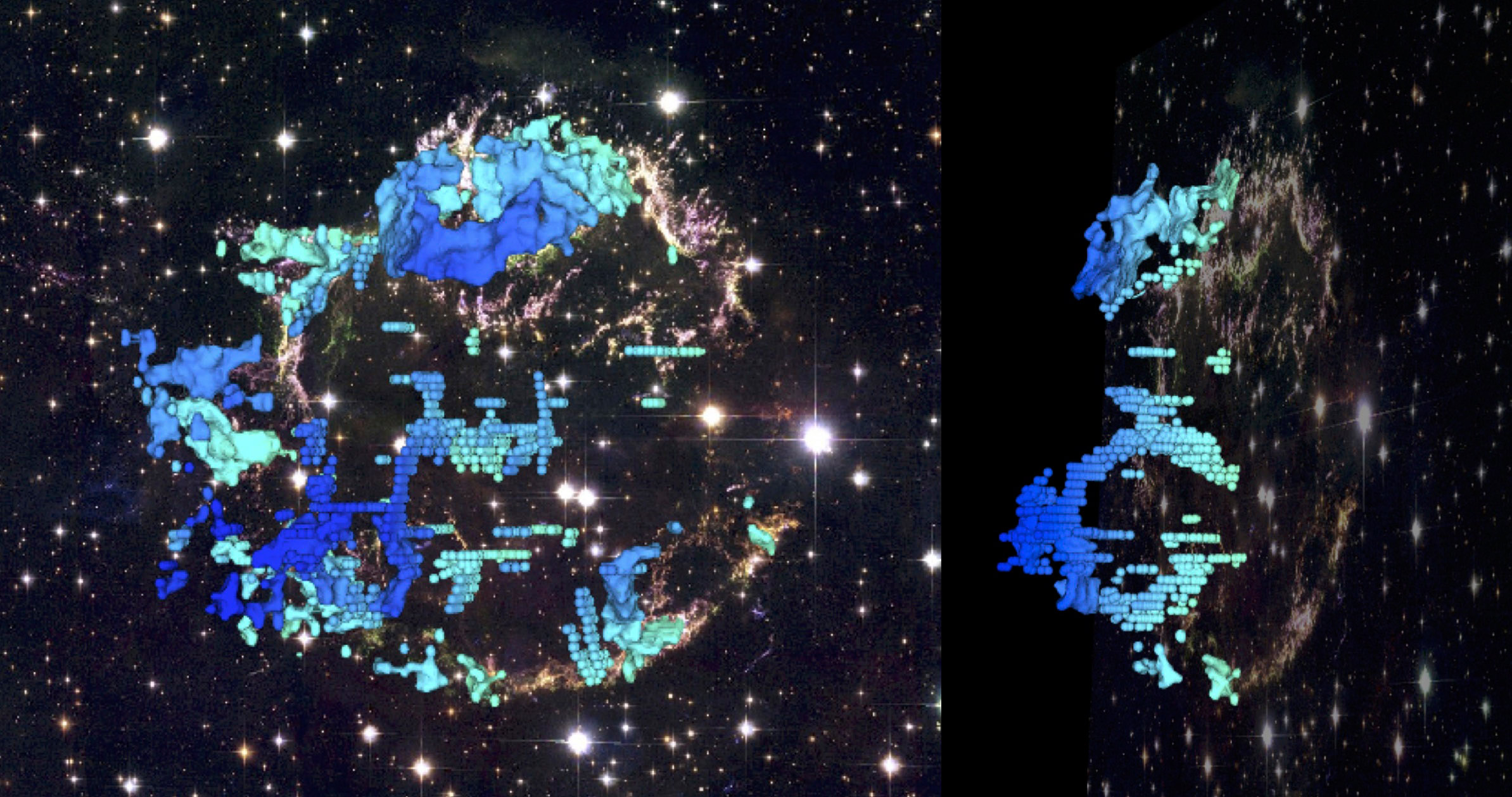
    This composite image shows two perspectives of a three-dimensional reconstruction of the Cassiopeia A supernova remnant. This new 3-D map provides the first detailed look at the distribution of stellar debris following a supernova explosion. Such 3-D reconstructions encode important information for astronomers about how massive stars actually explode. The blue-to-red colors correspond to the varying speed of the emitting gas along our line of sight. The background is a Hubble Space Telescope composite image of the supernova remnant. Credit: D. Milisavljevic (CfA) & R. Fesen (Dartmouth). Background image: NASA, ESA, and the Hubble Heritage Team; NASA/CXC/SAO

    New research from the Harvard-Smithsonian Center for Astrophysics reveals near-infrared observations of the young Milky Way supernova remnant Cassiopeia A and a three-dimensional map of its interior.

    Cassiopeia A, or Cas A for short, is one of the most well-studied supernova remnants in our galaxy. But it still holds major surprises. Harvard-Smithsonian and Dartmouth College astronomers have generated a new 3-D map of its interior using the astronomical equivalent of a CAT scan. They found that the Cas A supernova remnant is composed of a collection of about a half dozen massive cavities – or “bubbles.”

    “Our three-dimensional map is a rare look at the insides of an exploded star,” says Dan Milisavljevic of the Harvard-Smithsonian Center for Astrophysics (CfA). This research is being published in the January 30 issue of the journal Science.

    About 340 years ago a massive star exploded in the constellation Cassiopeia. As the star blew itself apart, extremely hot and radioactive matter rapidly streamed outward from the star’s core, mixing and churning outer debris. The complex physics behind these explosions is difficult to model, even with state-of-the-art simulations run on some of the world’s most powerful supercomputers. However, by carefully studying relatively young supernova remnants like Cas A, astronomers can investigate various key processes that drive these titanic stellar explosions.

    “We’re sort of like bomb squad investigators. We examine the debris to learn what blew up and how it blew up,” explains Milisavljevic. “Our study represents a major step forward in our understanding of how stars actually explode.”
    Chandra Reveals Supernova Remnant's Complex Structure
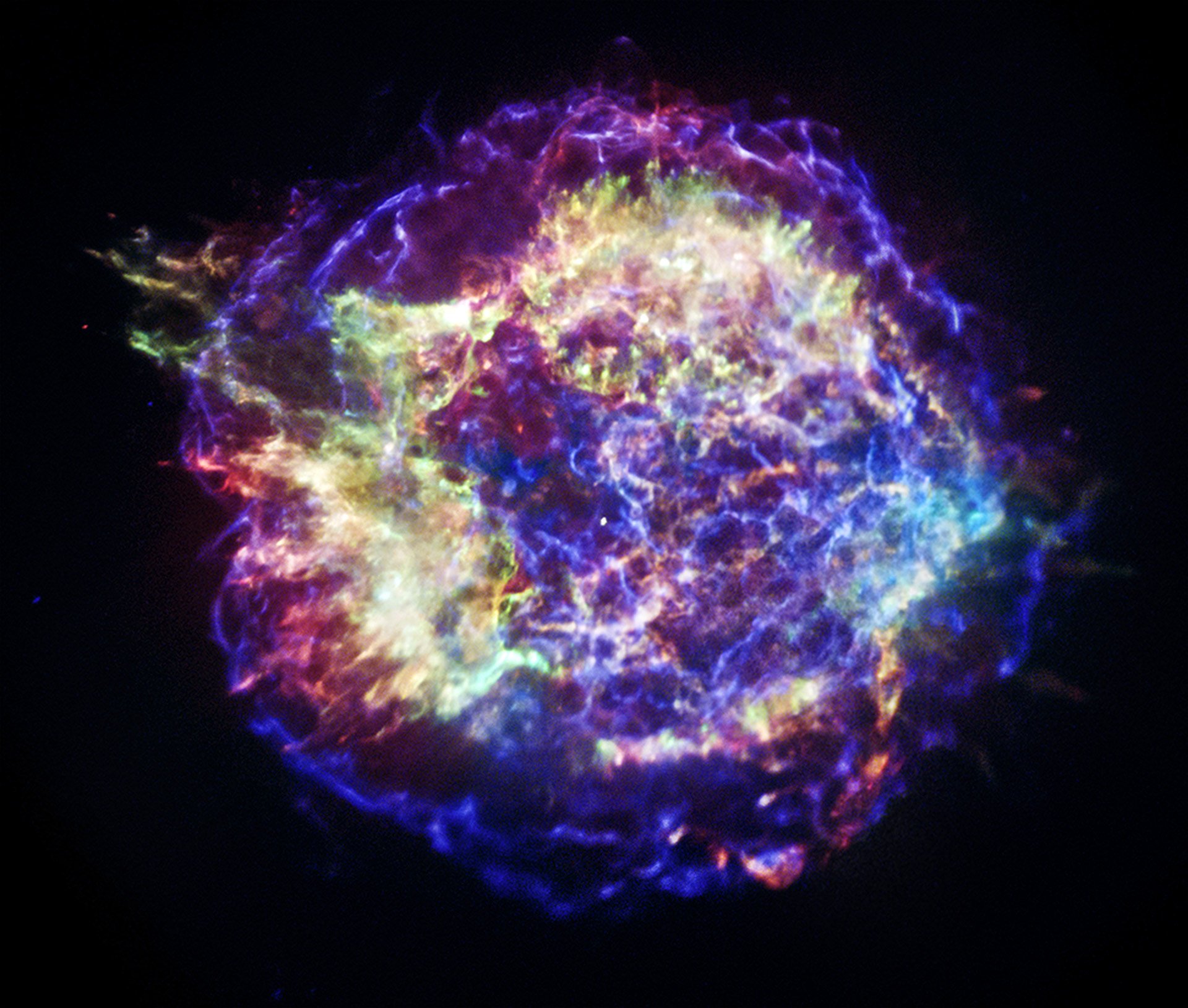
    A photograph of Cas A from NASA’s Chandra X-ray Observatory reveals the supernova remnant’s complex structure. In this representative-color image low-energy X-rays are red, medium-energy ones are green, and the highest-energy X-rays detected by Chandra are colored blue. Credit: D. Milisavljevic (CfA) & R. Fesen (Dartmouth).

    To make the 3-D map, Milisavljevic, and co-author Rob Fesen of Dartmouth College examined Cas A in near-infrared wavelengths of light using the Mayall 4-meter telescope at Kitt Peak National Observatory, southwest of Tucson, AZ. Spectroscopy allowed them to measure expansion velocities of extremely faint material in Cas A’s interior, which provided the crucial third dimension.

    They found that the large interior cavities appear to be connected to – and nicely explain – the previously observed large rings of debris that make up the bright and easily seen outer shell of Cas A. The two most well-defined cavities are 3 and 6 light-years in diameter, and the entire arrangement has a Swiss cheese-like structure.

    The bubble-like cavities were likely created by plumes of radioactive nickel generated during the stellar explosion. Since this nickel will decay to form iron, Milisavljevic, and Fesen predict that Cas A’s interior bubbles should be enriched with as much as a tenth of a solar mass of iron. This enriched interior debris hasn’t been detected in previous observations, however, so next-generation telescopes may be needed to find the “missing” iron and confirm the origin of the bubbles.

    Headquartered in Cambridge, Massachusetts, the Harvard-Smithsonian Center for Astrophysics (CfA) is a joint collaboration between the Smithsonian Astrophysical Observatory and the Harvard College Observatory. CfA scientists, organized into six research divisions, study the origin, evolution, and ultimate fate of the universe.

    Reference: “The bubble-like interior of the core-collapse supernova remnant Cassiopeia A” by Dan Milisavljevic and Robert A. Fesen, 30 January 2015, Science.
    DOI: 10.1126/science.1261949

    Never miss a breakthrough: Join the SciTechDaily newsletter.
    Follow us on Google and Google News.

    Astronomy Astrophysics Harvard-Smithsonian Center for Astrophysics Popular Supernova
    Share. Facebook Twitter Pinterest LinkedIn Email Reddit

    Related Articles

    Extreme Weight Loss: Shocking Supernova Discovery Challenges the Standard Theory of Stellar Evolution

    How Do the Most Massive Stars Explode? Bubbles With Titanium Trigger Titanic Explosions

    Intriguing Remains of a Rare Stellar Explosion Discovered in Milky Way Center

    “Heavy Metal” Supernova Discovery Challenges Current Ideas of How Supernovas Occur

    Astronomers Reveal “Missing-Link” in the Supernova-GRB Connection

    Reverse Shock Wave Racing Inward at 1000 Times the Speed of Sound

    Scientists Discover a New Type of Supernova

    Researchers Discovered a Very Rare Type Ibn Supernova

    Cloud of Hydrogen and Helium Plunging Toward the Galactic Center

    Leave A Reply Cancel Reply

    • Facebook
    • Twitter
    • Pinterest
    • YouTube

    Don't Miss a Discovery

    Subscribe for the Latest in Science & Tech!

    Trending News

    New “Nanozyme Hypothesis” Could Rewrite the Story of Life’s Origins

    Anatomy Isn’t Finished: The Human Body Still Holds Secrets

    “Pretty Close to Home”: The Hidden Earthquake Threat Beneath Seattle

    The Surprising Reason You Might Want To Sleep Without a Pillow

    Scientists Say This Natural Hormone Reverses Obesity by Targeting the Brain

    35-Million-Year-Old Mystery: Strange Arachnid Discovered Preserved in Amber

    Is AI Really Just a Tool? It Could Be Altering How You See Reality

    JWST Reveals a “Forbidden” Planet With a Baffling Composition

    Follow SciTechDaily
    • Facebook
    • Twitter
    • YouTube
    • Pinterest
    • Newsletter
    • RSS
    SciTech News
    • Biology News
    • Chemistry News
    • Earth News
    • Health News
    • Physics News
    • Science News
    • Space News
    • Technology News
    Recent Posts
    • The Ocean Current Stronger Than All Rivers Changed Earth Forever
    • NASA Artemis II Splashdown and Astronaut Recovery Operation [Image Gallery]
    • Splashdown! NASA Artemis II Returns From Record-Breaking Moon Mission
    • Scientists Freeze a Spinning Nanoparticle to Its Quantum Limit
    • A 100x Faster Breakthrough Could Fix Quantum Computers’ Biggest Problem
    Copyright © 1998 - 2026 SciTechDaily. All Rights Reserved.
    • Science News
    • About
    • Contact
    • Editorial Board
    • Privacy Policy
    • Terms of Use

    Type above and press Enter to search. Press Esc to cancel.