
Using partially entangled atoms, a new experiment by UC Berkeley physicists demonstrated more precisely than ever before that space looks the same in all directions.
Ever since Einstein proposed his special theory of relativity in 1905, physics and cosmology have been based on the assumption that space looks the same in all directions – that it’s not squeezed in one direction relative to another.
A new experiment by UC Berkeley physicists used partially entangled atoms — identical to the qubits in a quantum computer — to demonstrate more precisely than ever before that this is true, to one part in a billion billion.
The classic experiment that inspired Albert Einstein was performed in Cleveland by Albert Michelson and Edward Morley in 1887 and disproved the existence of an “ether” permeating space through which light was thought to move like a wave through water. What it also proved, said Hartmut Häffner, a UC Berkeley assistant professor of physics, is that space is isotropic and that light travels at the same speed up, down, and sideways.
“Michelson and Morley proved that space is not squeezed,” Häffner said. “This isotropy is fundamental to all physics, including the Standard Model of physics. If you take away isotropy, the whole Standard Model will collapse. That is why people are interested in testing this.”
The Standard Model of particle physics describes how all fundamental particles interact, and requires that all particles and fields be invariant under Lorentz transformations, and in particular that they behave the same no matter what direction they move.
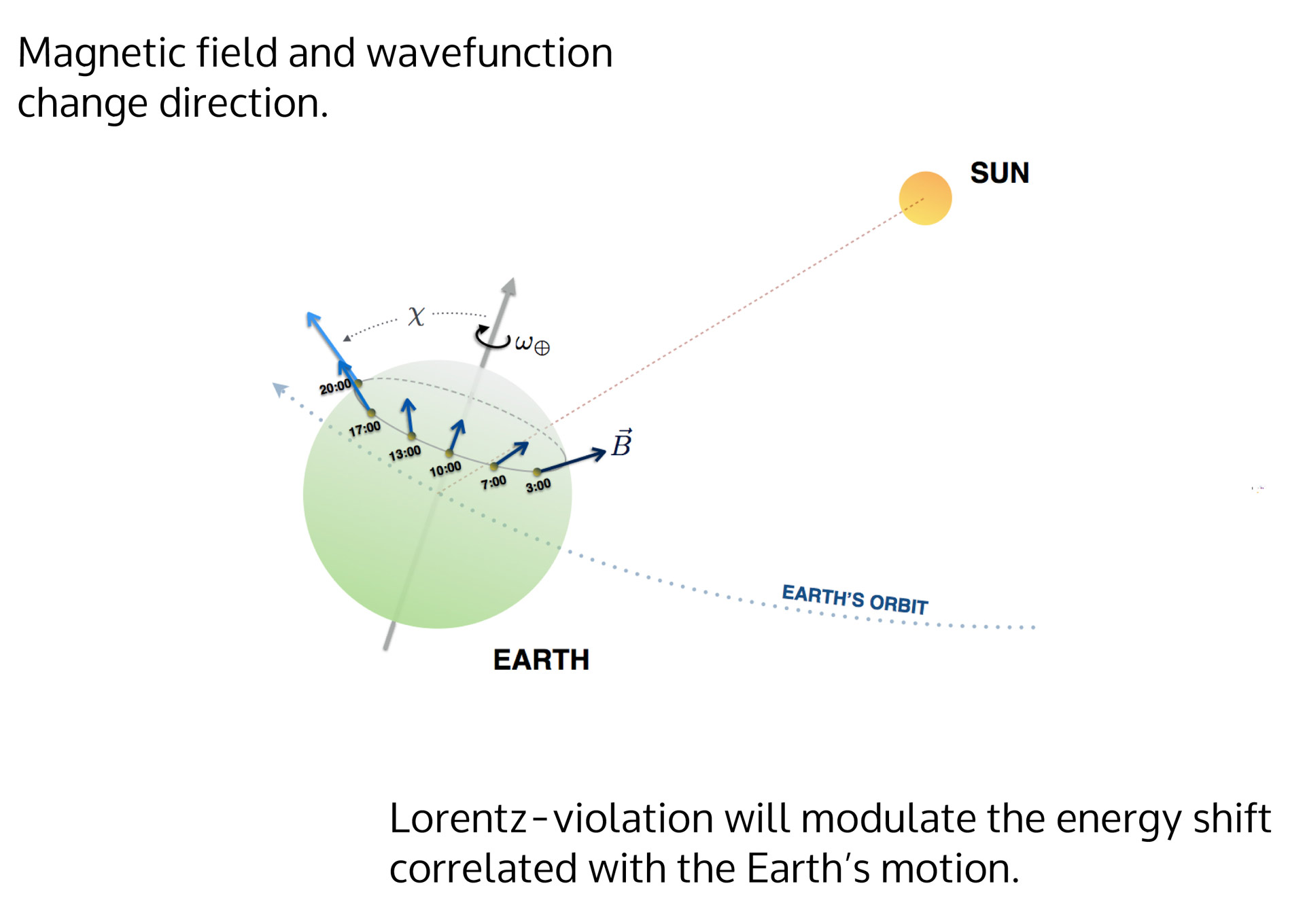
Häffner and his team conducted an experiment analogous to the Michelson-Morley experiment, but with electrons instead of photons of light. In a vacuum chamber, he and his colleagues isolated two calcium ions, partially entangled them as in a quantum computer, and then monitored the electron energies in the ions as Earth rotated over 24 hours.
If space were squeezed in one or more directions, the energy of the electrons would change with a 12-hour period. It didn’t, showing that space is in fact isotropic to one part in a billion billion (1018), 100 times better than previous experiments involving electrons, and five times better than experiments like Michelson and Morley’s that used light.
The results disprove at least one theory that extends the Standard Model by assuming some anisotropy of space, he said.
Häffner and his colleagues, including former graduate student Thaned Pruttivarasin, now at the Quantum Metrology Laboratory in Saitama, Japan, report their findings in the January 29 issue of the journal Nature.
Entangled qubits
Häffner came up with the idea of using entangled ions to test the isotropy of space while building quantum computers, which involve using ionized atoms as quantum bits, or qubits, entangling their electron wave functions, and forcing them to evolve to do calculations not possible with today’s digital computers. It occurred to him that two entangled qubits could serve as sensitive detectors of slight disturbances in space.
“I wanted to do the experiment because I thought it was elegant and that it would be a cool thing to apply our quantum computers to a completely different field of physics,” he said. “But I didn’t think we would be competitive with experiments being performed by people working in this field. That was completely out of the blue.”
He hopes to make more sensitive quantum computer detectors using other ions, such as ytterbium, to gain another 10,000-fold increase in the precision measurement of Lorentz symmetry. He is also exploring with colleagues future experiments to detect the spatial distortions caused by the effects of dark matter particles, which are a complete mystery despite comprising 27 percent of the mass of the universe.
“For the first time we have used tools from quantum information to perform a test of fundamental symmetries, that is, we engineered a quantum state which is immune to the prevalent noise but sensitive to the Lorentz-violating effects,” Häffner said. “We were surprised the experiment just worked, and now we have a fantastic new method at hand which can be used to make very precise measurements of perturbations of space.”
Reference: “Michelson–Morley analog for electrons using trapped ions to test Lorentz symmetry” by T. Pruttivarasin, M. Ramm, S. G. Porsev, I. I. Tupitsyn, M. S. Safronova, M. A. Hohensee and H. Häffner, 28 January 2015, Nature.
DOI: 10.1038/nature14091
Other co-authors are UC Berkeley graduate student Michael Ramm, former UC Berkeley postdoc Michael Hohensee of Lawrence Livermore National Laboratory, and colleagues from the University of Delaware and Maryland and institutions in Russia. The work was supported by the National Science Foundation.
Never miss a breakthrough: Join the SciTechDaily newsletter.
Follow us on Google and Google News.
1 Comment
In reading this I suppose I am left with the question as to why Black Holes, super-massive or micro do not have any effect in this experiment. If by a black holes very own nature space around it as one gets closer to the event horizon is compressed, twisted, and bent, then why is it in this experiment there seems to be no evidence that the fabric of space is being pulled or stretched in the direction of a black hole of any size. With that in mind, and assuming that the experiment is accurate in its readings, then can it be assumed that there is a counter force that exists within the universe that prevents the fabric of space from being pulled or stretched over light years from a black hole.