
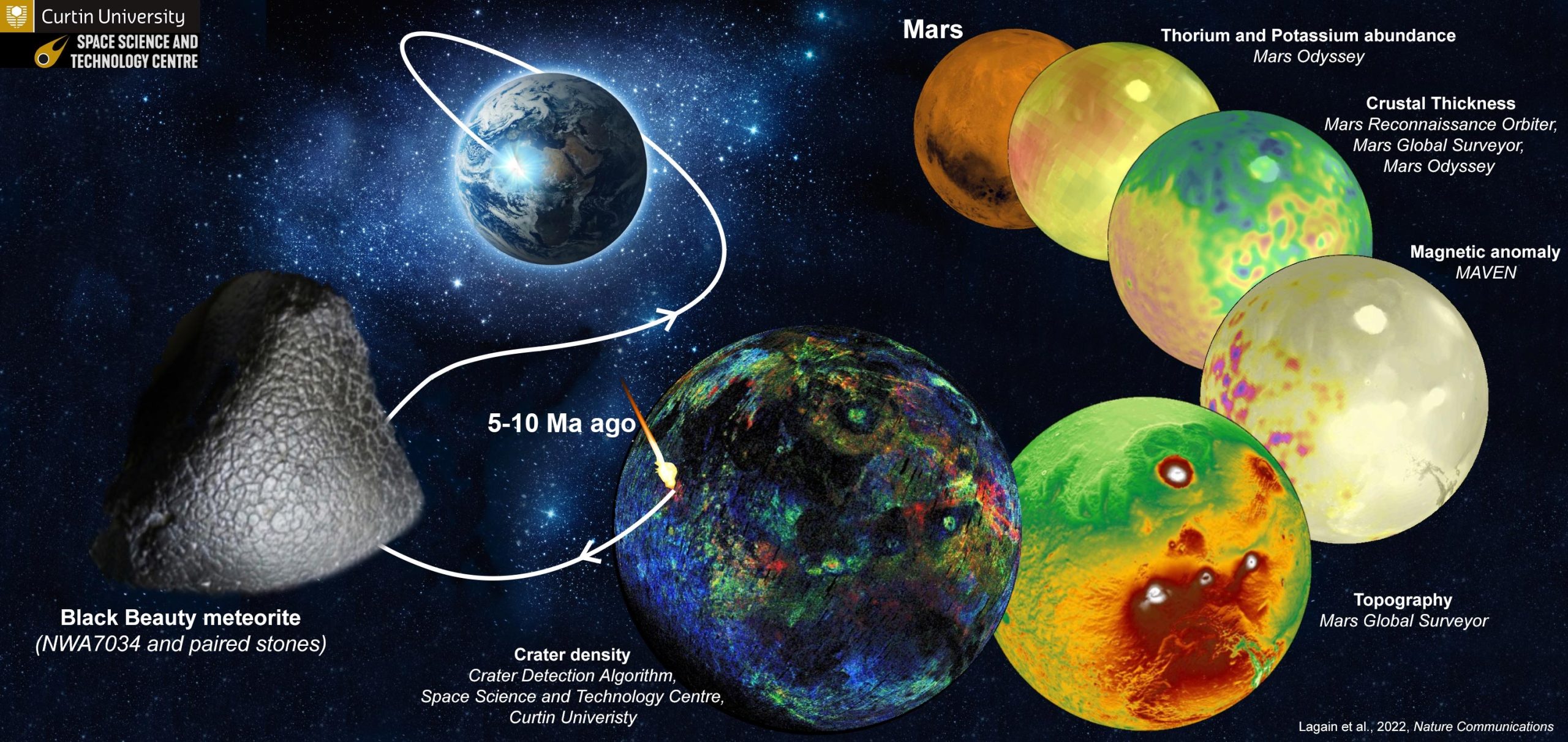
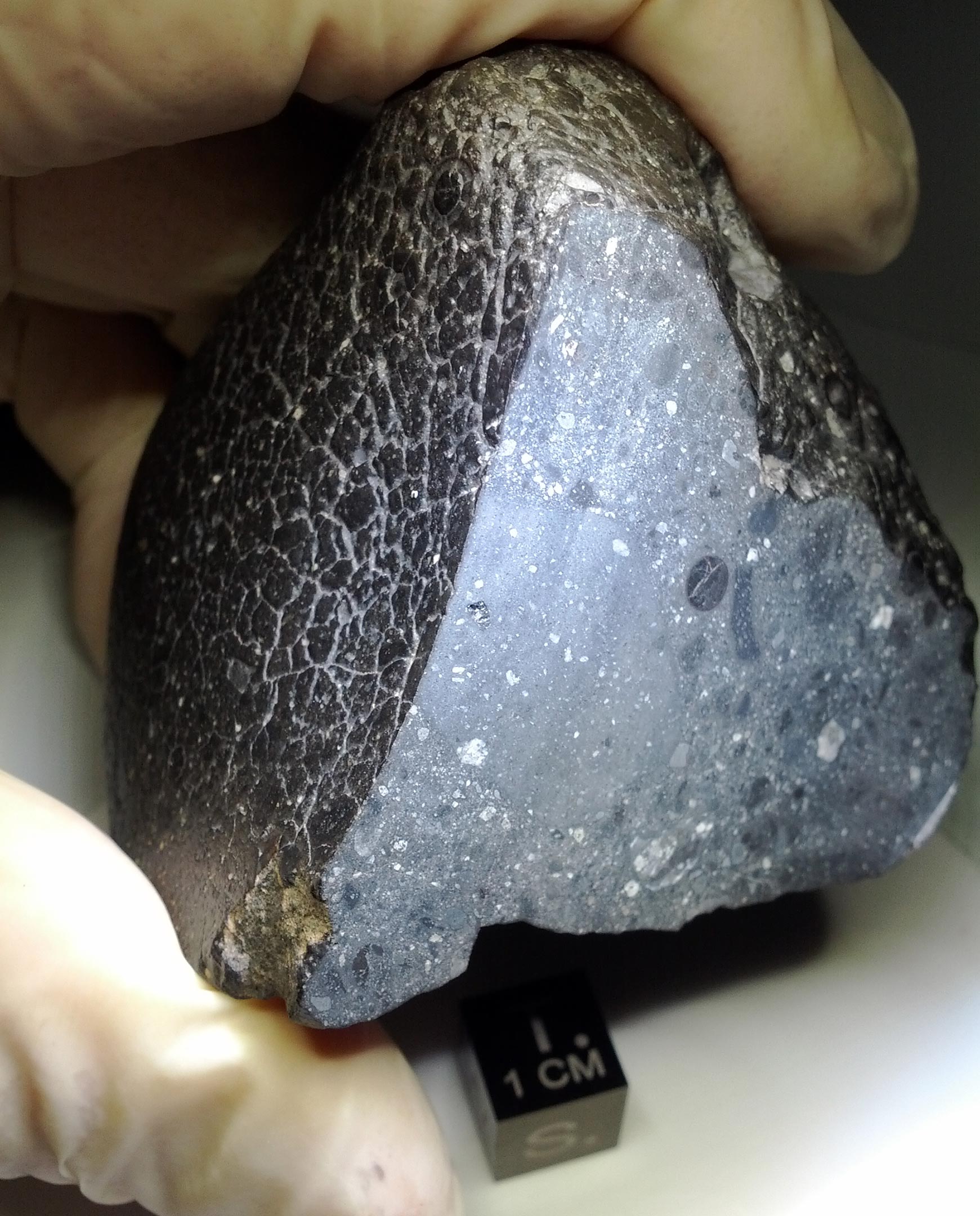
The Martian meteorite Black Beauty provides clues about Mars’ and Earth’s early evolution, offering insight into why Mars developed so differently from Earth.
What do Mars and Iceland have in common?
These days, not so much. However, more than 4.5 billion years ago, it’s possible the Red Planet had a crust comparable to Iceland today. This discovery, hidden in the oldest Martian fragments found on our planet, could provide information about Earth that was lost over billions of years of geological movement. It could also help explain why the Earth developed into a planet that sustains a broad diversity of life, while Mars did not.
These insights into Earth’s past came out of a new study that details how they found the likely Martian origin of the 4.48-billion-year-old meteorite, informally nicknamed Black Beauty. Its origin is one of the oldest regions of Mars. The study was published on July 12 in the journal Nature Communications, by an international team of researchers that includes a Northern Arizona University (NAU) scientist.
“This meteorite recorded the first stage of the evolution of Mars and, by extension, of all terrestrial planets, including the Earth,” said Valerie Payré, a postdoctoral researcher in the Department of Astronomy and Planetary Science. “As the Earth lost its old surface mainly due to plate tectonics, observing such settings in extremely ancient terrains on Mars is a rare window into the ancient Earth surface that we lost a long time ago.”
What Mars can tell us about Earth
The research team, led by Anthony Lagain from Curtin University in Australia, searched for the location of origin of a Martian meteorite (officially named NWA—Northwest Africa—7034 for where it was found on Earth). This meteorite, the chemistry of which indicates that Mars had volcanic activity to that found on Earth, recorded the first stage of Mars’ evolution. Although it was ejected from the surface of Mars five to 10 million years ago after an asteroid impact, its source region and geological context have remained a mystery.
To pinpoint where Black Beauty came from, this research team studied its chemical and physical properties. They determined it originated from Terra Cimmeria-Sirenum, one of the most ancient regions of Mars. It may have a surface similar to Earth’s continents. Planetary bodies like Mars have impact craters all over their surface, so finding the right one is challenging. In a previous study, Lagain’s team developed a crater detection algorithm that uses high-resolution images of the surface of Mars to identify small impact craters, finding about 90 million as small as 50 meters (160 feet) in diameter. In this study, they were able to isolate the most plausible ejection site—the Karratha crater that excavated the ejecta of an older crater named Khujirt.

“For the first time, we know the geological context of the only brecciated Martian sample available on Earth, 10 years before the NASA’s Mars Sample Return mission is set to send back samples collected by the Perseverance rover currently exploring the Jezero crater,” said Lagain, a research fellow in the School of Earth and Planetary Sciences at Curtin. “This research paved the way to locate the ejection site of other Martian meteorites, in order to create the most exhaustive view of the Red Planet’s geological history.”
Implications for Understanding Mars’ and Earth’s Crust
Payré studies the nature and formation of Mars’ crust to determine if Earth and Mars share a common past that includes both a continent-like and ocean-like crust. She uses orbital observations captured in this region to investigate whether traces of volcanism similar to Iceland exist on Mars.
“As of today, Mars’ crust complexity is not understood, and knowing about the origin of these amazing ancient fragments could lead future rover and spatial missions to explore the Terra Sirenum-Cimmeria region that hides the truth of Mars’ evolution, and perhaps the Earth’s,” she said. “This work paves the road to locate the ejection site of other Martian meteorites that will provide the most exhaustive view of the geological history of Mars and will answer one of the most intriguing questions: why Mars, now dry and cold, evolved so differently from Earth, a flourishing planet for life?”
The research team’s algorithm is adapted to detect impact craters constellating Mercury and the Moon, the other terrestrial bodies. This can be used to help unravel their geographical history and answer foundational questions regarding their formation and evolution. This work is a starting point to guide future investigations of the Solar System.
Reference: “Early crustal processes revealed by the ejection site of the oldest martian meteorite” by A. Lagain, S. Bouley, B. Zanda, K. Miljković, A. Rajšić, D. Baratoux, V. Payré, L. S. Doucet, N. E. Timms, R. Hewins, G. K. Benedix, V. Malarewic, K. Servis and P. A. Bland, 12 July 2022, Nature Communications.
DOI: 10.1038/s41467-022-31444-8
Never miss a breakthrough: Join the SciTechDaily newsletter.
Follow us on Google and Google News.
2 Comments
What would happen if you smoked a joint on Mars?
You would “blast off”!