
Close Menu
    Facebook X (Twitter) Instagram
    SciTechDaily
    • Biology
    • Chemistry
    • Earth
    • Health
    • Physics
    • Science
    • Space
    • Technology
    Facebook X (Twitter) Pinterest YouTube RSS
    SciTechDaily
    Home»Space»4.5 km Asteroid Tumbles Past Earth
    Space

    4.5 km Asteroid Tumbles Past Earth

    By Dr. Tony Phillips, Science@NASADecember 13, 2012No Comments3 Mins Read
    Facebook Twitter Pinterest Telegram LinkedIn WhatsApp Email Reddit
    Share
    Facebook Twitter LinkedIn Pinterest Telegram Email Reddit
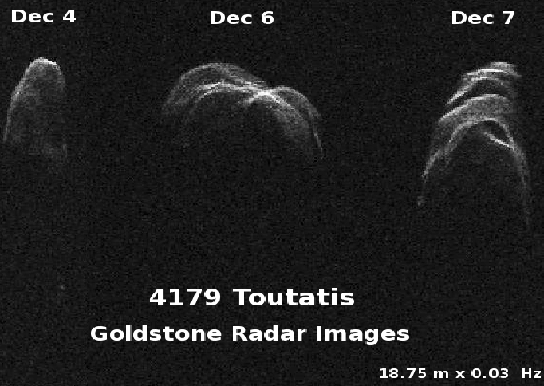
    Goldstone radar images of the asteroid Toutatis
    Goldstone delay-Doppler radar images of Toutatis from December 2012. Credit: NASA

    NASA’s Goldstone radar is capturing new images of the 4.5 km asteroid Toutatis as it passes by Earth this month.

    This week, NASA’s Goldstone radar is tracking a large asteroid as it passes by Earth, and obtaining unusually clear images of the tumbling space rock.

    “There is no danger of a collision with Earth,” says Lance Benner of NASA’s Near Earth Object Program. “At closest approach on December 12th, asteroid 4179 Toutatis will be 7 million km (4.3 million mi) away or 18 times farther than the Moon.”

    Asteroid Toutatis is well known to astronomers; it passes by Earth’s orbit every 4 years. Measuring 4.5 km (2.8 mi) in length, it is one of the largest known potentially hazardous asteroids (PHAs), and its orbit is inclined less than half-a-degree from Earth’s. No other kilometer-sized PHA moves around the Sun in an orbit so nearly coplanar with our own. This makes it an important target for radar studies.

    NASA’s Goldstone radar in the Mojave Desert will be pinging the space rock every day from December 4th through 22nd. The echoes highlight the asteroid’s topography and improve the precision with which researchers know the asteroid’s orbit.

    “We already know that Toutatis will not hit Earth for hundreds of years,” says Benner. “These new observations will allow us to predict the asteroid’s trajectory even farther into the future.”

    Benner and colleagues are particularly excited about a new digital imaging system at Goldstone that could reveal never-before-seen details on the asteroid’s surface. “Using the new system, we can now image the asteroid’s surface with 2 to 5 times finer resolution than previous flybys,” he says. “We may see something new on Toutatis.”

    The asteroid is already remarkable for the way that it spins. Unlike planets and the vast majority of asteroids, which rotate in an orderly fashion around a single axis, Toutatis travels through space tumbling like a badly thrown football (movie). One of the goals of the radar observations is to learn more about the asteroid’s peculiar spin state and how it changes in response to tidal forces from the Sun and Earth.

    It’s probably no coincidence that the tumbling asteroid is elongated and lumpy.

    “Toutatis appears to have a complicated internal structure,” says radar team member Michael Busch of the National Radio Astronomy Observatory. “Our radar measurements are consistent with the asteroid’s little lobe being ~15% denser than the big lobe, and they indicate 20% to 30% over-dense cores inside the two lobes.”

    This raises the interesting possibility that asteroid Toutatis is actually a mash-up of smaller space rocks. “Toutatis could be re-accumulated debris from an asteroid-asteroid collision in the main belt,” he says. The new observations will help test this idea.

    Busch points out that the upgraded Goldstone imaging system will produce data with a resolution of 3.75 meters (12.3 feet) per pixel. “We’ll be putting hundreds of thousands of pixels across the asteroid’s surface.”

    Never miss a breakthrough: Join the SciTechDaily newsletter.
    Follow us on Google and Google News.

    Asteroid Astronomy NASA
    Share. Facebook Twitter Pinterest LinkedIn Email Reddit

    Related Articles

    NASA’s Heat-Seeking Space Telescope Is Almost Ready to Spot Killer Asteroids

    Chunk of Moon Rock? NASA Tracks Asteroid 2024 PT5 During Close Earth Flyby

    Asteroid to Make a Record Close Approach to Earth on February 15

    Asteroid Apophis Will Make a Record Setting Close Approach to Earth

    New Images of Near-Earth Asteroid 2007 PA8

    NASA’s Dawn Gets a Close Up View of the Canuleia Crater on Vesta

    NASA’s WISE Uncovers New Clues on Jovian Trojans

    Orbits of a Near-Earth Asteroid and a Potentially Hazardous Asteroid

    Near Miss Asteroid – An Opportunity To Test a Rapid Response Program

    Leave A Reply Cancel Reply

    • Facebook
    • Twitter
    • Pinterest
    • YouTube

    Don't Miss a Discovery

    Subscribe for the Latest in Science & Tech!

    Trending News

    Popular Vitamin B3 Supplements May Help Cancer Cells Survive, Scientists Warn

    Scientists Discover Strange Property of Rice and Turn It Into a Smart Material

    NASA Artemis II Skips Burn As Astronaut Captures Stunning View of Earth

    NASA’s Artemis II: Humans Just Left Earth Orbit for the First Time Since 1972

    What Causes Chronic Pain? Scientists Identify Key Culprit in the Brain

    Semaglutide Shows Surprising Mental Health Benefits in Massive 100,000-Person Study

    This Liquid Snapped Instead of Flowing and Scientists Were Shocked

    Breakthrough Alzheimer’s Drug Rewires the Brain Instead of Just Clearing Plaques

    Follow SciTechDaily
    • Facebook
    • Twitter
    • YouTube
    • Pinterest
    • Newsletter
    • RSS
    SciTech News
    • Biology News
    • Chemistry News
    • Earth News
    • Health News
    • Physics News
    • Science News
    • Space News
    • Technology News
    Recent Posts
    • Scientists Uncover the Secret “Glue” That Helps Soil Hold Water
    • Climate Change Is Altering a Key Greenhouse Gas in a Way Scientists Didn’t Expect
    • Why Antarctic Sea Ice Suddenly Collapsed After Decades of Growth
    • Astronomers Discover the Most Pristine Star Ever Found
    • New Study Suggests Gravitational Waves May Have Created Dark Matter
    Copyright © 1998 - 2026 SciTechDaily. All Rights Reserved.
    • Science News
    • About
    • Contact
    • Editorial Board
    • Privacy Policy
    • Terms of Use

    Type above and press Enter to search. Press Esc to cancel.