
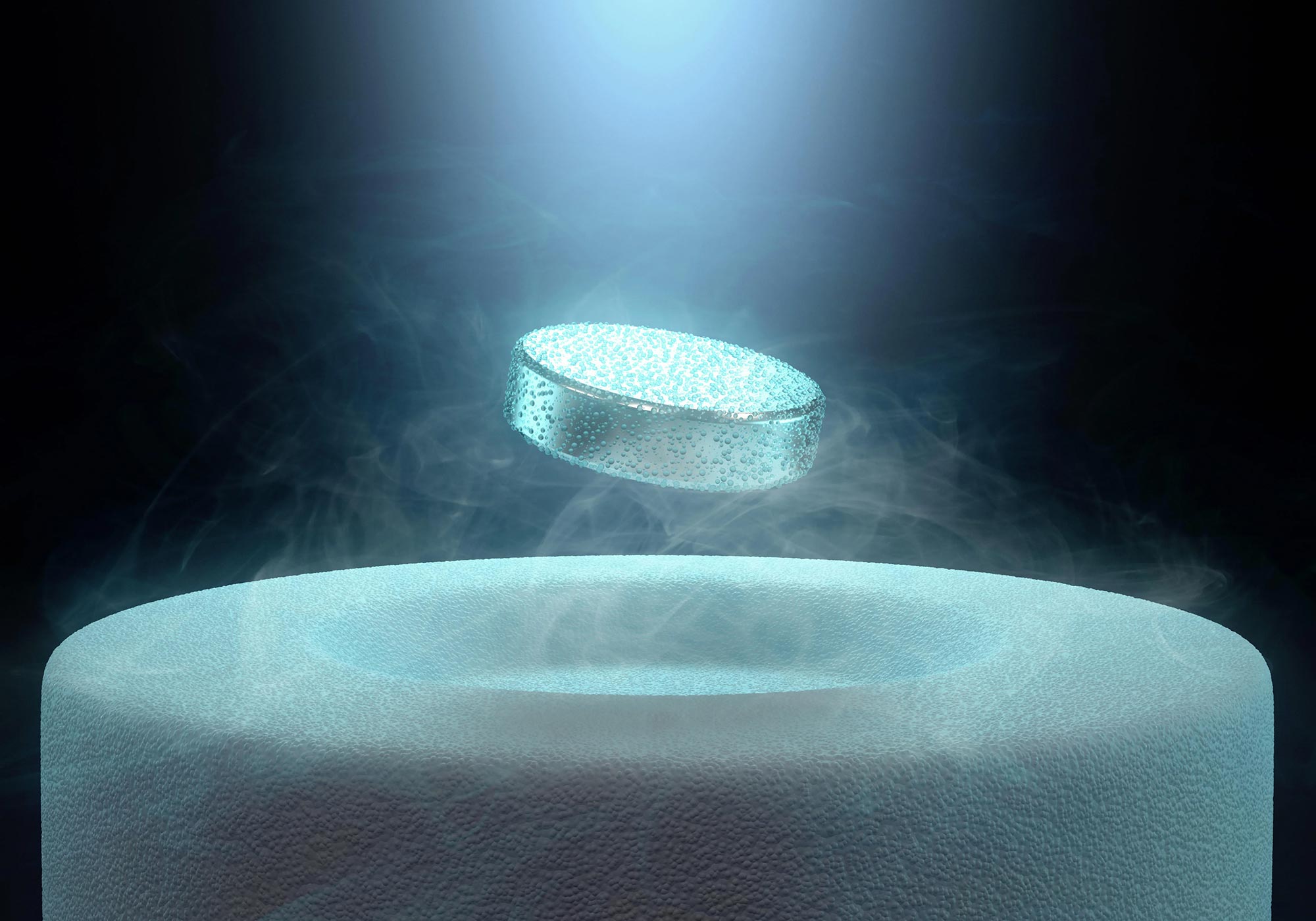
NUS scientists created the first copper-free superconductor to work above 30 K under ambient pressure, marking a major scientific leap. This discovery may revolutionize energy-efficient electronics.
Professor Ariando and Dr Stephen Lin Er Chow from the National University of Singapore (NUS) Department of Physics have designed and synthesised a groundbreaking new material—a copper-free superconducting oxide—capable of superconducting at approximately 40 Kelvin (K), or about minus 233 degrees Celsius (deg C), under ambient pressure. This discovery further advances NUS’ and Singapore’s leadership at the forefront of high-temperature superconductivity research.
Nearly four decades after the discovery of copper oxide superconductivity, which earned the 1987 Nobel Prize in Physics, the NUS researchers have now identified another high-temperature superconducting oxide that expands the understanding of unconventional superconductivity beyond copper oxides.
The promise of superconductors
Modern electronics generate heat and consume energy during operation. Superconductors, however, possess a unique property known as the zero-resistance state, which eliminates energy loss due to electrical resistance. In theory, this makes them ideal for modern electronic applications, addressing the world’s growing energy demands.

Despite the discovery of thousands of superconducting materials, the vast majority function only at extremely low temperatures near absolute zero (0 K), or about minus 273 deg C, making them impractical for widespread use.
The 1987 Nobel Prize Breakthrough
Nearly 40 years ago, physicists Johannes Bednorz and Karl Müller discovered a new class of superconducting materials: copper oxides. These materials exhibited superconductivity at temperatures above 30 kelvin, substantially higher than any known superconductor at the time.
Their groundbreaking discovery, which earned them the Nobel Prize in Physics, marked the beginning of high-temperature superconductivity research. Even today, copper oxides remain the only oxide materials known to exhibit superconductivity above 30 K (about −243°C) under ambient pressure, without the need for external lattice compression.
A breakthrough beyond copper
In a series of studies, Prof. Ariando and Dr. Chow established a direct link between interlayer interactions in layered materials and their superconducting transition temperatures.
Using this insight, they developed a phenomenological model that predicted several potential high-temperature superconductors, similar to copper oxides but without containing copper.
Among these predicted materials, the team successfully synthesized a nickel oxide compound, (Sm-Eu-Ca)NiO₂, and confirmed that it exhibits zero electrical resistance, clear evidence of superconductivity, at temperatures well above 30 K.

Dr Chow stated, “As we predicted and designed, this non-copper-based superconducting oxide demonstrates high-temperature superconductivity under atmospheric pressure at sea level, without the need for additional compression—just like copper oxides. This finding suggests that unconventional high-temperature superconductivity is not exclusive to copper but could be a more widespread property among elements in the periodic table.”
“This observation has profound implications for both theoretical understanding and experimental realisation of a broader scope of superconducting materials with practical applications in modern electronics,” added Prof Ariando.
The research breakthrough was published in the scientific journal Nature on 20 March 2025.
Expanding the frontier of high-temperature superconductors
“This is the first time since the Nobel-winning discovery that a copper-free high-temperature superconducting oxide has been found to function under ambient pressure,” emphasised Prof Ariando.
“Additionally, this new material is highly stable under ambient conditions, significantly improving its accessibility.”
This discovery has sparked growing interest, not only in the material itself but also in the broader potential for a new class of high-temperature superconductors.
Further research and future implications
The research team continues to investigate the material’s unique properties, exploring tuning parameters such as electronic occupancy shifting and hydrostatic pressure. These efforts aim to deepen the understanding of high-temperature superconducting mechanisms and pave the way for synthesizing a broader family of superconductors with even higher operating temperatures.
Another contributor to this work is Mr Zhaoyang Luo, an NUS PhD student with the research team, who demonstrated the high crystallinity and pure-phase nature of the synthesised material using electron microscopy.
This breakthrough represents a major step toward the development of next-generation superconducting materials, with practical applications in modern electronics and energy-efficient technologies.
Reference: “Bulk superconductivity near 40 K in hole-doped SmNiO2 at ambient pressure” by S. Lin Er Chow, Zhaoyang Luo and A. Ariando, 20 March 2025, Nature.
DOI: 10.1038/s41586-025-08893-4
Never miss a breakthrough: Join the SciTechDaily newsletter.
Follow us on Google and Google News.
4 Comments
This is very strange. The hype is a bit over the top.
Many years ago I saw the article pictured experiment done with a magnet, a piece of super conducting copper compound in a Styrofoam cup with coolant.
And it was certainly a lot warmer than the minus 387° F demonstrated in the article.
I saw a picture of a dog with a top hat but it was not the president. Hype.
It’s because of this kind of headline that I use a browser that blocks trackers
This is non-copper oxide superconductor. If you read the article you learn this is why the discovery is important. Based on their physics material model there are other elemental combinations that could have higher temperatures. This is direct proof of another way to existing to the high temperature superconductivity. It opens our understanding to clean more insights into superconductivity. The write up is not what I am defending, it is the research and the fact that it was achieved is important and has huge implications for future advances in the hope of meeting our energy storage and distribution challenges. Some are too critical of anything that gets attention. Some things get hyped but this is not as hyped as many things I am hearing today. Producing technology requiresdeepu understanding of the physics and mathematics but this is not what gets the huge attention. People want to be entertained and spoon fed. If it produces a cool fad it is desired but it is quickly yesterday’s thing. Providing something that changes generations often gets taken for granted. Such is the life of those who do the hard work. Unfortunately, today it is more rare to stop, consider, and thank the discoverers and pioneers who struggled to eventually accomplish their contribution to our life. We move on without a sense of respect for the value of the contribution. We want to be quickly entertained and if it doesn’t then it is thrown away. If you feel that you want to change spend some time studying science. Learn some math. Ask questions. Ask stupid questions. Seek to know how our “world” (nature, life, exploration, and systems) work. You will see pioneers and discoverers and you might even become one. More than in the past, ordinary people are contributing to sciences and mathematics. Criticism out of apathy is stupidity. Let’s rise above that.