
Close Menu
    Facebook X (Twitter) Instagram
    SciTechDaily
    • Biology
    • Chemistry
    • Earth
    • Health
    • Physics
    • Science
    • Space
    • Technology
    Facebook X (Twitter) Pinterest YouTube RSS
    SciTechDaily
    Home»Physics»Discovery Paves Way for Improved Quantum Computing Devices
    Physics

    Discovery Paves Way for Improved Quantum Computing Devices

    By University of QueenslandSeptember 7, 2021No Comments3 Mins Read
    Facebook Twitter Pinterest Telegram LinkedIn WhatsApp Email Reddit
    Share
    Facebook Twitter LinkedIn Pinterest Telegram Email Reddit

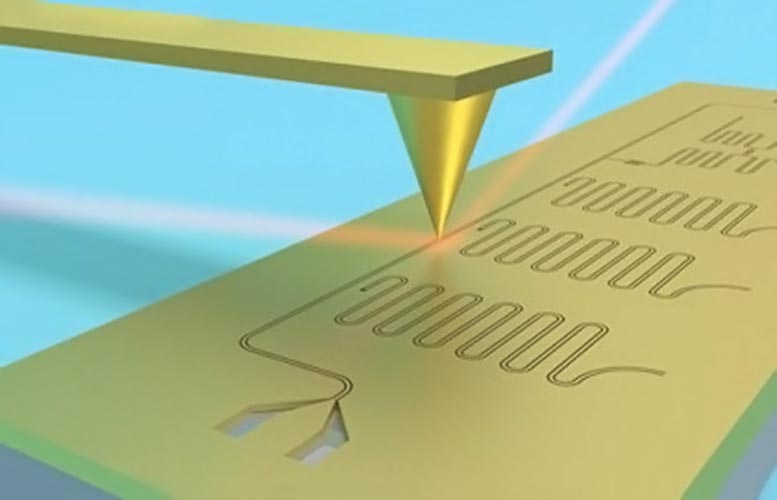
    Superconducting Circuit Silicon Chip Schematic
    Schematic of a superconducting circuit [thin black lines] on a silicon chip [yellow base], being imaged using terahertz scanning near-field microscopy [red beam focused into yellow tip]. Credit: University of Queensland
    Using THz SNOM, University of Queensland researchers identified nanoscale imperfections in superconducting quantum circuits that cause decoherence.

    Physicists and engineers have found a way to identify and address imperfections in materials for one of the most promising technologies in commercial quantum computing.

    The University of Queensland team was able to develop treatments and optimize fabrication protocols in common techniques for building superconducting circuits on silicon chips.

    Dr. Peter Jacobson, who co-led the research, said the team had identified that imperfections introduced during fabrication reduced the effectiveness of the circuits.

    Decoherence: A Barrier to Scalable Quantum Computing

    “Superconducting quantum circuits are attracting interest from industry giants such as Google and IBM, but widespread application is hindered by ‘decoherence’, a phenomenon which causes information to be lost,” he said.

    “Decoherence is primarily due to interactions between the superconducting circuit and the silicon chip – a physics problem – and to material imperfections introduced during fabrication – an engineering problem.

    “So we needed input from physicists and engineers to find a solution.”

     The team used a method called terahertz scanning near-field optical microscopy (THz SNOM) – an atomic force microscope combined with a THz light source and detector.

    This provided a combination of high spatial resolution – seeing down to the size of viruses – and local spectroscopic measurements.

    Professor Aleksandar Rakić said the technique enabled probing at the nanoscale rather than the macroscale by focusing light onto a metallic tip.  

    “This provides new access for us to understand where imperfections are located so we can reduce decoherence and help reduce losses in superconducting quantum devices,” Professor Rakić said.

    Common Fabrication Methods Introduce Hidden Defects

    “We found that commonly used fabrication recipes unintentionally introduce imperfections into the silicon chips, which contribute to decoherence.

    “And we also showed that surface treatments reduce these imperfections, which in turn reduces losses in the superconducting quantum circuits.”

    Associate Professor Arkady Fedorov said this allowed the team to determine where in the process defects were introduced and optimize fabrication protocols to address them.

    Protocol Optimization Without Destroying Devices

    “Our method allows the same device to be probed multiple times, in contrast to other methods that often require the devices to be cut up before being probed,” Dr. Fedorov said.

    “The team’s results provide a path towards improving superconducting devices for use in quantum computing applications.”

    In the future, THz SNOM could be used to define new ways to improve the operation of quantum devices and their integration into a viable quantum computer.

    Reference: “Near-field terahertz nanoscopy of coplanar microwave resonators” by Xiao Guo, Xin He, Zach Degnan, Bogdan C. Donose, Karl Bertling, Arkady Fedorov, Aleksandar D. Rakić and Peter Jacobson, 30 August 2021, Applied Physics Letters.
    DOI: 10.1063/5.0061078

    Never miss a breakthrough: Join the SciTechDaily newsletter.
    Follow us on Google and Google News.

    Materials Science Popular Quantum Computing Silicon Superconductor University of Queensland
    Share. Facebook Twitter Pinterest LinkedIn Email Reddit

    Related Articles

    Researchers Around the World Are Buzzing About a Candidate Superconductor Created at Quantum Foundry

    Unconventional Superconductor May Unlock New Ways To Build Quantum Computers

    Rare Superconductor Discovered – May Be Critical for the Future of Quantum Computing

    Exotic Superconductors: The Secret That Was Never There

    Quantum Entanglement of Electrons Using Heat

    Physicists Successfully Modify a Semiconductor to Create a Superconductor

    A Sensor So Good, It’s “Spooky” – Using Quantum Entanglement to Detect Magnetic Excitation

    High-Temperature Superconductor Study Reveals “Strange Metal” May Be “Densely Entangled Matter”

    New Insights Into How Superconducting Materials Interact With Magnetic Ones

    Leave A Reply Cancel Reply

    • Facebook
    • Twitter
    • Pinterest
    • YouTube

    Don't Miss a Discovery

    Subscribe for the Latest in Science & Tech!

    Trending News

    Wasp Colonies Explode Into Violence After Losing Their Queen

    Scientists Create “Living Plastic” That Self-Destructs in Just Six Days

    Your Blood May Carry a 700-Million-Year-Old Secret

    Scientists Discover Some “Zombie Cells” May Actually Help You Live Longer

    Earth May Be Seeding Venus With Life, According to New Research

    What Scientists Found Inside a 117-Year-Old Woman Reveals New Clues to Long Life

    Scientists Discover Mysterious Creature Living in the Great Salt Lake – and It Exists Nowhere Else on Earth

    It’s Alive? Surprising Discovery Changes What We Know About Fog

    Follow SciTechDaily
    • Facebook
    • Twitter
    • YouTube
    • Pinterest
    • Newsletter
    • RSS
    SciTech News
    • Biology News
    • Chemistry News
    • Earth News
    • Health News
    • Physics News
    • Science News
    • Space News
    • Technology News
    Recent Posts
    • Why Some Cancers Turn Deadly: Researchers Uncover a Hidden Trigger
    • The Best Exercise Combination for Longevity, According to a 30-Year Study
    • Popular Weight-Loss Drug Found To Slow Biological Aging in Landmark Human Trial
    • Hubble Captures a Stunning Spiral Galaxy Slowly Being Stripped of Its Future
    • Astronomers Detect a Close Pair of Supermassive Black Holes for the First Time
    Copyright © 1998 - 2026 SciTechDaily. All Rights Reserved.
    • Science News
    • About
    • Contact
    • Editorial Board
    • Privacy Policy
    • Terms of Use

    Type above and press Enter to search. Press Esc to cancel.