
Close Menu
    Facebook X (Twitter) Instagram
    SciTechDaily
    • Biology
    • Chemistry
    • Earth
    • Health
    • Physics
    • Science
    • Space
    • Technology
    Facebook X (Twitter) Pinterest YouTube RSS
    SciTechDaily
    Home»Space»Cosmic Rays – Originating From Supernova Remnants and Pulsars – May Be Key to Understanding Galactic Dynamics
    Space

    Cosmic Rays – Originating From Supernova Remnants and Pulsars – May Be Key to Understanding Galactic Dynamics

    By American Institute of PhysicsSeptember 6, 2021No Comments4 Mins Read
    Facebook Twitter Pinterest Telegram LinkedIn WhatsApp Email Reddit
    Share
    Facebook Twitter LinkedIn Pinterest Telegram Email Reddit
    Galaxy Universe Concept
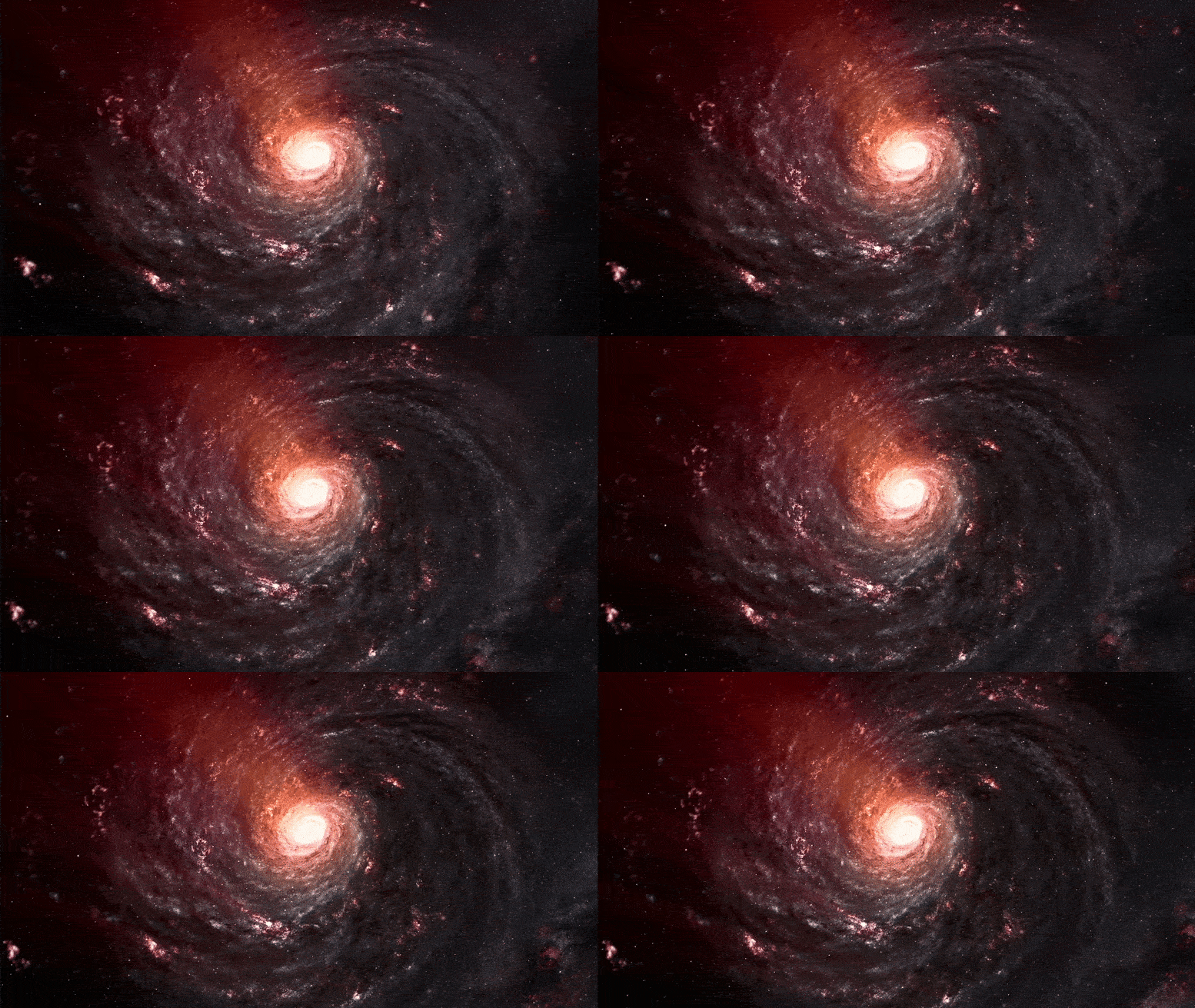
    Cosmic rays were traditionally seen as somewhat separate in the galaxy’s “ecology.” However, due to greater-than-expected instability around cosmic ray sources like supernova remnants and pulsars, these particles likely have a more significant impact on galactic dynamics and the star formation cycle than previously believed.

    Speedy cosmic rays, originating from supernova remnants and pulsars, likely impact galactic dynamics and star formation far more than previously known.

    Cosmic rays are charged subnuclear particles that move close to the speed of light, constantly raining down on the Earth. These particles are relativistic, as defined by Albert Einstein’s special relativity, and manage to generate a magnetic field that controls the way they move within the galaxy.

    Gas within the interstellar medium is composed of atoms, mostly hydrogen and mostly ionized, meaning its protons and electrons are separated. While moving around within this gas, cosmic rays kickstart the background protons, which causes a collective plasma wave movement akin to the ripples on a lake when you toss in a stone.

    The big question is how cosmic rays deposit their momentum into the background plasma that composes the interstellar medium. In Physics of Plasmas, from AIP Publishing, plasma astrophysicists in France review recent developments within the field of studying the streaming instability triggered by cosmic rays within astrophysical and space plasma.

    How Waves and Particles Interact
    This illustration shows how waves and particles interact — wave amplitude is growing while particle drift speed is dropping due to scattering. Credit: A. Marcowith, A.J. van Marle, and I. Plotnikov

    Shifting Perspectives on Galactic Ecology

    “Cosmic rays may help explain aspects of our galaxy from its smallest scales, such as protoplanetary disks and planets, to its largest scales, such as galactic winds,” said Alexandre Marcowith, from the University of Montpellier.

    Until now, cosmic rays were viewed as being a bit apart within galaxy “ecology.” But because instability works well and is stronger than expected around cosmic ray sources, such as supernova remnants and pulsars, these particles likely have far more impacts on galactic dynamics and the star formation cycle than previously known.

    “This is not really a surprise, but more of a paradigm shift,” Marcowith said. “In science and astrophysics, everything is connected.”

    Supernova shock waves expanding the interstellar/intergalactic medium “are known to accelerate cosmic rays, and because cosmic rays are streaming away, they may have contributed to generating the magnetic field seeds necessary to explain the actual magnetic field strengths we observe around us,” said Marcowith.

    Wave Damping, Heating, and Scattering Effects

    After the amplitude of a plasma wave is reduced or damped over time, much like those generated by a stone thrown into a lake, it heats the gas of the plasma. Meanwhile, it helps scatter cosmic rays.

    For this to occur, the waves need wavelengths of the same order as the cosmic ray gyro radius. Cosmic rays possess a helical (spiral) motion around the magnetic field, and its radius is called the Larmor radius.

    “Say you are driving a car on a winding road. If the wavelength is of the same order as your wheel size, it will be difficult to drive,” said Marcowith.

    Cosmic rays are strongly scattered by these waves, and the main instability at the origin of these perturbations (waves) is the streaming instability associated with the collective streaming motion of cosmic rays.

    “There are several fields of research in astrophysics using similar numerical techniques to investigate the impact of this streaming instability within different astrophysical contexts such as supernova remnants and jets,” said Marcowith. “This instability and turbulence it creates may be the source of many astrophysical phenomena, and it shows how cosmic rays play a role in the big circus of our Milky Way.”

    Reference: “The cosmic ray-driven streaming instability in astrophysical and space plasmas” by A. Marcowith, A. J. van Marle and I. Plotnikov, 24 August 2021, Physics of Plasmas.
    DOI: 10.1063/5.0013662

    Never miss a breakthrough: Join the SciTechDaily newsletter.
    Follow us on Google and Google News.

    American Institute of Physics Astrophysics Plasma Popular
    Share. Facebook Twitter Pinterest LinkedIn Email Reddit

    Related Articles

    New Way Invented To Produce Oxygen on Mars for Future Explorers

    Physicist Quantifies Amount of Information in Entire Visible Universe

    3D Model Provides New Insight into the Turbulent Death Throes of Supernovas

    Possible Death of Solar System Seen in White Dwarf Stars

    Rogue Planets Captured by Stars

    Ancient Galactic Collision Created Stellar Swirls of NGC 5907

    The Bolshoi Simulation: Boxing the Universe

    Scientists Convene to Take a Picture of the Supermassive Black Hole at the Center of the Milky Way

    Black Hole Fires Cosmic Bullets of Ionized Gases

    Leave A Reply Cancel Reply

    • Facebook
    • Twitter
    • Pinterest
    • YouTube

    Don't Miss a Discovery

    Subscribe for the Latest in Science & Tech!

    Trending News

    AI Could Detect Early Signs of Alzheimer’s in Under a Minute – Far Before Traditional Tests

    What if Dark Matter Has Two Forms? Bold New Hypothesis Could Explain a Cosmic Mystery

    This Metal Melts in Your Hand – and Scientists Just Discovered Something Strange

    Beef vs. Chicken: Surprising Results From New Prediabetes Study

    Alzheimer’s Breakthrough: Scientists Discover Key Protein May Prevent Toxic Protein Clumps in the Brain

    Quantum Reality Gets Stranger: Physicists Put a Lump of Metal in Two Places at Once

    Scientists May Have Found the Key to Jupiter and Saturn’s Moon Mystery

    Scientists Uncover Brain Changes That Link Pain to Depression

    Follow SciTechDaily
    • Facebook
    • Twitter
    • YouTube
    • Pinterest
    • Newsletter
    • RSS
    SciTech News
    • Biology News
    • Chemistry News
    • Earth News
    • Health News
    • Physics News
    • Science News
    • Space News
    • Technology News
    Recent Posts
    • What if Your Memories Never Happened? Physicists Take a New Look at the Boltzmann Brain Paradox
    • Students Found an Ancient Star That Shouldn’t Be in the Milky Way
    • Astronomers Solve 50-Year Mystery and Reveal Hidden Culprit Behind Strange X-Ray Emissions
    • One of the Universe’s Largest Stars May Be Getting Ready To Explode
    • Scientists Discover Enzyme That Could Supercharge Ozempic-Like Weight Loss Drugs
    Copyright © 1998 - 2026 SciTechDaily. All Rights Reserved.
    • Science News
    • About
    • Contact
    • Editorial Board
    • Privacy Policy
    • Terms of Use

    Type above and press Enter to search. Press Esc to cancel.