
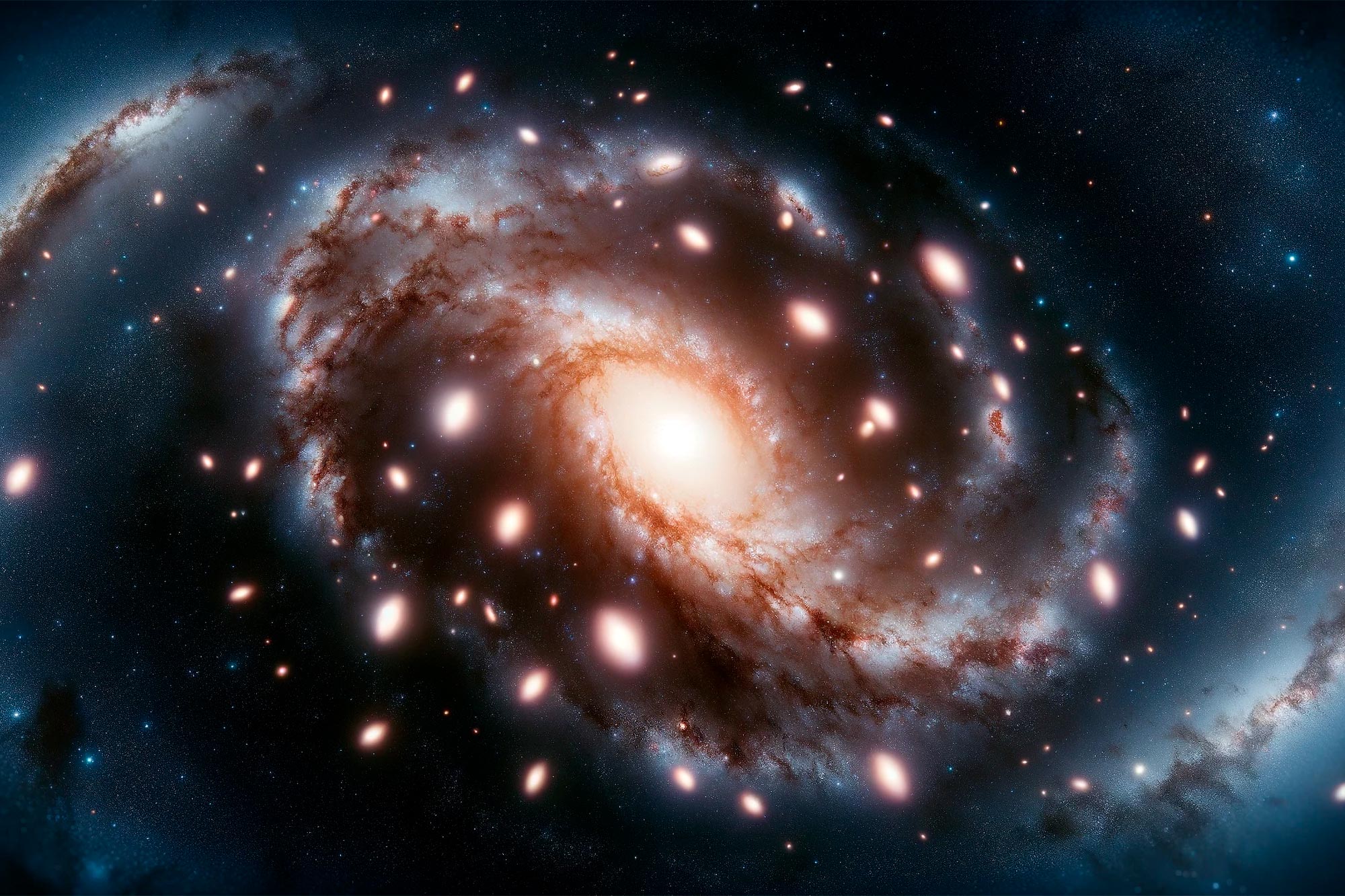
Recent Gaia satellite findings suggest that dwarf galaxies are transient and less influenced by dark matter than previously believed, challenging long-held assumptions about their nature and composition.
Commonly thought to be long-lived satellites of our galaxy, a new study now finds indications that most dwarf galaxies might in fact be destroyed soon after their entry into the Galactic halo. Thanks to the latest catalog from ESA’s Gaia satellite, an international team has now demonstrated that dwarf galaxies might be out of equilibrium. The study opens important questions on the standard cosmological model, particularly on the prevalence of dark matter in our nearest environment.
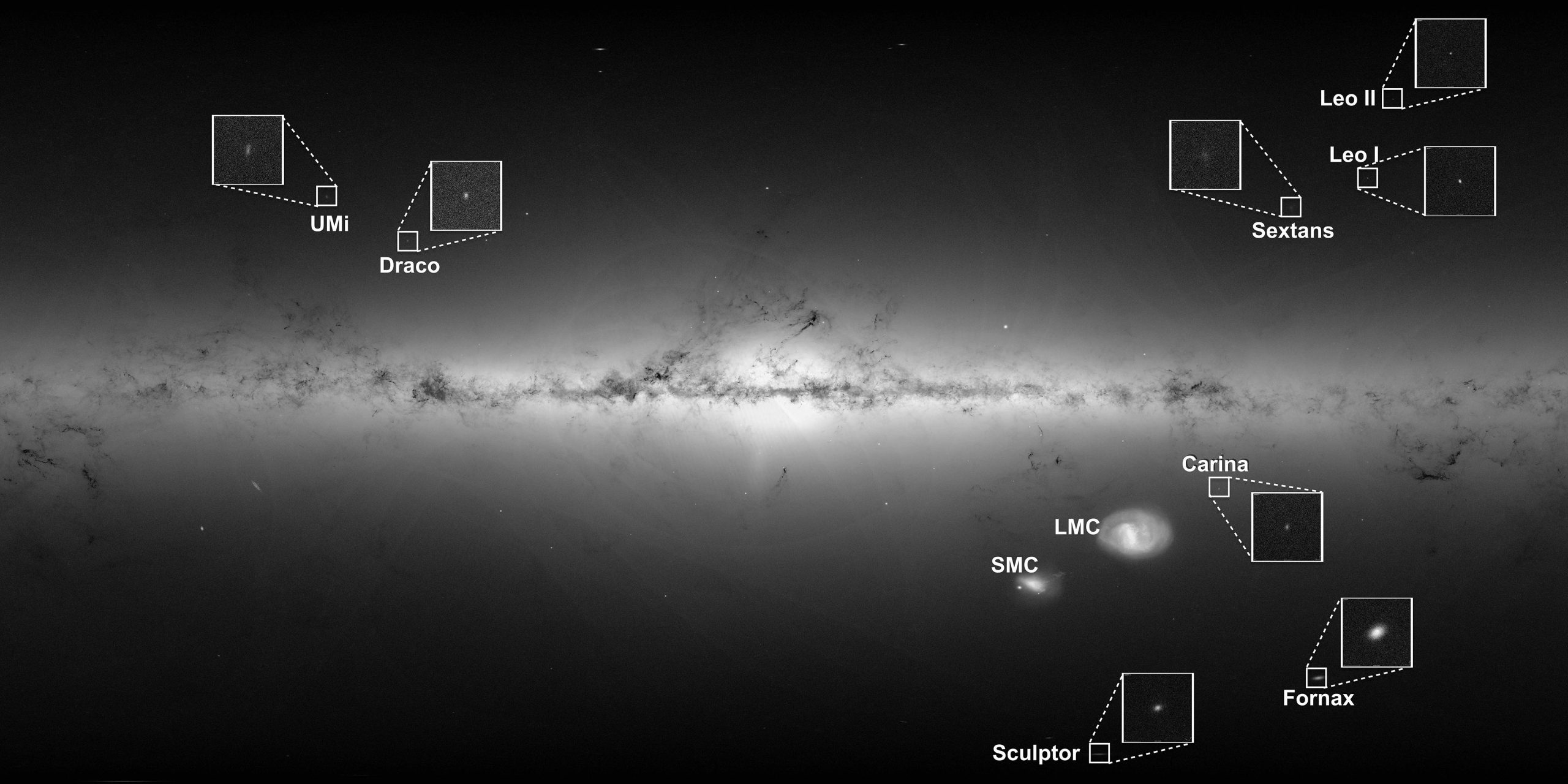
It has long been assumed that the dwarf galaxies around the Milky Way are ancient satellites orbiting our Galaxy for nearly 10 billion years. This required them to contain huge amounts of dark matter to protect them from the enormous tidal effects due to the gravitational pull of our galaxy. It was assumed that dark matter caused the large differences observed in the velocities of the stars within these dwarf galaxies.
New Insights on Dwarf Galaxy Dynamics
The latest Gaia data has now revealed a completely different view of dwarf galaxy properties. Astronomers from the Paris Observatory – PSL, the Centre national de la recherche scientifique (CNRS) and the Leibniz Institute for Astrophysics Potsdam (AIP) were able to date the history of the Milky Way, thanks to the relationship that connects the orbital energy of an object to its epoch of entry into the halo, the time they became first captured by the Milky Way’s gravitational field: Objects that arrived early, when the Milky Way was less massive, have lower orbital energies than recent arrivals.
The orbital energies of most dwarf galaxies are surprisingly substantially larger than that of the Sagittarius dwarf galaxy that entered the halo 5 to 6 billion years ago. This implies that most dwarf galaxies arrived much more recently, less than three billion years ago.
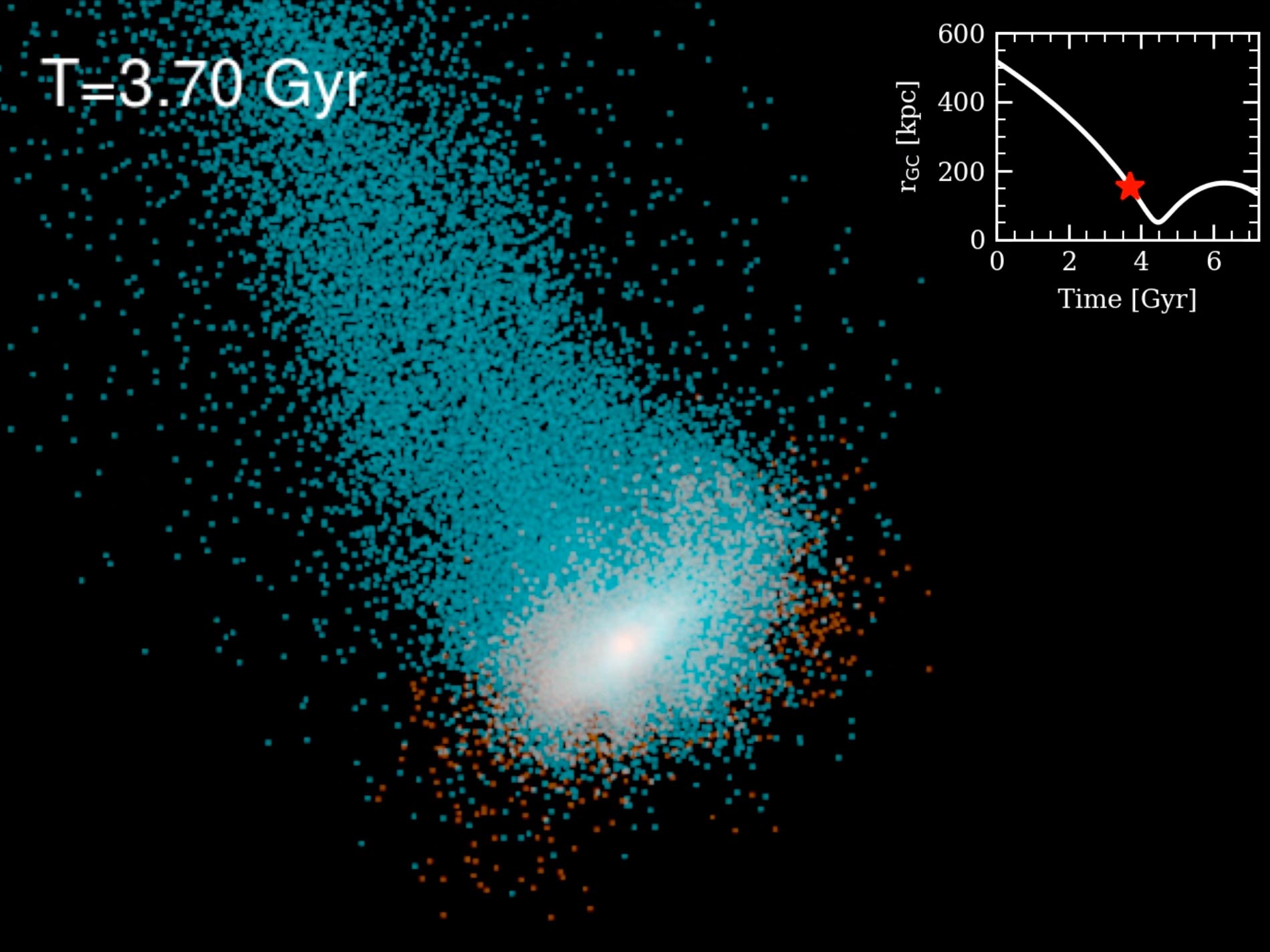
Video from a simulation of the transformation of a gas-rich and rotation-dominated galaxy into a spherical dwarf galaxy after it first enters the Milky Way halo. Here an analogue of the Sculptor dwarf galaxy is shown, with the gas represented in blue and stars in orange. The gas is stripped when the dwarf is closest to the Milky Way (distance shown in the upper right corner), resulting in a rapid expansion of the stars. The model thus predicts a large envelope of distant stars around the remnant of the dwarf galaxy. However, fading to the depth of optical observations illustrates that this envelope of stars is too faint to be easily detected. Credit: Jianling Wang, François Hammer
Transformation and Gas Loss in Dwarf Galaxies
Such a recent arrival implies that the nearby dwarfs come from outside the halo, where almost all dwarf galaxies are observed to contain huge reservoirs of neutral gas. The gas-rich galaxies lost their gas when they collided with the hot gas of the Galactic halo. The violence of shocks and turbulence in the process completely changed the dwarf galaxies. While the previously gas-rich dwarf galaxies were dominated by the rotation of gas and stars, when they are transformed into gas-free systems their gravity becomes balanced by the random motions of their remaining stars.
Dwarf galaxies lose their gas in a process so violent that it puts them out of equilibrium, which means that how fast their stars move is no longer in balance with their gravitational acceleration. The combined effects of gas loss and gravitational shocks due to the dive into the Galaxy nicely explain the wide spread of velocities of the stars within the dwarf galaxy remnant.
Rethinking Dark Matter’s Role
One of the curiosities of this study is the role of dark matter. First, the absence of an equilibrium prevents any estimation of the dynamical mass of the Milky Way dwarfs and their dark matter content. Second, while in the previous scenario dark matter protected the supposed stability of dwarf galaxies, invoking dark matter becomes rather awkward for objects out of balance. In fact, if the dwarf would already contain a lot of dark matter, it would have stabilized its initial rotating disk of stars, preventing the dwarf’s transformation into a galaxy with random stellar motions as observed.
Implications and Questions Raised
The described recent arrival of dwarf galaxies and their transformations in the halo explain well many observed properties of these objects, in particular why they have stars at large distances from their center. Their properties seem compatible with an absence of dark matter, contrary to the previous understanding of dwarf galaxies as the most dark-matter dominated objects.
Many questions now arise, such as: Where are the many dark matter dominated dwarf galaxies that the standard cosmological mode expects around the Milky Way? How can we infer the dark matter content of a dwarf galaxy if equilibrium cannot be assumed? What other observations could discriminate between the proposed out-of-equilibrium dwarf galaxies and the classical picture with dark matter dominated dwarfs?
Reference: “The accretion history of the Milky Way – II. Internal kinematics of globular clusters and of dwarf galaxies” by Francois Hammer, Jianling Wang, Gary A Mamon, Marcel S Pawlowski, Yanbin Yang, Yongjun Jiao, Hefan Li, Piercarlo Bonifacio, Elisabetta Caffau and Haifeng Wang, 20 November 2023, Monthly Notices of the Royal Astronomical Society.
DOI: 10.1093/mnras/stad2922
Never miss a breakthrough: Join the SciTechDaily newsletter.
Follow us on Google and Google News.
1 Comment
First image hints at a donut hamburger morphology, which naturally leads me to a seltzer tablet interpretation for the other two images.