
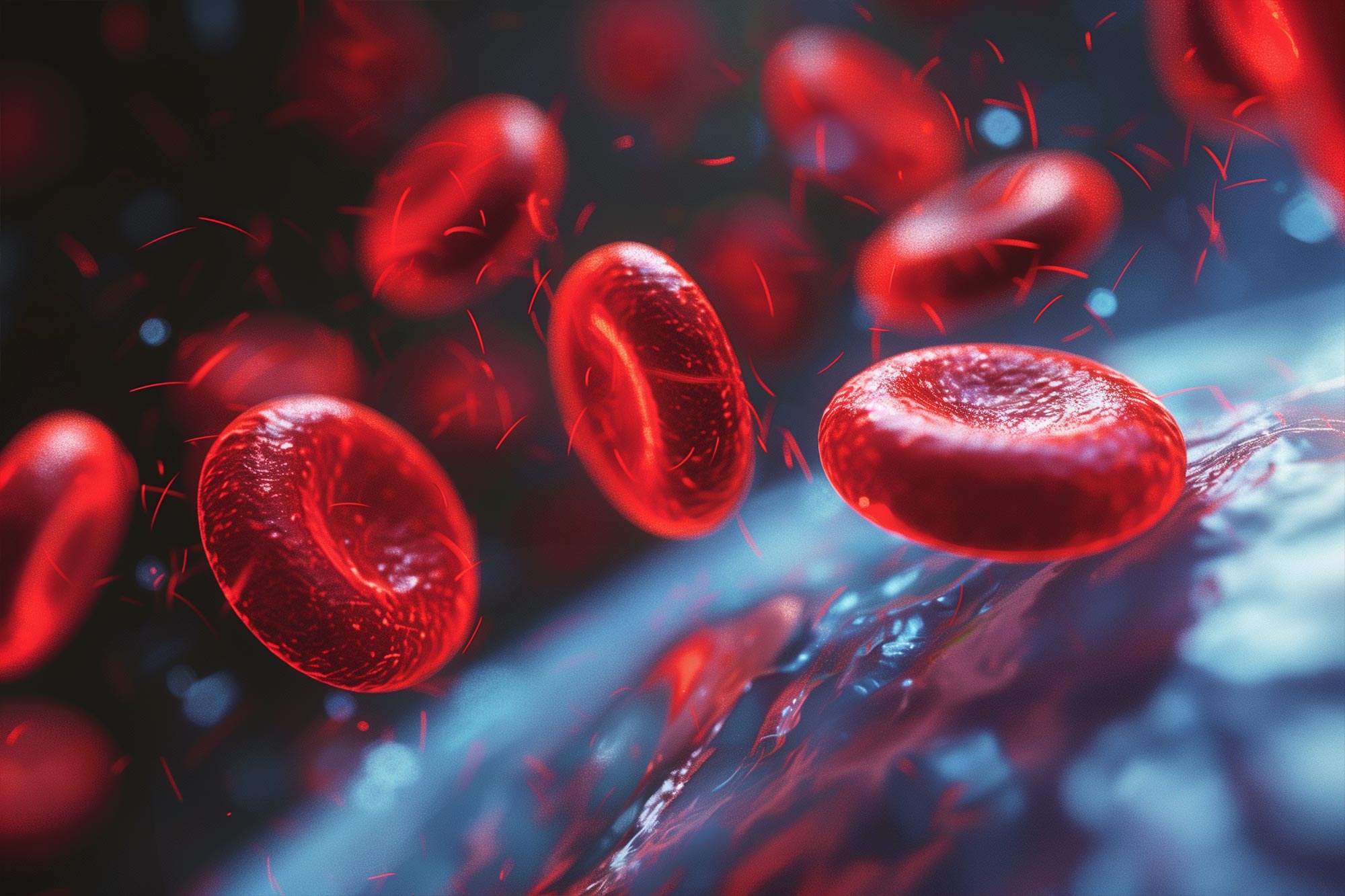
Penn researchers have revealed that red blood cells, not just platelets, play an active role in clot contraction.
For years, scientists believed that red blood cells simply tagged along during clot formation without doing much. A new study from the University of Pennsylvania now shows they play an active part in helping clots tighten and contract.
“This discovery reshapes how we understand one of the body’s most vital processes,” says Rustem Litvinov, a senior researcher at the Perelman School of Medicine (PSOM) and co-author of the study. “It also opens the door to new strategies for studying and potentially treating clotting disorders that cause either excessive bleeding or dangerous clots, like those seen in strokes.”
The research, recently published in Blood Advances, challenges the long-standing belief that only platelets—the tiny fragments responsible for sealing wounds—are responsible for clot contraction. The Penn team demonstrated that red blood cells themselves play a direct role in strengthening and stabilizing clots as they shrink.
“Red blood cells have been studied since the 17th century,” says co-author Prashant Purohit, Professor in Mechanical Engineering and Applied Mechanics within Penn Engineering. “The surprising fact is that we’re still finding out new things about them in the 21st century.”
An Unexpected Finding
Until now, researchers believed that only platelets were responsible for clot contraction. These tiny cell fragments pull on rope-like strands of the protein fibrin to tighten and stabilize clots.
“Red blood cells were thought to be passive bystanders,” says co-author John Weisel, Professor of Cell and Developmental Biology within PSOM and an affiliate of the Bioengineering graduate group within Penn Engineering. “We thought they were just helping the clot to make a better seal.”
In this timelapse, a blood clot (in white) contracts, despite being engineered to have no platelets. Credit: Rustem Litvinov
That assumption began to unravel when Weisel and Litvinov ran a test they expected to fail. They created blood clots without platelets. “We expected nothing to happen,” says Weisel. “Instead, the clots shrank by more than 20%.”
To double-check their results, the team repeated the experiment using regular blood treated with chemicals to block platelet activity. The clots still contracted. “That’s when we realized red blood cells must be doing more than just taking up space,” says Litvinov.
Modeling the Mechanics of Blood Clots
To figure out how red blood cells were driving this unexpected behavior, the team turned to Purohit, a mechanical engineer by training.
An expert on soft materials like blood clots and gels, Purohit developed a mathematical model that suggested that red blood cells compact together primarily due to “osmotic depletion.”

This process also explains how particles in colloids — mixtures like paint, milk or muddy water — can gather and form clusters when the conditions around them change.
“Essentially, the proteins in the surrounding fluid create an imbalance in pressure that pushes red blood cells together,” says Purohit. “This attractive force causes them to pack more tightly, helping the clot contract even without platelets.”
How Clotting Works Without Platelets
As blood begins to clot, a web-like protein called fibrin forms a mesh that traps red blood cells and pulls them close together. “That packing sets the stage for osmotic depletion forces to take over,” says Purohit.
Once the red blood cells are packed tightly within the fibrin mesh, proteins in the surrounding fluid are squeezed out from the narrow spaces between the cells. This creates an imbalance: the concentration of proteins is higher outside the packed cells than between them, which results in a difference in “osmotic pressure.”
That pressure difference acts like a squeeze from the outside, pushing the red blood cells even closer together. “This attraction causes the cells to aggregate and transfer mechanical forces to the fibrin network around them,” adds Purohit. “The result is a stronger, more compact clot, even without the action of platelets.”
Validating the Model
Prior research suggested another possible explanation: bridging, in which the attraction between small molecules on the surface of red blood cells causes them to adhere.
“Our model suggested the bridging effect was real,” says Purohit, “but much smaller than the effect of osmotic depletion.”
To test the model, first author Alina Peshkova, now a postdoctoral researcher in Pharmacology within PSOM, performed a series of experiments on modified blood clots.
In the absence of the molecules that cause the bridging effect, the clots still contracted, but little contraction occurred in an environment designed to prevent osmotic depletion.
“We experimentally confirmed what the model predicted,” says Peshkova. “It’s an example of theory and practice coming together to support each other.”
Fighting Clotting Diseases and Strokes
Gaining a better understanding of the role red blood cells play in the formation and maturation of clots could lead to new treatments for conditions like thrombocytopenia, in which low platelet counts can cause uncontrolled bleeding.
The findings could also shed light on how clots break into fragments that travel through the bloodstream and cause blockages — known as embolisms — that can trigger strokes.
“Ultimately, our model is going to be helpful in understanding, preventing, and treating diseases related to clotting inside the bloodstream,” says Purohit.
Reference: “Red blood cell aggregation within a blood clot causes platelet-independent clot shrinkage” by Alina D. Peshkova, Ekaterina K. Rednikova, Rafael R. Khismatullin, Oleg V. Kim, Vladimir R. Muzykantov, Prashant K. Purohit, Rustem I. Litvinov and John W. Weisel, 10 July 2025, Blood Advances.
DOI: 10.1182/bloodadvances.2024015533
This study was conducted at the University of Pennsylvania Perelman School of Medicine (PSOM) and the School of Engineering and Applied Science and was supported by the National Institutes of Health (R01 HL148227, P01 HL146373, R01 HL148014 and R01 HL159256), and the American Heart Association (25POST1357254/2025).
Never miss a breakthrough: Join the SciTechDaily newsletter.
Follow us on Google and Google News.
3 Comments
great
Which shows why we should not be using mRNA Covid shots to manufacture spike protein copies inside red blood cells with which to prime our immune systems to battle Covid.
If this were a valid approach, our own human body would have long ago developed and adopted this technique.
God’s Creation.