
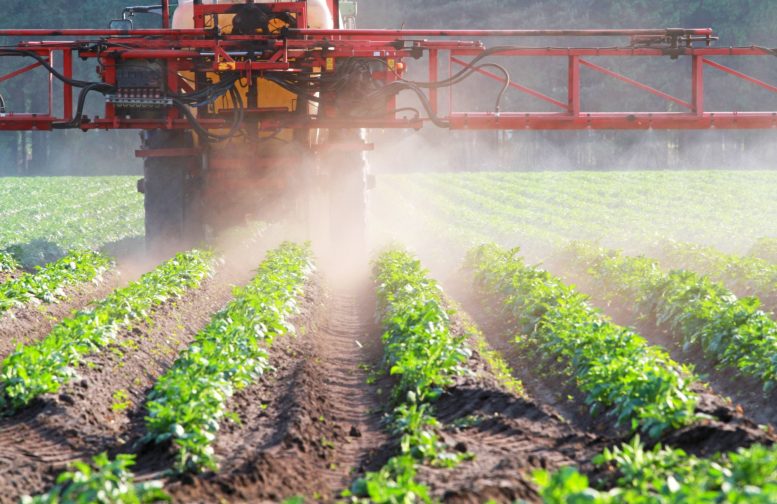
Amines Can Have a Damaging Effect on Human and Environmental Health
“Dicamba drift,” or the movement of the herbicide dicamba through the atmosphere, can cause unintentional damage to surrounding plants. Other chemicals, usually amines, are added with dicamba to “lock” it in place and prevent it from volatilizing, or turning into a vapor that flows more readily in the atmosphere.

New research has now shed new light on this story by establishing for the first time that these amines themselves volatilize, frequently more than dicamba itself. The research was conducted by the lab of Kimberly Parker, an assistant professor of energy, environmental, and chemical engineering at Washington University in St. Louis.
The study was recently published in the journal Environmental Science & Technology.
The volatilization of amines when combined with dicamba may help explain the mechanisms that cause dicamba drift. However, amines are also used in other herbicides, such as glyphosate, the most widely used herbicide globally. Regardless of herbicide, the researchers discovered that amines still volatilized.
If amines are released into the environment, they may have a negative impact on human health by forming cancer-promoting substances. They also have an impact on atmospheric chemistry and climate. Because of their potential danger and prevalence, the scientific literature is full of studies on how they are released into the atmosphere — except when used in herbicide-amine formulations.
“Amines also undergo reactions to form particulate matter — tiny particles that can make their way into the body when inhaled,” Parker said. “Those particles are also toxic and carcinogenic,” and they carry consequences for atmospheric chemistry by affecting climate.
Overlooked Source of Atmospheric Amines
“Researchers have looked at industrial applications, animal operations, and environmental sources of amines, but no one has looked at herbicides at all, as far as we have seen, despite the fact that large quantities of herbicide-amine mixtures are being sprayed onto crops across the country,” Parker said.
“We were really surprised to see that this source had been overlooked.”
Her lab has done research into the use of amines with herbicides in agriculture. In those scenarios, the amines were added to stop the herbicide dicamba from volatilizing. The technique often was ineffective, however, and the dicamba wound up drifting to nearby crops.
First author Stephen Sharkey, a Ph.D. student in Parker’s lab, led that earlier research studying dicamba volatilization from dicamba-amine mixtures and wondered, “If the dicamba is volatilizing, what’s happening to the amine that’s supposed to be there stopping the volatilization process?”
To find out, Sharkey measured the change in the amount of amines present over time when mixed with different herbicides. The results? In all mixtures, the amines volatilized from the herbicide-amine mixtures. Sharkey also worked with the lab of Brent Williams, an associate professor of energy, environmental and chemical engineering, to confirm that the amines were entering the gas phase from herbicide-amine mixtures by capturing amines from the air to measure.
In agricultural settings, Parker pointed out, amines are not only mixed with dicamba, but also with other herbicides, including 2,4-D and the widely used glyphosate.
Quantifying Amines in the Atmosphere
In addition to experimentation, Sharkey also quantified the amount of amines that were actually entering the atmosphere, which required a bit of detective work. He used two separate data sets — estimated rates of herbicide applications and survey data from U.S. farmers that showed which specific amines were used with different herbicides.
Sharkey concluded that herbicide use is responsible for the release of about 4 gigagrams (4,000 metric tons) of amines annually in the United States.
The findings came somewhat as a surprise to Parker, not only because the chemistry doesn’t immediately suggest that amines volatilize in this way, but also for a more practical reason.
“There has been extensive work looking at the different ways in which amines enter the atmosphere,” she said. “There has been a lot of effort put into understanding where amines come from, but research into its use with herbicides just wasn’t considered before.”
Reference: “Amine Volatilization from Herbicide Salts: Implications for Herbicide Formulations and Atmospheric Chemistry” by Stephen M. Sharkey, Anna M. Hartig, Audrey J. Dang, Anamika Chatterjee, Brent J. Williams and Kimberly M. Parker, 23 September 2022, Environmental Science & Technology.
DOI: 10.1021/acs.est.2c03740
The study was funded by the American Chemical Society Petroleum Research Fund and the National Science Foundation.
Never miss a breakthrough: Join the SciTechDaily newsletter.
Follow us on Google and Google News.
7 Comments
I wish I could send this article to every hardcore vegetarian out there who tries to make meat eaters feel guilty of destroying the planet.
I’m not surprised at all that this has been conveniently “overlooked”. Many scientists believe that herbicides and insecticides are the single greatest cause of increasing cancers and ill health on earth. Yes, cows do release tons of methane every year, which increases global warming. But I personally would rather deal with that than deal with all of these chemicals being released into our air, soils and water poisoning all of us at a slow rate, so that we don’t notice it, like a lobster slowly being boiled in a pot.
As I tell my vegetarian friends, when I eat a nice grass-fed piece of organic steak, I am eating the most ancient and purest food on earth. And unlike plants, meat doesn’t create poisons or chemicals or contain things like oxalates that are meant to deter other things from eating it. But when they eat a nice “organic” salad, it’s not really organic because our soils contain all of the past herbicides and insecticides from decades ago. So they are literally ingesting chemicals in a nice green package.
Good luck with that.
Amen. Locally-produced and organic is indeed the only answer. Meat or no meat.
I agree with you 💯 % Mic drop.
The 3 wars… covid. Ukraine and legalized sprays and insecticides
The chemical war is winning but is far worse in its effects than a bullet
The amines are an issue in both vegetable production for human consumption and feed production for animal consumption. I get lots of amine damage from lawn spraying drift as well. In addition,I have to avoid Bermuda grass sprayed with persistent herbacides bc I compost and use it on sensitive broad leaf plants (tomatoes particularly). The broadleaf plants my cows forage and I feed to laying hens gets herbacide damage from amine drift. Definitely not about vegetarian vs meat eater.
There is a certain political party that isn’t happy with just taking your money, they want to kill you too: Monsanto with Agent Orange… DuPont has so many, but their PFAS are pretty ingenious. Dow, Syngenta, etc. All the same political party, all trying to Kill you, and succeeding. They won’t even make a product unless it can Kill you, what fun would that be. Eat up, Drink up. Watch them poison you and your children simply because it’s fun. Johnson & Johnson Kills mothers and their babies…
New research. Is there a relationship Mad cow, meat consumption and dementia?
Countries consuming less beef have less dementia