
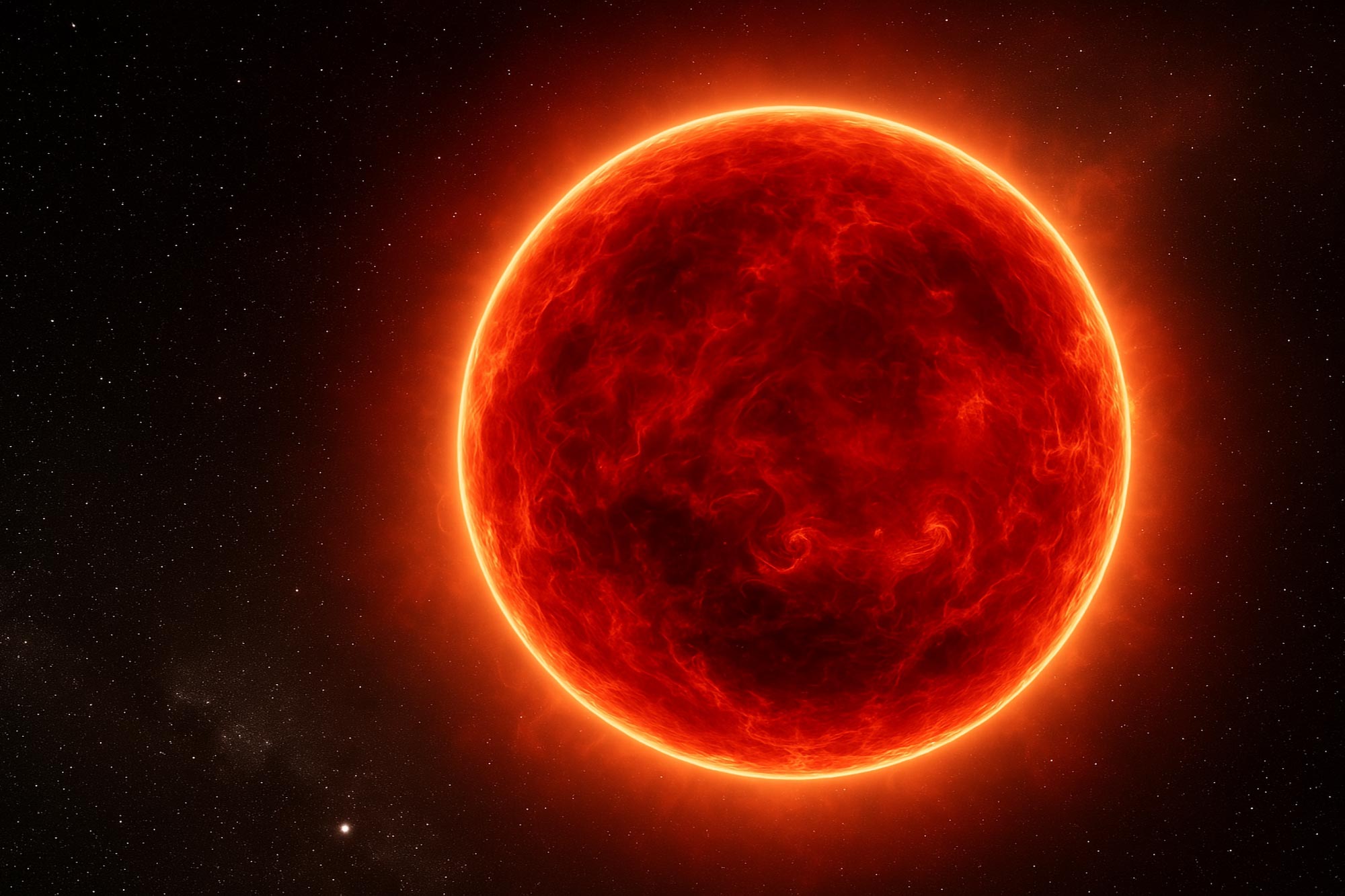
New high-resolution simulations reveal that stellar rotation plays a crucial role in transporting material inside red giant stars.
Recent advances in supercomputing have helped astronomers solve a long-standing mystery about red giant stars. Scientists have long wondered why the chemical makeup at the surfaces of these stars changes as they age and grow larger.
For decades, researchers could not fully explain how changes deep inside a red giant eventually appear at the surface. Nuclear reactions in the star’s core alter its internal chemistry. However, a stable layer separates the inner region from the outer convective envelope. This barrier prevents material from moving easily between the two zones, leaving scientists unsure how elements travel from the interior to the surface.
A new study published in Nature Astronomy by researchers from the University of Victoria’s (UVic) Astronomy Research Centre (ARC) and the University of Minnesota now provides an answer.
The solution? Stellar rotation.
“Using high-resolution 3D simulations, we were able to identify the impact that the rotation of these stars was having on the ability for elements to cross the barrier,” says Simon Blouin, lead researcher and postdoctoral fellow at UVic. “Stellar rotation is crucial and provides a natural explanation for the observed chemical signatures in typical red giants. This discovery is another step forward in understanding how stars evolve.”
Observing Changes in Stellar Chemistry
Astronomers have known for many years that Sun-like stars eventually run out of hydrogen fuel in their cores. When this happens, the stars expand dramatically and become red giants that can grow to as much as 100 times their original size.
Since the 1970s, scientists have detected clear changes in the surface chemistry of these expanding stars. One notable example is a drop in the ratio of carbon-12 compared with carbon-13. These changes suggest that material produced deep inside the star must somehow reach the surface. Until now, researchers could not confirm the physical process responsible for that transport.
“We knew that internal waves, generated by churning motions in the convective envelope, were able to pass through this barrier layer, but previous simulations found that these waves transported very little material. We were able to show that the rotation of the star dramatically amplifies how effectively these waves can mix material across the barrier, to an extent that matches the observed changes in surface composition,” says Simon Blouin, a UVic postdoctoral fellow.
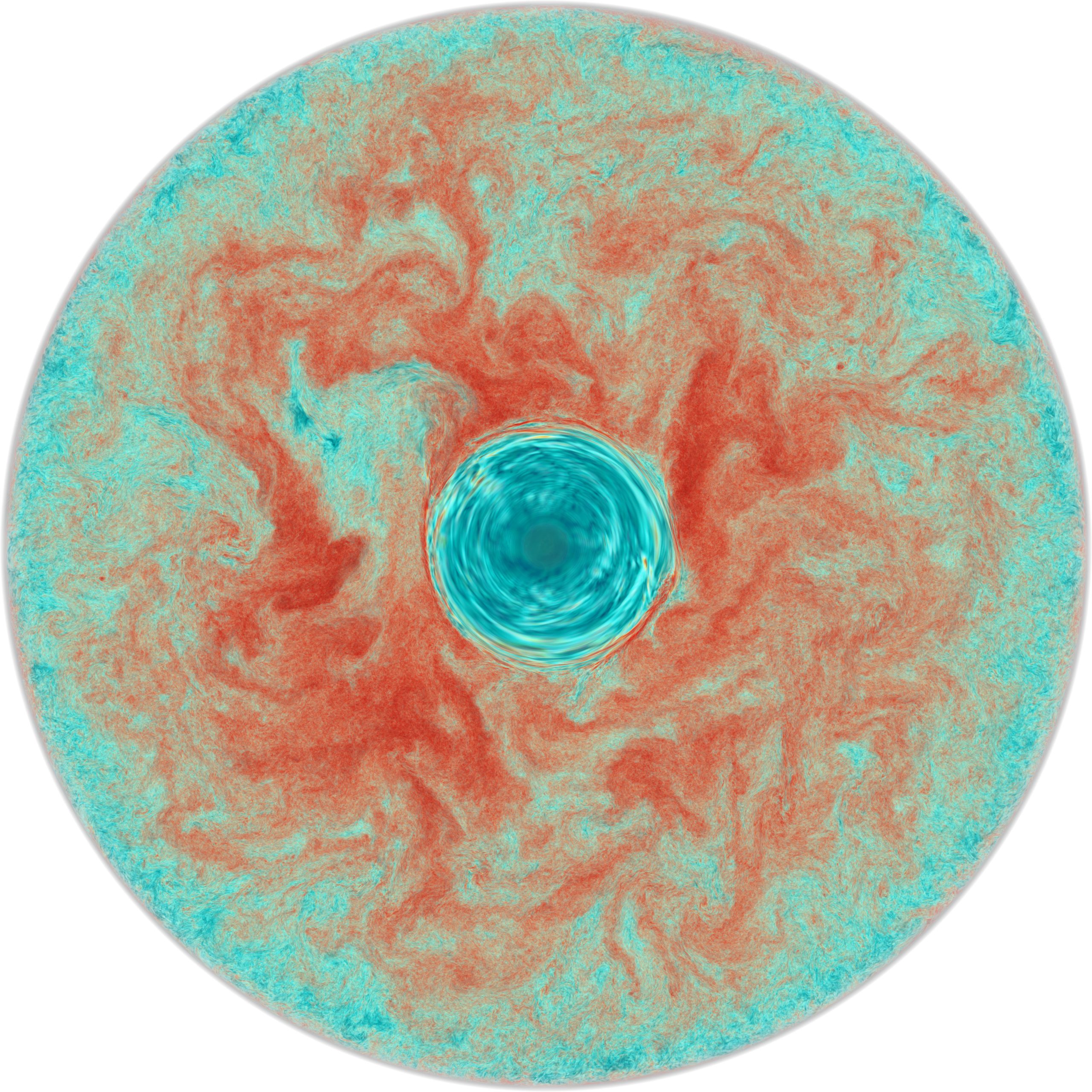
Blouin and his colleagues discovered that mixing inside the modeled star can occur more than 100 times faster than in stars that do not rotate. The simulations also show that mixing becomes even stronger as rotation speeds increase. Because red giants represent a future stage in the life of our own Sun, these findings provide new clues about how the Sun will evolve billions of years from now.
The important role of supercomputers
To reach these conclusions, the research team performed hydrodynamical simulations. These large three-dimensional models track how material moves inside stars and require enormous computing power.
Such calculations are extremely demanding, and they were only possible thanks to the latest generation of supercomputers.
“Until recently, while stellar rotation was thought to be part of solving this conundrum, limited computing abilities prevented us from quantitatively testing the hypothesis,” says Falk Herwig, principal investigator and director of ARC. “These simulations allow us to tease out small effects to determine what actually happens, helping us to understand our observations.”
The team carried out their simulations using computing systems at the Texas Advanced Computing Centre at the University of Texas at Austin and the new Trillium supercomputing cluster at SciNet at the University of Toronto.
Trillium, which launched in August 2025, is among the most powerful supercomputers available for large parallel academic simulations in Canada. It is part of the national network supported by the Digital Research Alliance of Canada. The system’s expanded computing capacity played a crucial role in completing this research.
“We were able to discover a new stellar mixing process only because of the immense computing power of the new Trillium machine. These are the computationally most intensive stellar convection and internal gravity wave simulations performed to date,” states Falk Herwig, professor of physics and astronomy and director of ARC.
Broader Applications and Future Research
The computational techniques used to simulate stellar convection apply broadly to understanding flows in the natural world—from ocean currents to atmospheric dynamics to blood flow. Herwig is also working with researchers across these fields to develop shared approaches and infrastructure for large-scale flow simulations.
Blouin plans to continue investigating stellar rotation. While this research studied one particular type of star, he is interested in exploring what happens in other stars, including how different rotation profiles affect how efficiently the star mixes, and whether rotation also enhances wave mixing in other types of stars and evolutionary phases.
Reference: “Wave-driven mixing enhanced by rotation in red giant branch stars” by Simon Blouin, Paul R. Woodward, Pavel A. Denissenkov, Praneet Pathak and Falk Herwig, 29 December 2025, Nature Astronomy.
DOI: 10.1038/s41550-025-02743-z
This research was supported by the Natural Sciences and Engineering Research Council (NSERC), the National Science Foundation (NSF) and the US Department of Energy.
Never miss a breakthrough: Join the SciTechDaily newsletter.
Follow us on Google and Google News.