
Close Menu
    Facebook X (Twitter) Instagram
    SciTechDaily
    • Biology
    • Chemistry
    • Earth
    • Health
    • Physics
    • Science
    • Space
    • Technology
    Facebook X (Twitter) Pinterest YouTube RSS
    SciTechDaily
    Home»Technology»5G Wireless May Lead to Inaccurate Weather Forecasts Due to Radiation “Leakage”
    Technology

    5G Wireless May Lead to Inaccurate Weather Forecasts Due to Radiation “Leakage”

    By Rutgers UniversitySeptember 24, 2020No Comments3 Mins Read
    Facebook Twitter Pinterest Telegram LinkedIn WhatsApp Email Reddit
    Share
    Facebook Twitter LinkedIn Pinterest Telegram Email Reddit
    5G Leakage and Weather Forecasts
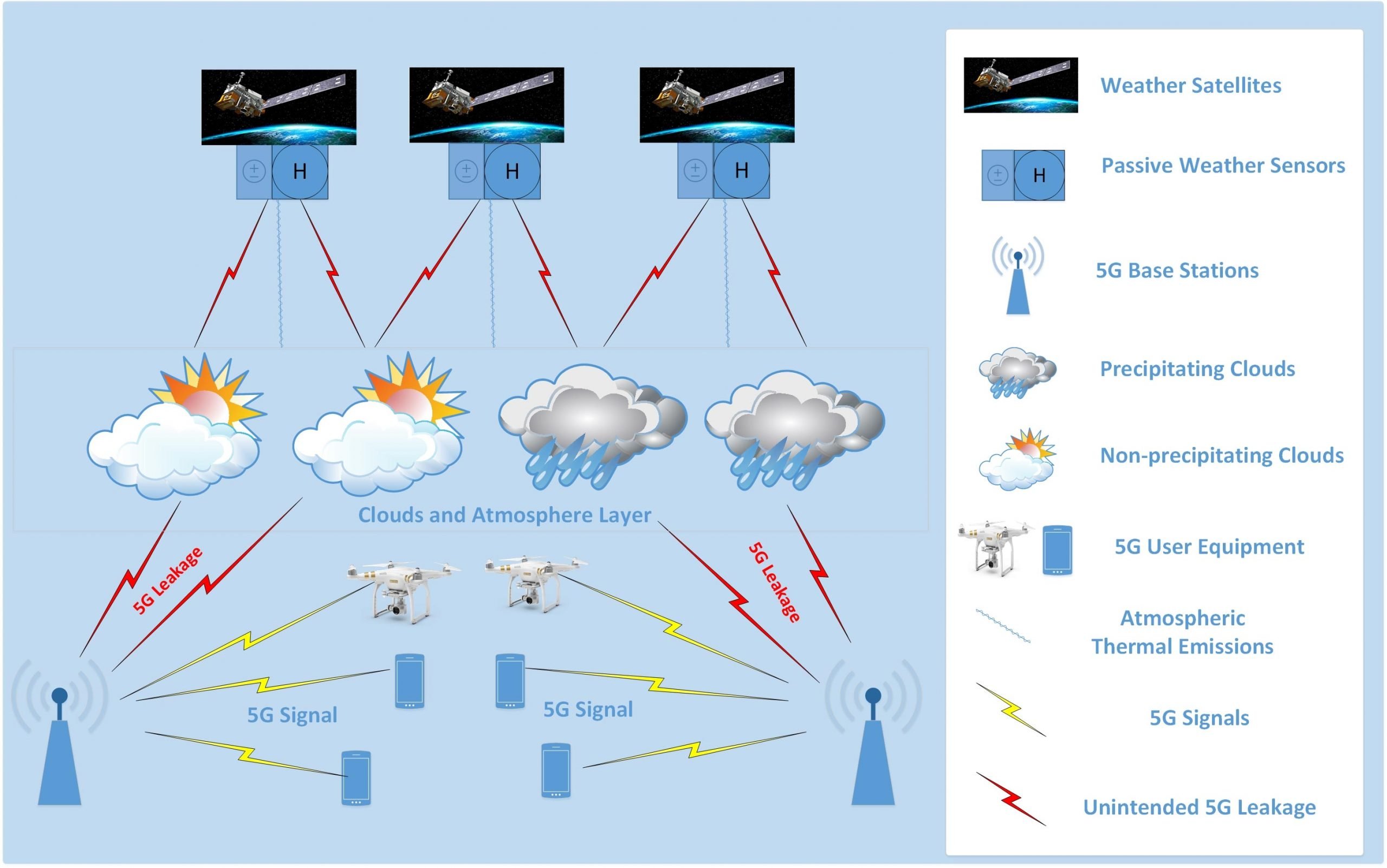
    This image shows leakage (unintended radiation from a transmitter into an adjacent frequency band or channel) from a 5G cellular network affecting sensors on weather satellites. Credit: Mohammad Yousefvand

    Rutgers study is the first to model impact of 5G radiation “leakage” on forecasting.

    Upcoming 5G wireless networks that will provide faster cell phone service may lead to inaccurate weather forecasts, according to a Rutgers study on a controversial issue that has created anxiety among meteorologists.

    “Our study – the first of its kind that quantifies the effect of 5G on weather prediction error – suggests that there is an impact on the accuracy of weather forecasts,” said senior author Narayan B. Mandayam, a Distinguished Professor at the Wireless Information Network Laboratory (WINLAB), who also chairs the Department of Electrical and Computer Engineering in the School of Engineering at Rutgers University–New Brunswick.

    The peer-reviewed study was published this month at the 2020 IEEE 5G World Forum, sponsored by the Institute of Electrical and Electronics Engineers. Fifth-generation cellular wireless technology (5G) stems from new, smarter ways to use the higher (mmWave) frequencies for mobile communications. This technology will revolutionize internet communication and telecommunication. It has faster connection times, increases the number of devices that can connect to a network, and will be more widely available over the next two to three years, according to IEEE.

    The Rutgers study used computer modeling to examine the impact of 5G “leakage” – unintended radiation from a transmitter into an adjacent frequency band or channel – on forecasting the deadly 2008 Super Tuesday Tornado Outbreak in the South and Midwest.

    The signals from the 5G frequency bands potentially could leak into the band used by weather sensors on satellites that measure the amount of water vapor in the atmosphere and affect weather forecasting and predictions. Meteorologists rely on satellites for the data needed to forecast weather.

    Based on modeling, 5G leakage power of -15 to -20 decibel Watts (a decibel Watt is a unit of power that describes the strength of radio waves) affected the accuracy of forecasting of precipitation (by up to 0.9 millimeters) during the tornado outbreak and temperatures near ground level (by up to 2.34 degrees Fahrenheit).

    “It can be argued that the magnitude of error found in our study is insignificant or significant, depending on whether you represent the 5G community or the meteorological community, respectively,” Mandayam said. “One of our takeaways is that if we want leakage to be at levels preferred by the 5G community, we need to work on more detailed models as well as antenna technology, dynamic reallocation of spectrum resources and improved weather forecasting algorithms that can take into account 5G leakage.”

    Reference: “Modeling the Impact of 5G Leakage on WeatherPrediction” by Mohammad Yousefvand, Chung-Tse Michael Wu, Ruo-Qian Wang, Joseph Brodie and Narayan Mandayam, 10 September 2015, 2020 IEEE 5G World Forum.
    DOI: 10.1109/5GWF49715.2020.9221472
    PDF

    The lead author is Mohammad Yousefvand, a Rutgers electrical engineering doctoral student. Co-authors include Professor Chung-Tse Michael Wu in the Department of Electrical and Computer Engineering, Professor Ruo-Qian (Roger) Wang in the Department of Civil and Environmental Engineering and Joseph Brodie, director of atmospheric research in the Rutgers Center for Ocean Observing Leadership.

    Never miss a breakthrough: Join the SciTechDaily newsletter.
    Follow us on Google and Google News.

    5G Rutgers University Telecommunications
    Share. Facebook Twitter Pinterest LinkedIn Email Reddit

    Related Articles

    9,380x Faster Than 5G: Scientists Set New Wireless Transmission Speed Record

    Light-Speed Calculations: New Photonic Chips Are Changing Wireless Communication

    Mobile Communications Beyond 5G With New “Beam-Steering” Technology

    Topological Phenomena Found at High Frequencies for 5G Communications and Quantum Information Processing

    What Is 5G? An Electrical Engineer Explains the Technology

    Helping Next-Generation 5G Cell Technology See Past the Trees

    New Chip Can Decode Any Type of Data Sent Across a Network

    Enhanced Ceramics Could Play Pivotal Role in Advancing High-Frequency 5G Technology

    Coding Scheme Guarantees Fastest Possible Delivery of Data

    Leave A Reply Cancel Reply

    • Facebook
    • Twitter
    • Pinterest
    • YouTube

    Don't Miss a Discovery

    Subscribe for the Latest in Science & Tech!

    Trending News

    Scientists Say This Simple Supplement May Actually Reverse Heart Disease

    Warming Oceans Could Trigger a Dangerous Methane Surge

    This Simple Movement Could Be Secretly Cleaning Your Brain

    Male Birth Control Breakthrough: Scientists Find Way To Turn Sperm Production Off and Back On

    A Common Vitamin Could Hold the Key to Treating Fatty Liver Disease

    New Research Shows Vitamin B12 May Hold the Key to Healthy Aging

    These Simple Daily Habits Can Quickly Improve Blood Pressure and Heart Risk Factors

    A Common Nutrient May Play a Surprising Role in Anxiety

    Follow SciTechDaily
    • Facebook
    • Twitter
    • YouTube
    • Pinterest
    • Newsletter
    • RSS
    SciTech News
    • Biology News
    • Chemistry News
    • Earth News
    • Health News
    • Physics News
    • Science News
    • Space News
    • Technology News
    Recent Posts
    • Scientists Just Exposed a 300 Million-Year-Old Fossil Mistake
    • Ravens Don’t Follow Wolves, They Predict Them
    • This Common Knee Surgery May Be Doing More Harm Than Good
    • Scientists Discover a New Way To Control Metals at the Atomic Scale
    • Scientists Create “Quantum Sound” Device That Works Near Absolute Zero
    Copyright © 1998 - 2026 SciTechDaily. All Rights Reserved.
    • Science News
    • About
    • Contact
    • Editorial Board
    • Privacy Policy
    • Terms of Use

    Type above and press Enter to search. Press Esc to cancel.