
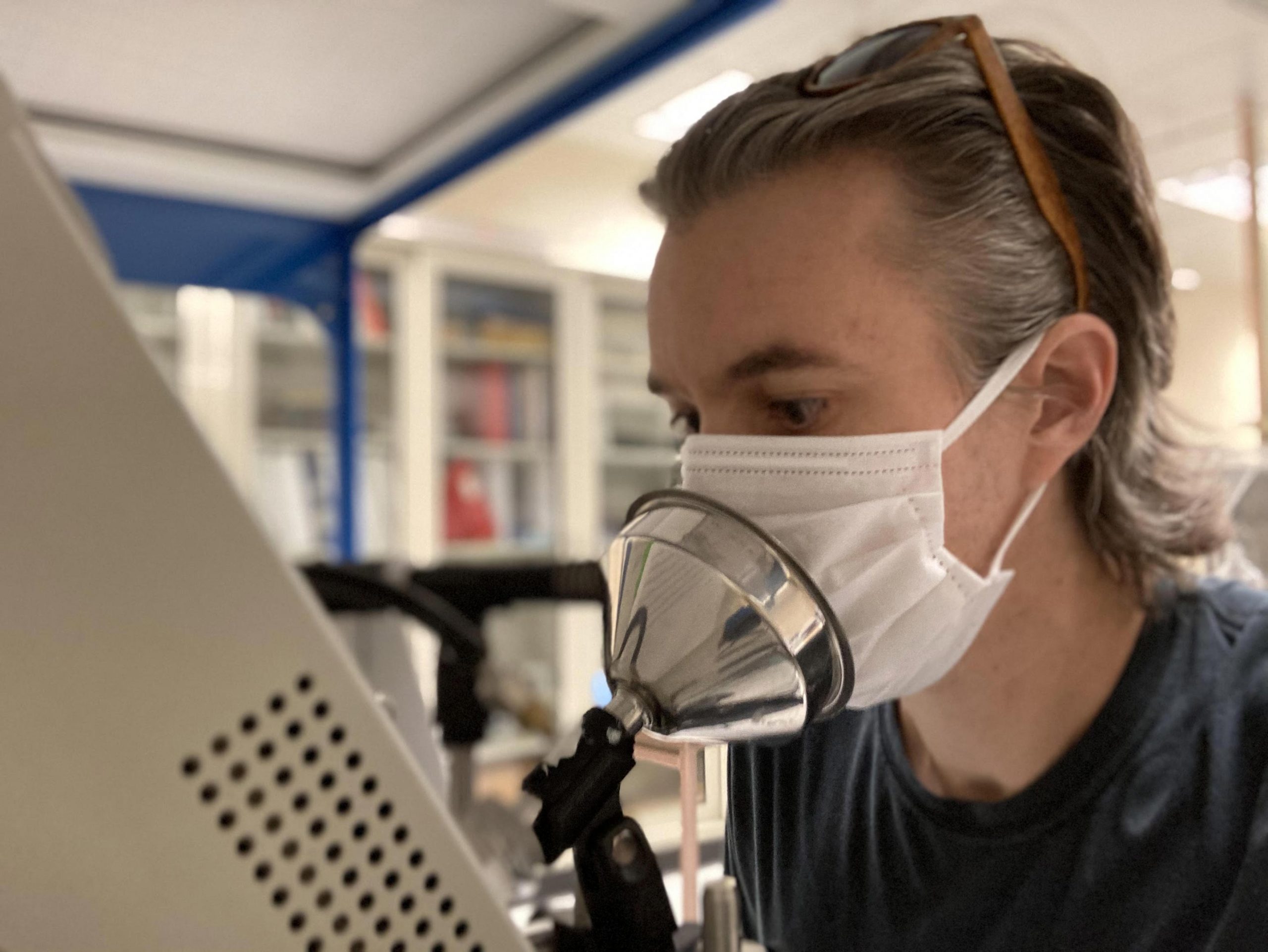
Surgical masks significantly reduce expelled particles during talking or coughing, proving effective even with imperfect fit.
A new study from the University of California, Davis and the Icahn School of Medicine at Mount Sinai confirms that surgical masks effectively reduce outgoing airborne particles from talking or coughing, even after allowing for leakage around the edges of the mask. The results are published in Scientific Reports.
Wearing masks and other face coverings can reduce the flow of airborne particles that are produced during breathing, talking, coughing, or sneezing, protecting others from viruses carried by those particles such as SARS-CoV2 and influenza, said Christopher Cappa, professor of civil and environmental engineering at UC Davis and corresponding author on the paper.
High-efficiency masks such as N95 respirators are designed to have a tight seal to the face, while surgical and most cloth face masks leave small gaps around the sides, which can be reduced when they are worn correctly.
Impressive Reduction in Airborne Emissions
The researchers looked at particles flowing from these gaps by sitting volunteers in front of an instrument that counts airborne particles down to a size of half a micron. The 12 volunteers read aloud or coughed, with and without a surgical mask of the type widely used by the public, either with their mouth directly in front of the funnel of the particle counter, turned to the side, or with their head lowered or raised to count particles passing directly through the mask or leaking around the sides.
The researchers found that wearing a mask while talking reduced particles directly through the mask by an average of 93%, from the bottom by 91%, the sides by 85% and the top by 47%, although with substantial variability between individuals. They got similar results for coughing.
Models to Measure Leakage
The team used simulations to model the overall reduction in particles due to wearing a mask, allowing for leakage around the edges. They calculated that the overall efficiency of masks was about 70% for talking and 90% for coughing.
“While air escape does limit the overall efficiency of surgical masks at reducing expiratory particle emissions, such masks nonetheless provide substantial reduction,” Cappa said. “Our results confirm that mask-wearing provides a significant reduction in the probability of disease transmission via expiratory particles, especially when both infected and susceptible individuals wear masks.”
Masks also redirect the flow of air from a high-velocity plume from the talker or cougher towards anybody in front of them, Cappa said.
Reference: “Expiratory aerosol particle escape from surgical masks due to imperfect sealing” by Christopher D. Cappa, Sima Asadi, Santiago Barreda, Anthony S. Wexler, Nicole M. Bouvier and William D. Ristenpart, 8 June 2021, Scientific Reports.
DOI: 10.1038/s41598-021-91487-7
Additional authors on the study are: Sima Asadi, Santiago Barreda, Anthony Wexler and William Ristenpart at UC Davis and Nicole Bouvier, Icahn School of Medicine at Mount Sinai, New York. (Sima Asadi is now at the Massachusetts Institute of Technology.) The work was funded by a grant from the National Institute for Allergy and Infectious Diseases.
Never miss a breakthrough: Join the SciTechDaily newsletter.
Follow us on Google and Google News.
2 Comments
Give me a break, what you ar saying is that the center of the mask works good. What about the billions of virus particles that escape from the edges? Just shut up
“The 12 volunteers read aloud or coughed, with and without a surgical mask of the type widely used by the public, either with their mouth directly in front of the funnel of the particle counter, turned to the side, or with their head lowered or raised to count particles passing directly through the mask or leaking around the sides.
The researchers found that wearing a mask while talking reduced particles directly through the mask by an average of 93%, from the bottom by 91%, the sides by 85% and the top by 47%, although with substantial variability between individuals. They got similar results for coughing.”
Still, it doesn’t replicate the real world environment. This proves masks works in an controlled environment or under ideal conditions. It does not consider factors like accumulation of virus and bacteria in the mask, prolonged use, touching the mask, your face, your itchy nose, contact with other people, external virus concentration exposure, air currents…
That said I would advise people to follow the good practice instructions available on WHO website. And don’t wear a cloth mask, they just don’t work, in the sense that they don’t provide a significant reduction compared to other options (surgical masks) or they just don’t work at all.
A there are plenty of side effects associated with wearing a mask, some unknown, others known but not studied or ignored (microfibers inhalation and polution). Don’t wear a mask when you don’t need to, it’s all in the guidelines.
Forcing 2-5 year olds to wear a mask is literally a crime (some people suggest it’s ok, I say it’s not) and kids up to 12 shouldn’t wear it as a norm but rather as an exception. And yeah it’s all in the guidelines and easily confirmed by the studies available, just ignore most of the pseudo scientific psychology studies, you would be better off using common sense.