
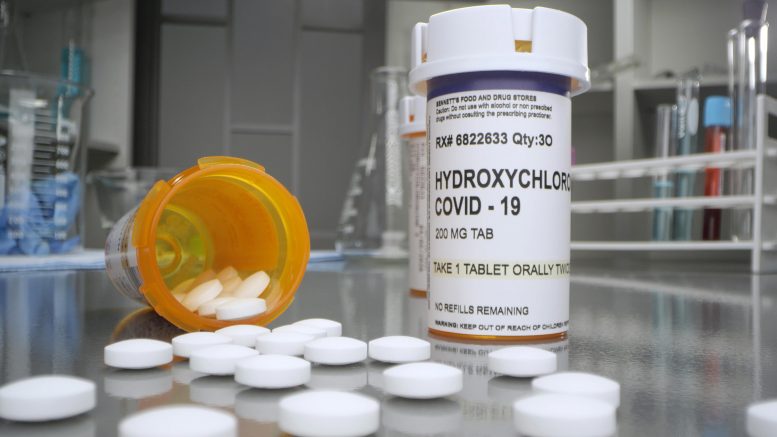
Short-term hydroxychloroquine treatment is not associated with lethal heart rhythms in patients with COVID-19 who are risk assessed prior to receiving the drug. That’s the finding of research published today (September 25, 2020) in EP Europace, a journal of the European Society of Cardiology (ESC).[1]
“This was the largest study to assess the risk of dangerous heart rhythms (arrhythmias) in COVID-19 patients treated with hydroxychloroquine,” said study author Dr. Alessio Gasperetti of Monzino Cardiology Centre, Milan, Italy and University Hospital Zurich, Switzerland. “In our cohort, there was a low rate of arrhythmias and none were associated with hydroxychloroquine.”
The study began when there was very little experience using hydroxychloroquine to treat patients with COVID-19. Current evidence suggests that it is ineffective in patients with advanced disease but there is debate around its effectiveness in the early phase.[2,3] This study was not designed to test the effectiveness of hydroxychloroquine in COVID-19 but rather to examine cardiac safety.
Hydroxychloroquine is known to cause an electrical change in the heart in some patients. It is called QT prolongation because of the pattern on the electrocardiogram (ECG). This electrical pattern is linked with an increased risk of deadly heart rhythms.
Hydroxychloroquine has been used for decades to treat lupus and rheumatoid arthritis and prevent malaria. But the COVID-19 pandemic is the first time the drug has been used in large numbers of acutely ill patients with multiple health conditions and possibly receiving other QT-prolonging drugs. The scale of the pandemic raises the likelihood of inherited heart problems that predispose patients to arrhythmias. In addition, changes in blood electrolytes, which can trigger arrhythmias, can occur in those needing treatment in an intensive care unit (ICU).
This study was conducted to assess ECG changes and arrhythmias in COVID-19 patients treated with hydroxychloroquine in different clinical settings.
A total of 649 COVID-19 patients were enrolled from seven institutions between 10 March and 10 April 2020. The average age was 62 years and 46% were men. A risk calculator was used to assess the likelihood of QT prolongation and decide the treatment setting. All patients had an ECG before starting treatment and at least one follow-up measurement.
In all centers, patients took 200 mg hydroxychloroquine twice a day (i.e. a total of 400 mg per day). More than half of patients (58.6%) took a loading dose on the first day, meaning they received 400 mg twice on that day (i.e. a total of 800 mg).
Hydroxychloroquine was administered early after symptom onset in three different care settings: 126 (19.4%) patients were managed at home, 495 (76.3%) were hospitalized in a medical ward, and 28 (4.3%) patients were treated in ICU. In line with real-world practice, 30% of patients received two QT-prolonging drugs, and 13.6% received three (including hydroxychloroquine).
A significant QT interval prolongation was observed in the overall cohort, but the magnitude of the increase was modest and similar across care settings. The most important determinants of QT prolongation during hydroxychloroquine treatment were fever at admission and baseline QT length.
Over a median follow-up of 16 days, there were no lethal arrhythmias. A total of seven patients (1.1%) had a serious ventricular arrhythmia, but none were deemed related to QT prolongation or to hydroxychloroquine treatment.
Dr. Gasperetti said: “Hydroxychloroquine treatment was associated with QT prolongation, as expected, but the change was small. There was no connection between the drug and the occurrence of arrhythmias. The study shows that hydroxychloroquine administration, alone or in combination with other potentially QT-prolonging drugs, is safe for short-term treatment of COVID-19 patients at home or in hospital, provided that they undergo risk assessment and ECG monitoring by a physician.”
References:
- “Arrhythmic safety of hydroxychloroquine in COVID-19 patients from different clinical settings” by Alessio Gasperetti, Mauro Biffi, Firat Duru, Marco Schiavone, Matteo Ziacchi, Gianfranco Mitacchione, Carlo Lavalle, Ardan Saguner, Antonio Lanfranchi, Giacomo Casalini, Marco Tocci, Davide Fabbricatore, Francesca Salghetti, Marco Valerio Mariani, Mattia Busana, Alfonso Bellia, Chiara Beatrice Cogliati, Pierluigi Viale, Spinello Antinori, Massimo Galli, Nazzareno Galiè, Claudio Tondo and Giovanni Battista Forleo, 25 September 2020, EP Europace.
DOI: 10.1093/europace/euaa216 - “Observational Study of Hydroxychloroquine in Hospitalized Patients with Covid-19” by Joshua Geleris, M.D., Yifei Sun, Ph.D., Jonathan Platt, Ph.D., Jason Zucker, M.D., Matthew Baldwin, M.D., George Hripcsak, M.D., Angelena Labella, M.D., Daniel K. Manson, M.D., Christine Kubin, Pharm.D., R. Graham Barr, M.D., Dr.P.H., Magdalena E. Sobieszczyk, M.D., M.P.H. and Neil W. Schluger, M.D., 18 June 2020, New England Journal of Medicine.
DOI: 10.1056/NEJMoa2012410 - “A Randomized Trial of Hydroxychloroquine as Postexposure Prophylaxis for Covid-19” by David R. Boulware, M.D., M.P.H., Matthew F. Pullen, M.D., Ananta S. Bangdiwala, M.S., Katelyn A. Pastick, B.Sc., Sarah M. Lofgren, M.D., Elizabeth C. Okafor, B.Sc., Caleb P. Skipper, M.D., Alanna A. Nascene, B.A., Melanie R. Nicol, Pharm.D., Ph.D., Mahsa Abassi, D.O., M.P.H., Nicole W. Engen, M.S., Matthew P. Cheng, M.D., Derek LaBar, Pharm.D., Sylvain A. Lother, M.D., Lauren J. MacKenzie, M.D., M.P.H., Glen Drobot, M.D., Nicole Marten, R.N., Ryan Zarychanski, M.D., Lauren E. Kelly, Ph.D., Ilan S. Schwartz, M.D., Ph.D., Emily G. McDonald, M.D., Radha Rajasingham, M.D., Todd C. Lee, M.D., M.P.H. and Kathy H. Hullsiek, Ph.D., 6 August 2020, New England Journal of Medicine.
DOI: 10.1056/NEJMoa2016638
Never miss a breakthrough: Join the SciTechDaily newsletter.
Follow us on Google and Google News.
2 Comments
This article is sponsored by WH?
Trump was right