
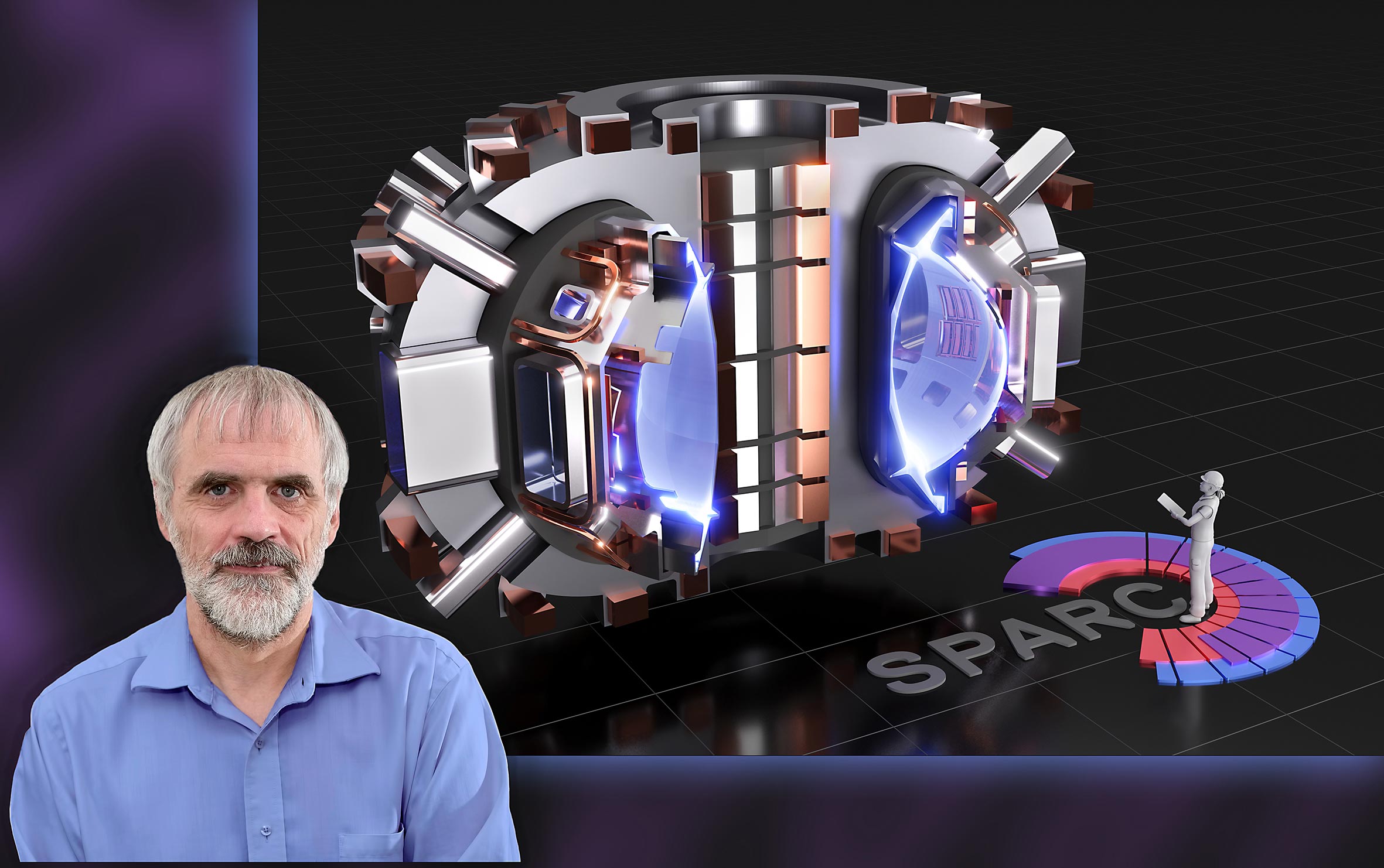
SPARC’s superconducting magnets enable effective alpha particle confinement, advancing the path toward commercial fusion energy.
The U.S. Department of Energy’s (DOE) Princeton Plasma Physics Laboratory (PPPL) is collaborating with private industry on cutting-edge fusion research aimed at achieving commercial fusion energy. This work, enabled through a public-private DOE grant program, supports efforts to develop high-performance fusion-grade plasmas. In one such project PPPL is working in coordination with MIT’s Plasma Science and Fusion Center (PSFC) and Commonwealth Fusion Systems, a start-up spun out of MIT that is developing a tokamak fusion device called SPARC.
The goal of the project is to predict the leakage of fast “alpha” particles produced during the fusion reactions in SPARC, given the size and potential misalignments of the superconducting magnets that confine the plasma. These particles can create a largely self-heated or “burning plasma” that fuels fusion reactions. Development of burning plasma is a major scientific goal for fusion energy research. However, leakage of alpha particles could slow or halt the production of fusion energy and damage the interior of the SPARC facility.
New Superconducting Magnets
Key features of the SPARC machine include its compact size and powerful magnetic fields enabled by the ability of new superconducting magnets to operate at higher fields and stresses than existing superconducting magnets. These features will enable the design and construction of smaller and less expensive fusion facilities, as described in recent publications by the SPARC team — assuming that the fast alpha particles created in fusion reactions can be contained long enough to keep the plasma hot.
“Our research indicates that they can be,” said PPPL physicist Gerrit Kramer, who participates in the project through the DOE Innovation Network for Fusion Energy (INFUSE) program. The two-year-old program, which PPPL physicist Ahmed Diallo serves as deputy director, aims to speed the private-sector development of fusion energy through partnerships with national laboratories.
Well-Confined
“We found that the alpha particles are indeed well confined in the SPARC design,” said Kramer, coauthor of a paper in the Journal of Plasma Physics that reports the findings. He worked closely with the lead author Steven Scott, a consultant to Commonwealth Fusion Systems and former long-time physicist at PPPL.
Kramer used the SPIRAL computer code developed at PPPL to verify the particle confinement. “The code, which simulates the wavy pattern, or ripples, in a magnetic field that could allow the escape of fast particles, showed good confinement and lack of damage to the SPARC walls,” Kramer said. Moreover, he added, “The SPIRAL code agreed well with the ASCOT code from Finland. While the two codes are completely different, the results were similar.”
The findings gladdened Scott. “It’s gratifying to see the computational validation of our understanding of ripple-induced losses,” he said, “since I studied the issue experimentally back in the early 1980s for my doctoral dissertation.”
Fusion reactions combine light elements in the form of plasma — the hot, charged state of matter composed of free electrons and atomic nuclei, or ions, that comprise 99 percent of the visible universe — to generate massive amounts of energy. Scientists around the world are seeking to create fusion as a virtually unlimited source of power for generating electricity.
Key Guidance
Kramer and colleagues noted that misalignment of the SPARC magnets will increase the ripple-induced losses of fusion particles leading to increased power striking the walls. Their calculations should provide key guidance to the SPARC engineering team about how well the magnets must be aligned to avoid excessive power loss and wall damage. Properly aligned magnets will enable studies of plasma self-heating for the first time and development of improved techniques for plasma control in future fusion power plants.
Reference: “Fast-ion physics in SPARC” by S. D. Scott, G. J. Kramer, E. A. Tolman, A. Snicker, J. Varje, K. Särkimäki, J. C. Wright and P. Rodriguez-Fernandez, 29 September 2020, Journal of Plasma Physics.
DOI: 10.1017/S0022377820001087
Support for this research comes from Commonwealth Fusion Systems. Support for Kramer comes from the DOE Office of Science INFUSE program. Contributors to the project include physicists from PSFC; Aalto University in Espoo, Finland; and Chalmers University of Technology in Gothenburg, Sweden.
Never miss a breakthrough: Join the SciTechDaily newsletter.
Follow us on Google and Google News.
6 Comments
DRUGGINGTHECHILDRENFORTHETRUTHANDALLYOURDAMAGESYOUDISERVEWITHKEVENHARTFORJUMANJIPLANTKEEPTHECLILMMETCHANGESYODIDCAREREPAYYOURMANYKIDDNSSES
So…. you’re saying its coming soon, about 10 years away. Sounds familiar.
So doesn’t anyone think using hydrogen (the basis and need of all hydrocarbon lifeforms ) as a fuel and turning it into helium ( which is able to freely escape eats orbit on its own)is a bad idea.Other atoms could surely be used..I’don’t use Fe (iron) myself..supernova fusion plus magnetically contrablable.
Substitute earth for Eats
Substitute I’d for I don’t
Lol..
Let’s think this through. Fusion reactors are built worldwide. High neutron flux outside each reactor. Put a blanket of natural Uranium around the reactor and breed Plutonium. Suddenly people all around the world can make nuclear weapons. Maybe not such a good idea after all?
When I was a student at Princeton in the late 70s and early 80s, I visited the PPPL. They said commercial use was maybe 30 years away. The timeline seems to have slipped to early 2030s for commercial use. I do hope someday this is feasible and we have thought through all the possible ramifications. The Chinese may get there first, which is not a bad thing, if we can use the same technologies.