
Close Menu
    Facebook X (Twitter) Instagram
    SciTechDaily
    • Biology
    • Chemistry
    • Earth
    • Health
    • Physics
    • Science
    • Space
    • Technology
    Facebook X (Twitter) Pinterest YouTube RSS
    SciTechDaily
    Home»Health»Here’s What Scientists Say Is Needed to Prevent Large COVID-19 Outbreaks in Schools
    Health

    Here’s What Scientists Say Is Needed to Prevent Large COVID-19 Outbreaks in Schools

    By PLOSJuly 8, 2021No Comments3 Mins Read
    Facebook Twitter Pinterest Telegram LinkedIn WhatsApp Email Reddit
    Share
    Facebook Twitter LinkedIn Pinterest Telegram Email Reddit
    COVID-19 Classroom Transmission
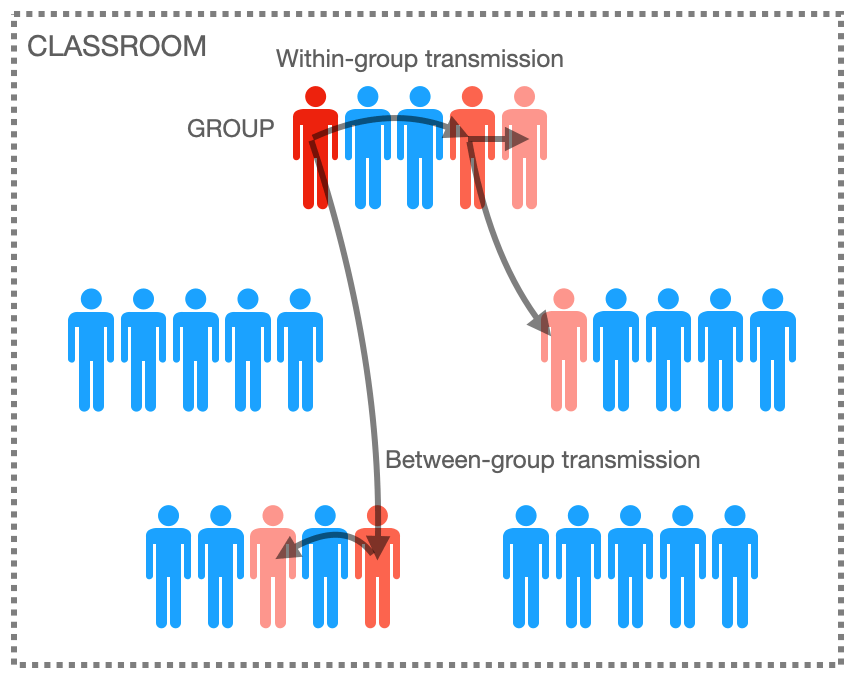
    Depiction of classroom transmission. The classroom has five groups of students who are considered close contacts. The index case (dark red) attends a class in which all other students are susceptible. The index case may infect some other students directly (medium red), and they may go on to infect others (pale red). Transmission can occur within groups and between groups (at a lower rate). Credit: Paul Tupper (CC BY 4.0)

    Regular monitoring may be only way to prevent large COVID-19 outbreaks in schools. New simulations suggest that waiting until a student tests positive is too late for prevention.

    A new study examines factors that underlie COVID-19 outbreaks in schools and suggests that large outbreaks can only be prevented with regular monitoring of everyone in the school setting. Paul Tupper and Caroline Colijn of Simon Fraser University, Canada, present these findings in the open-access journal PLOS Computational Biology.

    Data from around the world show highly varied outcomes for COVID-19 clusters in schools, with some settings having many large outbreaks and others having few serious problems. The factors underlying this variability have been unclear, as have the most effective strategies for preventing large outbreaks.

    To better understand COVID-19 dynamics at schools, Tupper and Colijn used a mathematical model to simulate disease spread in the classroom. The simulations incorporated two factors that could affect outbreak severity: differences between infected individuals in how easily they can transmit the disease to others, and differences in transmission rates for different environments and activities.

    The simulations showed that, in a classroom with 25 students, anywhere from 0 to 20 students might be infected after exposure, depending on even small adjustments to transmission rates for infected individuals or environments.

    The researchers then simulated the effects of different protocols to prevent large clusters. They found that, in scenarios with high transmission rates, preventive actions (such as closing down a whole class) that only took effect after a student developed symptoms and tested positive were too slow to prevent large outbreaks. In fact, large clusters could only be prevented with regular monitoring of everyone in the setting, for example with pooled rapid testing on site.

    “We found that waiting until a student develops symptoms and tests positive is too slow a response, even though this was the method used in many jurisdictions to prevent COVID-19 transmission,” Tupper says. “Screening students without symptoms works quite well in our model and could also be applied in workplaces or shared living accommodations.”

    The scientists plan to incorporate additional data and expand their model to explore the best strategies to prevent spread after a case is detected, both in classrooms and other settings.

    Reference: “COVID-19 in schools: Mitigating classroom clusters in the context of variable transmission” by Paul Tupper and Caroline Colijn, 8 July 2021, PLOS Computational Biology.
    DOI: 10.1371/journal.pcbi.1009120

    Funding: PT was supported by a Natural Science and Engineering Research Council (Canada) Discovery Grant, RGPIN-2019-06911. They did not play any role in the study design, data collection, and analysis, decision to publish, or preparation of the manuscript. CC was supported by a Genome BC grant, COV-142. They did not play any role in the study design, data collection, and analysis, decision to publish, or preparation of the manuscript.

    Never miss a breakthrough: Join the SciTechDaily newsletter.
    Follow us on Google and Google News.

    COVID-19 Education Infectious Diseases PLOS Public Health Virology
    Share. Facebook Twitter Pinterest LinkedIn Email Reddit

    Related Articles

    $51 “Lab-in-a-Backpack” Offers Fast, Affordable, Reliable COVID-19 Testing

    CDC Failure: Internal Investigation Finds Design Errors and Contamination in First Batch of COVID-19 Tests

    MIT Researchers Provide Suggestions for Keeping Classroom Air Fresh During the COVID-19 Pandemic

    Global Response to COVID-19 Hurt by Inadequate Sequencing of SARS-CoV-2 Variants

    Testing Shows COVID-19 Lingered Longer Than Reported in Wuhan, China

    New Strategy Identifies Existing Drug That Inhibits COVID-19 Virus – Outperforms Remdesivir

    New Research Finds Lasting Fatigue Common After COVID-19 Infection

    How COVID-19 Kills: New Study Explains the Mechanisms of the New Coronavirus

    Vitamin D Linked to Low Coronavirus Death Rate

    Leave A Reply Cancel Reply

    • Facebook
    • Twitter
    • Pinterest
    • YouTube

    Don't Miss a Discovery

    Subscribe for the Latest in Science & Tech!

    Trending News

    Mezcal “Worm” in a Bottle Mystery: DNA Testing Reveals a Surprise

    New Research Reveals That Your Morning Coffee Activates an Ancient Longevity Switch

    This Is What Makes You Irresistible to Mosquitoes

    Shockingly Powerful Giant Octopuses Ruled the Seas 100 Million Years Ago

    Scientists Stunned by New Organic Molecules Found on Mars

    Rewriting Dinosaur Evolution: Scientists Unearth Remarkable 150-Million-Year-Old Stegosaur Skull

    Omega-3 Supplements Linked to Cognitive Decline in Surprising New Study

    First-of-Its-Kind Discovery: Homer’s Iliad Found Embedded in a 1,600-Year-Old Egyptian Mummy

    Follow SciTechDaily
    • Facebook
    • Twitter
    • YouTube
    • Pinterest
    • Newsletter
    • RSS
    SciTech News
    • Biology News
    • Chemistry News
    • Earth News
    • Health News
    • Physics News
    • Science News
    • Space News
    • Technology News
    Recent Posts
    • Male Birth Control Breakthrough: Scientists Find Way To Turn Sperm Production Off and Back On
    • A Common Vitamin Could Hold the Key to Treating Fatty Liver Disease
    • New Research Shows Vitamin B12 May Hold the Key to Healthy Aging
    • Scientists Map Thousands of Brain Connections With RNA Barcodes
    • This Gene Tweak Turns Strawberries Into Healthier, Tastier Superfruit
    Copyright © 1998 - 2026 SciTechDaily. All Rights Reserved.
    • Science News
    • About
    • Contact
    • Editorial Board
    • Privacy Policy
    • Terms of Use

    Type above and press Enter to search. Press Esc to cancel.