
Close Menu
    Facebook X (Twitter) Instagram
    SciTechDaily
    • Biology
    • Chemistry
    • Earth
    • Health
    • Physics
    • Science
    • Space
    • Technology
    Facebook X (Twitter) Pinterest YouTube RSS
    SciTechDaily
    Home»Space»Artificial Intelligence Helps Resolve Long-Running Astrophysics Debate on Supermassive Black Holes
    Space

    Artificial Intelligence Helps Resolve Long-Running Astrophysics Debate on Supermassive Black Holes

    By Royal Astronomical SocietyJuly 26, 2021No Comments4 Mins Read
    Facebook Twitter Pinterest Telegram LinkedIn WhatsApp Email Reddit
    Share
    Facebook Twitter LinkedIn Pinterest Telegram Email Reddit
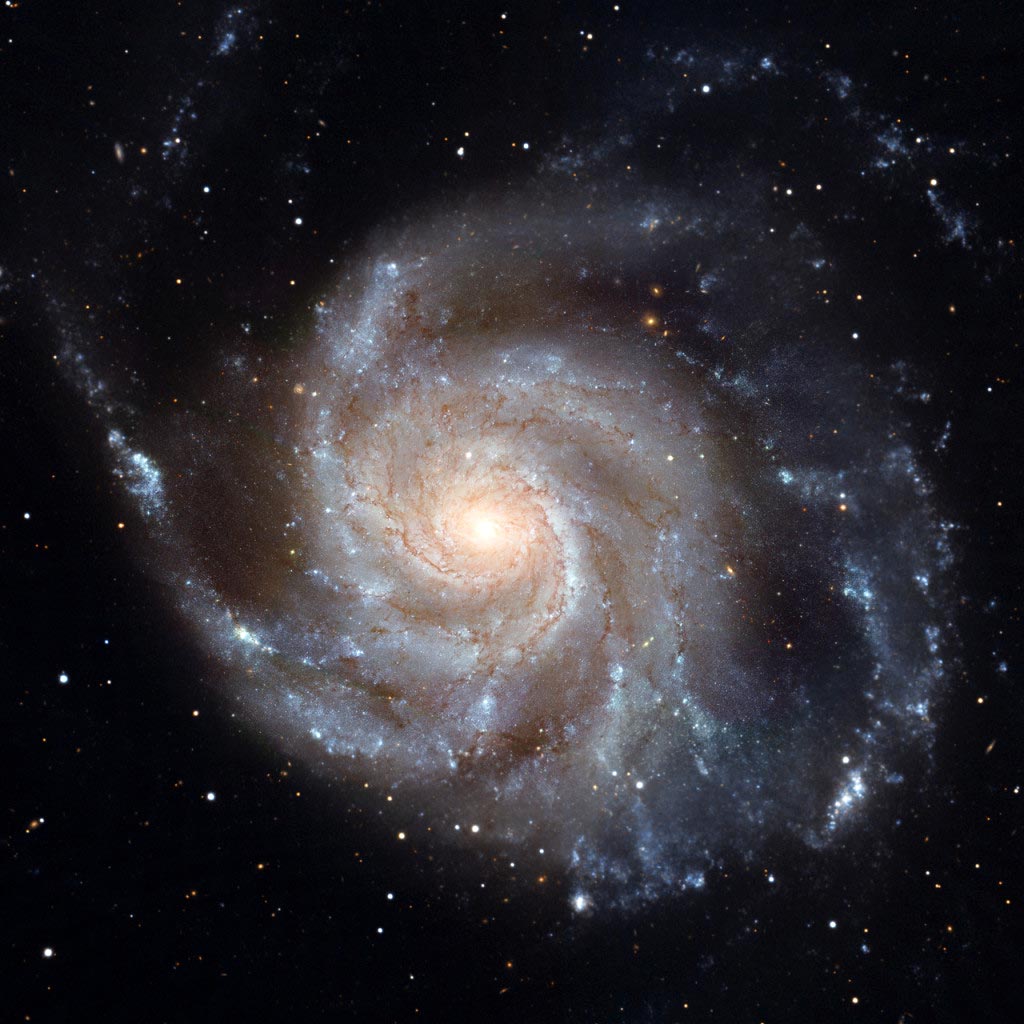
    Messier 101 Pinwheel Galaxy Hubble
    An image of Messier 101, the Pinwheel Galaxy, made with the Hubble Space Telescope. The bright blue clumps in the spiral arms are sites of recent star formation. Credit: NASA, ESA, K. Kuntz (JHU), F. Bresolin (University of Hawaii), J. Trauger (Jet Propulsion Lab), J. Mould (NOAO), Y.-H. Chu (University of Illinois, Urbana), and STScI

    New research using simulations and machine learning has confirmed that supermassive black holes play the central role in shutting down star formation in galaxies.

    Black holes with masses equivalent to millions of suns do put a brake on the birth of new stars, say astronomers. Using machine learning and three state-of-the-art simulations to back up results from a large sky survey, the researchers resolve a 20-year long debate on the formation of stars. Joanna Piotrowska, a PhD student at the University of Cambridge, presented the new work on July 20, 2021, at the virtual National Astronomy Meeting (NAM 2021).

    Star formation in galaxies has long been a focal point of astronomy research. Decades of successful observations and theoretical modeling resulted in our good understanding of how gas collapses to form new stars both in and beyond our own Milky Way. However, thanks to all-sky observing programs like the Sloan Digital Sky Survey (SDSS), astronomers realized that not all galaxies in the local Universe are actively star-forming — there exists an abundant population of “quiescent” objects which form stars at significantly lower rates.
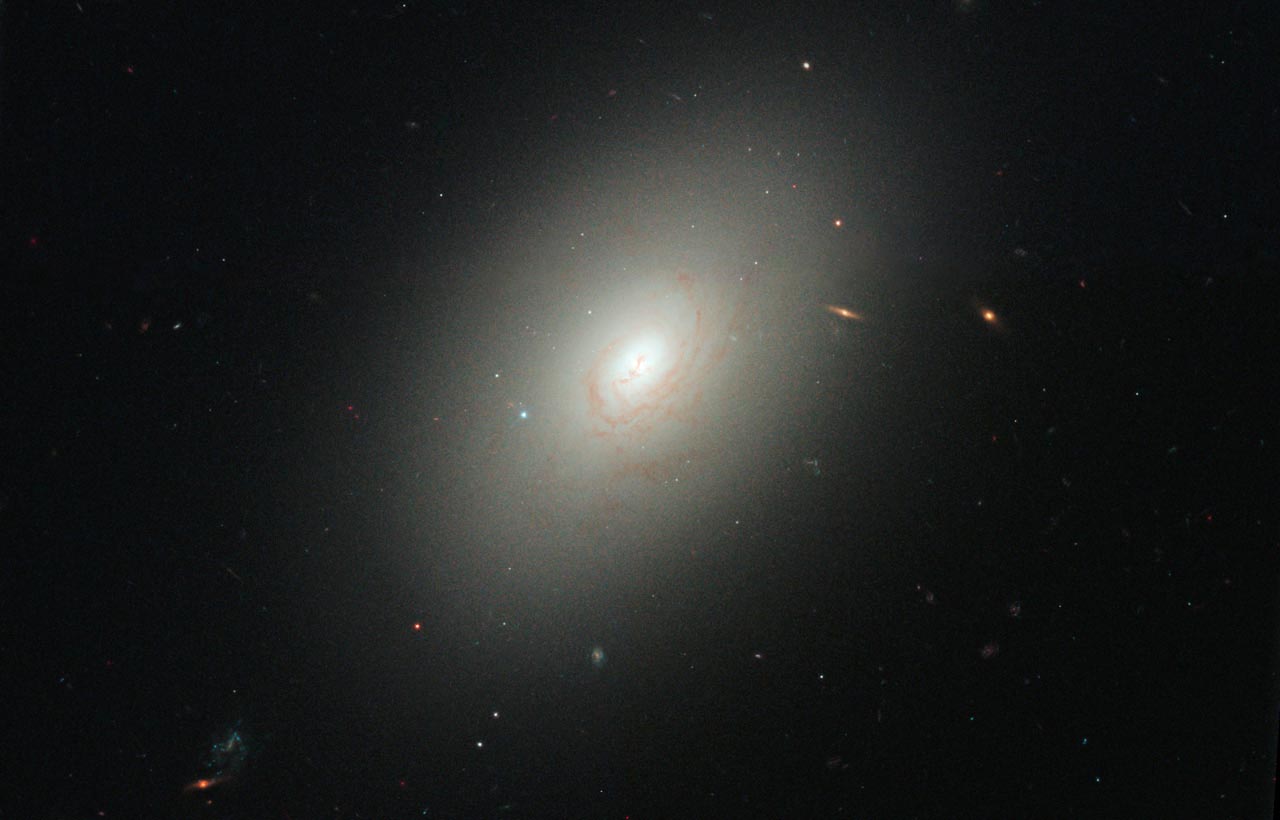
    Quiescent Elliptical Galaxy NGC 4150
    A Hubble Space Telescope image of the quiescent elliptical galaxy NGC 4150. In this star formation has essentially shut down. Credit: NASA, ESA, R.M. Crockett (University of Oxford, U.K.), S. Kaviraj (Imperial College London and University of Oxford, U.K.), J. Silk (University of Oxford), M. Mutchler (Space Telescope Science Institute, Baltimore), R. O’Connell (University of Virginia, Charlottesville), and the WFC3 Scientific Oversight Committee

    The question of what stops star formation in galaxies remains the biggest unknown in our understanding of galaxy evolution, debated over the past 20 years. Piotrowska and her team set up an experiment to find out what might be responsible.

    Using three state-of-the-art cosmological simulations — EAGLE, Illustris, and IllustrisTNG — the astronomers investigated what we would expect to see in the real Universe as observed by the SDSS, when different physical processes were halting star formation in massive galaxies.

    Machine Learning Reveals Key Predictors

    The astronomers applied a machine learning algorithm to classify galaxies into star-forming and quiescent, asking which of three parameters: the mass of the supermassive black holes found at the center of galaxies (these monster objects have typically millions or even billions of times the mass of our Sun), the total mass of stars in the galaxy, or the mass of the dark matter halo around galaxies, best predicts how galaxies turn out.
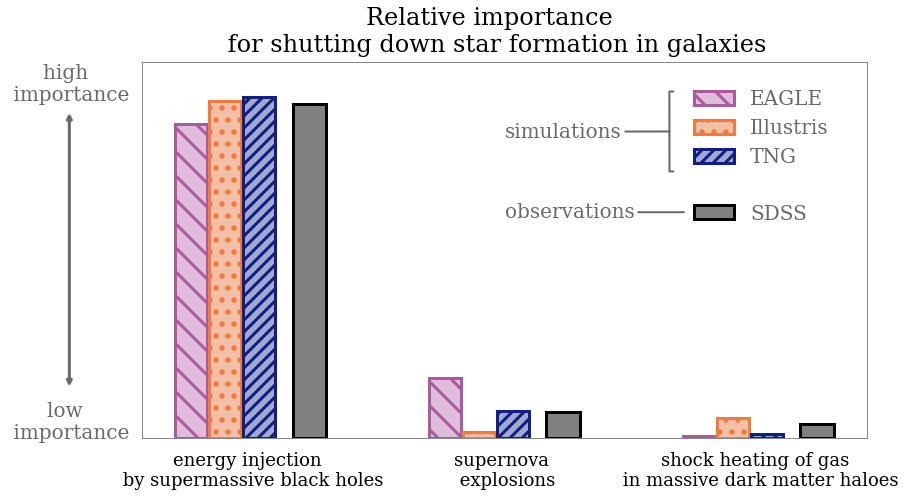
    Shutting Down Star Formation in Galaxies Chart
    Diagram showing the relative importance of supermassive black holes, supernova explosions, and dark matter haloes, in shutting down star formation in galaxies. Credit: Joanna Piotrowska

    Black Hole Mass Emerges as the Main Culprit

    These parameters then enabled the team to work out which physical process: energy injection by supermassive black holes, supernova explosions or shock heating of gas in massive halos is responsible for forcing galaxies into semi-retirement.

    The new simulations predict the supermassive black hole mass as the most important factor in putting the brakes on star formation. Crucially, the simulation results match observations of the local Universe, adding weight to the researchers’ findings.

    Piotrowska says: “It’s really exciting to see how the simulations predict exactly what we see in the real Universe. Supermassive black holes — objects with masses equivalent to millions or even billions of Suns — really do have a big effect on their surroundings. These monster objects force their host galaxies into a kind of semi-retirement from star formation.”

    Meeting: Royal Astronomical Society National Astronomy Meeting

    Never miss a breakthrough: Join the SciTechDaily newsletter.
    Follow us on Google and Google News.

    Astronomy Astrophysics Black Hole Machine Learning Popular Royal Astronomical Society Stars
    Share. Facebook Twitter Pinterest LinkedIn Email Reddit

    Related Articles

    The Center of Our Galaxy May Not Be a Black Hole

    Breaking a 50-Year Law: New Evidence Challenges Fundamental Black Hole Physics

    Astronomers Spot Possible Biggest Black Hole in the Universe

    Death by Spaghettification: Telescopes Record Last Moments of Star Devoured by a Black Hole

    How Galaxies Die: New Insights Into Galaxy Halos, Black Holes, and Quenching of Star Formation

    Dancing Stars and Black Holes in a Cosmic Cloud of Gas: Investigating the “Common Envelope Phase”

    Synchrotron Emission Will Allow Astronomers to Find Stars That No One Has Seen Before

    Two Massive Stars with Magnetic Fields Discovered in Binary System Epsilon Lupi

    New Method for Measuring Black Hole Spin Could Provide a Greater Understanding of Galaxy Growth

    Leave A Reply Cancel Reply

    • Facebook
    • Twitter
    • Pinterest
    • YouTube

    Don't Miss a Discovery

    Subscribe for the Latest in Science & Tech!

    Trending News

    The Universe Is Expanding Too Fast and Scientists Can’t Explain Why

    “Like Liquid Metal”: Scientists Create Strange Shape-Shifting Material

    Early Warning Signals of Esophageal Cancer May Be Hiding in Plain Sight

    Common Blood Pressure Drug Shows Surprising Power Against Deadly Antibiotic-Resistant Superbug

    Scientists Uncover Dangerous Connection Between Serotonin and Heart Valve Disease

    Scientists Discover a “Protector” Protein That Could Help Reverse Hair Loss

    Bone-Strengthening Discovery Could Reverse Osteoporosis

    Scientists Uncover Hidden Trigger Behind Stem Cell Aging

    Follow SciTechDaily
    • Facebook
    • Twitter
    • YouTube
    • Pinterest
    • Newsletter
    • RSS
    SciTech News
    • Biology News
    • Chemistry News
    • Earth News
    • Health News
    • Physics News
    • Science News
    • Space News
    • Technology News
    Recent Posts
    • Drinking Alcohol To Cope in Your 20s Could Damage Your Brain for Life
    • Scientists Crack Alfalfa’s Chromosome Mystery After Decades of Debate
    • Ancient Ant-Plant Alliance Collapses As Predatory Wasps Move In
    • Scientists Discover Tiny New Spider That Hunts Prey 6x Its Size
    • Natural Component From Licorice Shows Promise for Treating Inflammatory Bowel Disease
    Copyright © 1998 - 2026 SciTechDaily. All Rights Reserved.
    • Science News
    • About
    • Contact
    • Editorial Board
    • Privacy Policy
    • Terms of Use

    Type above and press Enter to search. Press Esc to cancel.