
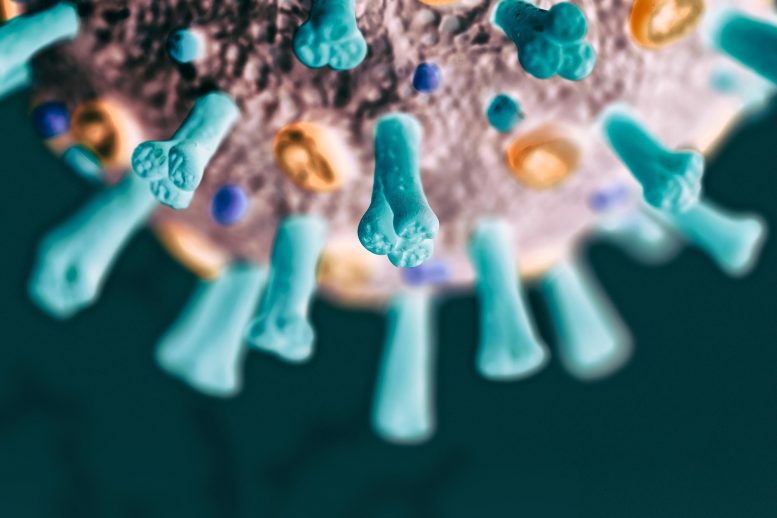
Antibodies capable of neutralizing multiple SARS-CoV-2 strains can inform strategies for broadly protective COVID-19 booster vaccines.
As the SARS-CoV-2 virus that causes COVID-19 continues to evolve, immunologists and infectious diseases experts are eager to know whether new variants are resistant to the human antibodies that recognized initial versions of the virus. Vaccines against COVID-19, which were developed based on the chemistry and genetic code of this initial virus, may confer less protection if the antibodies they help people produce do not fend off new viral strains. Now, researchers from Brigham and Women’s Hospital and collaborators have created an “atlas” that charts how 152 different antibodies attack a major piece of the SARS-CoV-2 machinery, the spike protein, as it has evolved since 2020. Their study, published in Cell, highlights antibodies that are able to neutralize the newer strains, while identifying regions of the spike protein that have become more resistant to attack.
“Emerging data show that vaccines still confer some protection from new SARS-CoV-2 variants, and our study shows how that works from an antibody standpoint,” said corresponding author Duane Wesemann, MD, PhD, of the Division of Allergy and Clinical Immunology and Division of Genetics at the Brigham and an associate professor at Harvard Medical School. “These data can help us think about what the best kind of booster vaccine might be by studying how the repertoire of human antibodies recognizes the spike protein.”
The researchers examined the antibody-producing Memory B cells of 19 patients who were infected with SARS-CoV-2 in March of 2020, before the emergence of new variants. They studied how these antibodies, as well as other antibodies that have been characterized by researchers, bind to spike protein models of the B.1.1.7 (Alpha), B.1351 (Beta) and P.1 (Gamma) variants of SARS-CoV-2, which were first identified in the United Kingdom, South Africa, and Brazil, respectively. An analysis of the Delta variant is currently underway.
Overall, the authors confirmed that the hundreds of antibodies they studied largely bind to seven major “footprints” on the spike protein. While many of these antibodies “compete” to bind to the same regions of the early version of the SARS-CoV-2 spike protein, when it comes to newer strains, some of these antibodies lose their potency while others emerge as broadly responsive neutralizers.
How New Variants Evade or Resist Antibody Neutralization
In particular, antibodies binding to two of these spike protein regions, dubbed RBD-2 and NTD-1, were the most potent neutralizers of initial forms of the spike protein. The B.1.351 spike variant proved to exhibit the greatest ability to evade existing antibody arsenals, escaping many RBD-2- and NTD-1-binding antibodies. Some antibodies binding another region, called S2-1, could recognize spike proteins from more distantly related viruses such as MERS, SARS, and common cold coronaviruses.
“Making different antibodies that compete for one region of the virus allows the immune system to be more flexible,” Wesemann said. “Otherwise-redundant recognition by antibodies targeting the same footprint of one version of the virus confers recognition depth of the same footprint on variants, and some antibodies maintain high neutralization potency against all the variants. Now that we can identify the antibodies that are more broadly reactive to all of the variants, we can think about how to elicit them more strongly in a vaccine.”
Reference: “Memory B Cell Repertoire for Recognition of Evolving SARS-CoV-2 Spike” Pei Tong, Avneesh Gautam, Ian W. Windsor, Meghan Travers, Yuezhou Chen, Nicholas Garcia, Noah B. Whiteman, Lindsay G.A. McKay, Nadia Storm, Lauren E. Malsick, Anna N. Honko, Felipe J.N. Lelis, Shaghayegh Habibi, Simon Jenni, Yongfei Cai, Linda J. Rennick, W. Paul Duprex, Kevin R. McCarthy, Christy L. Lavine, Teng Zuo, Junrui Lin, Adam Zuiani, Jared Feldman, Elizabeth A. MacDonald, Blake M. Hauser, Anthony Griffths, Michael S. Seaman, Aaron G. Schmidt, Bing Chen, Donna Neuberg, Goran Bajic, Stephen C. Harrison, Duane R. Wesemann, Accepted, Cell.
DOI: 10.1016/j.cell.2021.07.025
This study was supported by NIH grants T32 AI007245, T32 GM007753, AI146779, AI007512, T32 AI007306, AI121394, AI139538, and AI137940, and by MassCPR and Fast Grants for COVID Science.
Never miss a breakthrough: Join the SciTechDaily newsletter.
Follow us on Google and Google News.
2 Comments
All the talk is about the spike proteins, but the real problem is in the virus and how coronaviruses may attack cells and why two of the most dangerous, MERS and Covid-19, are so infectious. My independent research has found multiple one-in-a-million nucleotide sequence matches between all the coronaviruses and the human genome. Those sequences are the same as some of the DHU loops of human tRNA. Using those loops and their anticodon matches, viruses may be able to fool the nucleus membrane in cells to allow the virus to enter and associate with the human DNA, creating more opportunities for further infection. Our immune system may be compromised and may no longer be able to stop the virus and other diseases from attacking organs throughout the body. Vaccines that attack the virus protein shells while ignoring their contents are doomed to failure from the Darwin effect, but recognizing these DHU loops suggests a possible approach to successful coronavirus vaccines. For MERS, eliminating the nucleotide sequence CAGTGGTAG from the virus may make it less infectious and stimulate the body to create antibodies to attack the entire virus. And eliminating the nucleotide sequence TAGTGGTGAG from Covid-19 may do the same thing. Only the infection process is considered in my work, not the innate virulence of the virus. For more info, check out this YouTube: https://www.youtube.com/watch?v=pd4OD4GpsJI
Whoever came up with the Covid plan from the beginning…is that person alive and what was his End goal…are we there yet or is there more