
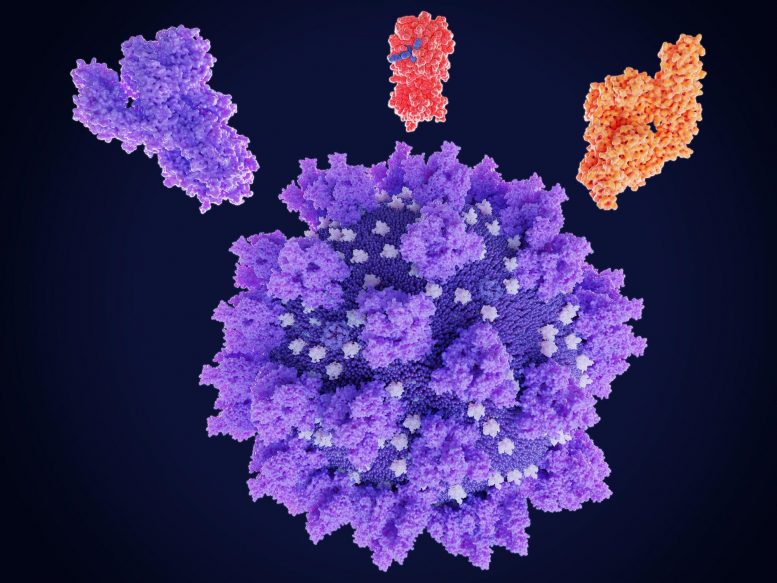
A study reveals how SARS-CoV-2 uses viral proteases to hijack host cells and enhance replication.
Researchers at the University of Liverpool have shown how SARS-CoV-2 viral proteases attack the host cell, and how this can be targeted to stop virus replication in cell culture with drugs in current clinical use or in the pipeline.
The new findings, published today (September 21, 2021) in Nature Communications, offer a powerful resource to understand proteolysis in the context of viral infection, and to inform the development of targeted strategies to inhibit the virus that causes COVID-19.
SARS-CoV-2 has been responsible for over 227 million infections, and more than 4.6 million deaths worldwide during the pandemic. Efforts to test, treat and vaccinate against the virus all benefit from an improved understanding of the basic biology of SARS-CoV-2.
Both viral and cellular proteases play a crucial role in SARS-CoV-2 replication, and inhibitors targeting proteases have already shown success at inhibiting SARS-CoV-2 in cell culture models.
Innovative Mass Spectrometry Approach
In this study, led by the University of Liverpool and the Institut Pasteur in Paris, researchers used a mass spectrometry approach to study proteolytic cleavage events during SARS-CoV-2 infection.
“Mass spectrometry-based approaches to identify protease substrates have existed for a number of years however, they have seen only limited application to the study of viral substrates, and had not been previously applied to the study of proteolysis during coronavirus infection,” explains lead author Dr. Emmott Edward, a Tenure-Track Fellow at the University’s Institute of Systems, Molecular and Integrative Biology.
The team found previously unknown cleavage sites in multiple viral proteins, including major antigenic proteins S and N, which are the main targets for vaccine and antibody testing efforts.
They discovered significant increases in cellular cleavage events consistent with cleavage by SARS-CoV-2 main protease (Mpro) and identified 14 potential high-confidence substrates of the main and papain-like proteases, validating a subset with in vitro assays.
Drug Targets Show Promise in Inhibiting SARS-CoV-2
They went on to show that siRNA depletion of these cellular proteins inhibits SARS-CoV-2 replication, and that drugs targeting two of these proteins: the tyrosine kinase SRC and Ser/Thr kinase MYLK, showed a dose-dependent reduction in SARS CoV-2 titers.
Both Bafetinib (an experimental cancer drug) and Sorafenib (an approved drug used to treat kidney and liver cancer) showed SARS-CoV-2 inhibition at concentrations that did not result in cytotoxicity in a human cell line model of infection.
Dr. Emmott said: “An improved understanding of the exact ways in which proteolytic cleavage is regulated, modulates protein activity, and serves to benefit viral replication will be crucial for targeting cellular substrates of viral proteases as a therapeutic strategy.
“As further SARS-CoV-2 variants emerge, the incorporation of post translational modification data from studies such as this can also support efforts to predict phenotypes from genetic data on emerging variants.”
Reference: “Characterising proteolysis during SARS-CoV-2 infection identifies viral cleavage sites and cellular targets with therapeutic potential” by Bjoern Meyer, Jeanne Chiaravalli, Stacy Gellenoncourt, Philip Brownridge, Dominic P. Bryne, Leonard A. Daly, Arturas Grauslys, Marius Walter, Fabrice Agou, Lisa A. Chakrabarti, Charles S. Craik, Claire E. Eyers, Patrick A. Eyers, Yann Gambin, Andrew R. Jones, Emma Sierecki, Eric Verdin, Marco Vignuzzi and Edward Emmott, 21 September 2021, Nature Communications.
DOI: 10.1038/s41467-021-25796-w
Never miss a breakthrough: Join the SciTechDaily newsletter.
Follow us on Google and Google News.