
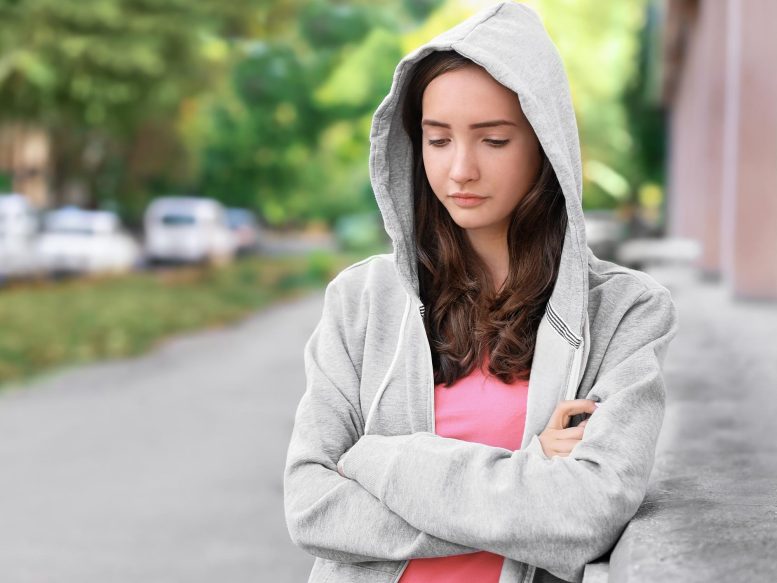
The climate crisis is taking an increasing toll on the mental health of children and young people; leaders must act now to create a path to a happier and healthier future.
Levels of eco-anxiety — the chronic fear of environmental doom — are growing, particularly among children and young people, and are likely to be significant and potentially damaging to individuals and society, warn experts in The BMJ today (October 6, 2021).
Mala Rao and Richard A Powell say neglecting the effects of increasing eco-anxiety “risks exacerbating health and social inequalities between those more or less vulnerable to these psychological impacts,” while the socioeconomic effects — as yet hidden and unquantified — “will add considerably to the national costs of addressing the climate crisis.”
And they call on leaders to “recognize the challenges ahead, the need to act now, and the commitment necessary to create a path to a happier and healthier future, leaving no one behind.”
Children and Teens Show Deep Climate Distress
They point to a 2020 survey of child psychiatrists in England showing that more than half (57%) are seeing children and young people distressed about the climate crisis and the state of the environment.
And a recent international survey of climate anxiety in young people aged 16 to 25 showed that the psychological (emotional, cognitive, social, and functional) burdens of climate change are “profoundly affecting huge numbers of these young people around the world.”
These findings also offer insights into how young people’s emotions are linked with their feelings of betrayal and abandonment by governments and adults, they write. Governments are seen as failing to respond adequately, leaving young people with “no future” and “humanity doomed.”
Solutions to Ease Eco-Anxiety
So what is to be done to alleviate the rising levels of climate anxiety, they ask?
“The best chance of increasing optimism and hope in the eco-anxious young and old is to ensure they have access to the best and most reliable information on climate mitigation and adaptation,” they explain.
“Especially important is information on how they could connect more strongly with nature, contribute to greener choices at an individual level, and join forces with like-minded communities and groups.”
They conclude: “The climate crisis is an existential threat, and fearfulness about the future cannot be fully tackled until a common united global strategy is put in place to address the root cause, global warming, and to give everyone — especially the young and the most vulnerable communities — the hope of a better future.”
Reference: “The climate crisis and the rise of eco-anxiety” 6 October 2021, The BMJ.
https://blogs.bmj.com/bmj/2021/10/06/the-climate-crisis-and-the-rise-of-eco-anxiety
Never miss a breakthrough: Join the SciTechDaily newsletter.
Follow us on Google and Google News.
3 Comments
How quickly we forget! The generation that grew up during the Cold War saw news reels of nuclear tests that wiped out entire Pacific islands, not just flooding them. School children practiced ducking under their desks with the expectation that if they were lucky(?) enough to survive the blasts of a nuclear exchange, they might not have a home or parents to go home to. There probably would not be any food to eat, and they probably would become sick with radiation poisoning.
Today, we have computer models of questionable veracity that predict all kinds of possible slow-motion catastrophes, but no hard evidence of the consequences such as a mushroom cloud that residents of Las Vegas regularly observed.
Perhaps the difference is that today the public is inundated by new claims everyday of what might, could, or possibly happen in our lives, with CO2 being blamed for virtually everything bad, with the exception of the “heart break of psoriasis.”
Papers are published with the research community in mind, and it’s a nice side effect to have them in plain view. A lot of people don’t know how to read them in sterile context, and in a number of cases, a communications student with little understanding is writing PR copy while working at the institution’s head research office.
I tend to trust them much more than someone weaving emotionally charged phrases into an assessment devoid of supporting arguments.
“I tend to trust THEM much more than someone weaving emotionally charged phrases into an assessment devoid of supporting arguments.”
Who is “them?”